

There is no such thing as a safe UV index for tanning. Tanning happens when your skin reacts to damage caused by UV rays. The low UV index means less intensity and harm than higher ones, but even then, exposure to the lowest UV can still damage your skin. That is why many health agencies like the CDC and FDA all warn that UV rays can damage your skin, increase the risk of skin cancer, and cause premature aging.
But if you still want to get that perfect tanned look without dealing with peeling, pain, or nasty sunburn and know what UV rays are best for tanning, then you’re in the right place.
Table of Contents
What Is the UV Ray Index?
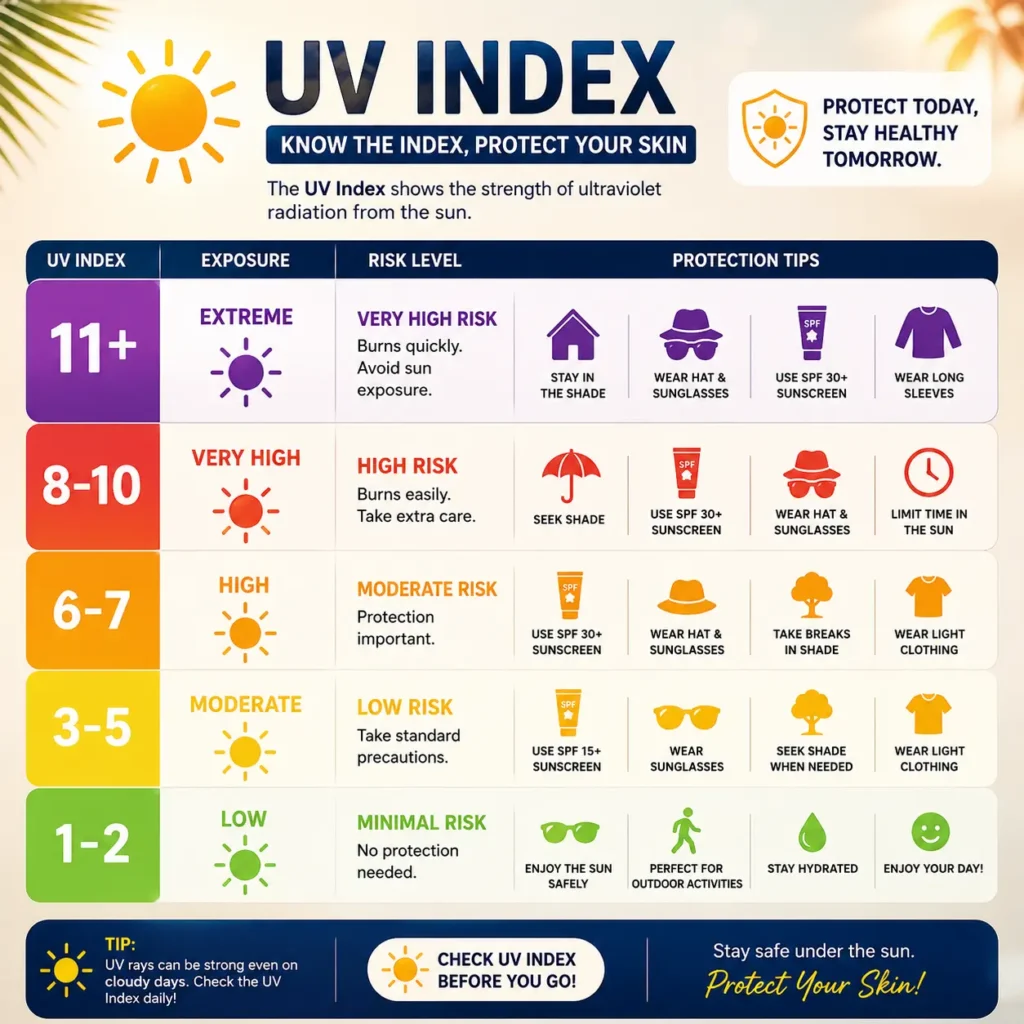
The UV (Ultraviolet) ray index is a standard measurement created by scientists and weather experts to tell us how strong the sun’s ultraviolet radiation is on any given day. In the United States, the National Weather Service and the Environmental Protection Agency (EPA) say the scale follows World Health Organization guidelines. This scale runs from 0 to 11+.
Think of it like a weather forecast, but instead of telling you if you need an umbrella, it tells you how fast your skin will burn.
- A score of 0 to 2 means the sun is very weak. (No protection needed)
- A score of 3-7 means moderate to high UV exposure. (Protection needed)
- A score of 8 or higher means the UV is dangerously strong. (Extra protection needed)
According to the World Health Organization (WHO), paying attention to this number is the best way to plan your outdoor activities and protect your skin from long-term damage.
That is why people searching for “today’s UV ray index” are really looking for the UV forecast for their exact location. It changes by city, season, time of day, cloud cover, and altitude.
What UV Rays Are Good for Tanning?
When you go outside, your skin gets exposed to two types of ultraviolet rays. UVA and UVB rays. Both of them have different effects on your skin.
If you are wondering what UV rays are good for tanning, the answer is that both are needed. Let’s talk about how they work:
1. UVA Rays (The “Aging” Rays)
95% UV light that reaches the Earth is UVA rays. These rays penetrate deep into your skin’s thickest layer (the dermis). When UVA rays hit your skin, they oxidize the melanin (the pigment in your skin) that is already there. This gives you that immediate, brownish tint right after you get out of the sun exposure. However, UVA rays don’t create new melanin. They are also the main UV rays that cause wrinkles, sunspots, and premature aging.
2. UVB Rays (The “Burning” Rays)
UVB rays are only about the remaining 5% of sunlight that reaches Earth, but they carry a massive punch. These rays stop at the top layer of your skin (the epidermis). UVB rays are the ones that cause sunburns. However, UVB rays also trigger your skin cells to produce melanin. This is what gives you a long-lasting, delayed tan that shows up a couple of days after you’ve been exposed to the sun.
In short, to get a deep, long-lasting tan, your body needs both of these UV rays. While UVB triggers new pigment, UVA darkens it to last longer. However, because both rays carry heavy risks for skin cancer, the Food and Drug Administration (FDA) warns against getting overexposed to either of these UV rays.
The Best UV Ray Index for Tanning
A lot of people think that to get a good tan, they need to sit for hours in the sun when it’s blazing hot and the UV index is sky-high. But it is a big mistake. Tanning in extreme UV levels can seriously damage your skin, which can lead to peeling and completely ruin your tan.
Many experts agree that the best UV ray index for tanning is between 3 and 5.
Why is UV 3 to 5 the best for tanning?
When the UV ray index is at 3, 4, or 5, teh sun’s ultraviolet rays are strong enough to trigger your body’s melanin production but weak enough so that your skin won’t burn within some time. Here is why these numbers are good for tanning:
- Low Risk of Burning
In this moderate zone, you can stay outside for a reasonable amount of time (around 30 to 45 minutes for most people) without damaging your skin.
- Gradual Color
A slow, gradual tan always looks better and lasts much longer than a rushed tan.
- Less Stress on Skin
Your skin has time to react and protect itself without being overwhelmed by intense radiation.
If you try to tan and get exposed to the sun when the index is a 7, 8, or 9, you are playing a dangerous game. At those levels, the skin burns much faster than it can tan. However, in reality, none of them is truly safe. So take proper precautions while getting tan.
How Long Is It Safe to Tan? A Guide to UV Levels
Everyone’s skin is different. The same amount of sun exposure can have different effects on 2 different people. How long you can stay in sunlight depends on your skin type. Experts use something called teh Fitzpatrick Skin Score, which ranges from Type 1 (very pale, burns easily) to Type 6 (deeply pigmented, rarely burns).
Here is a simple breakdown of UV ray index levels, what they mean, and a rough estimation of how long it takes for a person with medium-toned skin to burn.
| UV Index Level | Risk Category | What It Means for Tanning | Average Time to Burn |
| 0 – 2 | Low | Very little UV radiation. Great for long walks, but you won’t get much of a tan here. | 60+ minutes |
| 3 – 5 | Moderate | The ideal tanning zone. Good for building a slow, healthy-looking, sun-kissed glow. | 30 – 45 minutes |
| 6 – 7 | High | Skin burns quickly. Tanning here is risky. Use heavy sunscreen and limit time. | 15 – 25 minutes |
| 8 – 10 | Very High | Danger zone. Sunburn happens fast. Do not actively try to tan at these levels. | 10 – 15 minutes |
| 11+ | Extreme | Extreme danger. Seek shade immediately. Skin can fry in minutes. | Less than 10 minutes |
Checking the Weather: How to Find the UV Ray Index Today
Before you head to the beach to get tanned, make sure you check the UV index for today.
It’s not some complicated process. You can easily check it in your mobile’s weather app or just do a quick search. You can easily find today’s UV ray index in the UV section.
If you want to be extra precise, especially if you’re planning a trip to the beach, you can use:
- The EPA’s SunWise App
A free government tool that gives you exact UV forecasts based on your zip code.
- Weather.com or Local News
They usually broadcast the peak UV times for the day.
- Smartwatches
Many modern Apple and Android watches display the live UVI right on the watch face.
Make sure that the UV index can change throughout the day. It is usually lowest in the early morning, highest between 10 AM and 2 PM, and drops again in the late afternoon.
The 2026 Safe Tanning Guide: Step-by-Step
Many health organizations like the Centers for Disease Control and Prevention (CDC) and the FDA state that there is no such thing as a “safe tan.” Any changes in your skin color due to the sun are a sign of skin damage.
However, many people still want to get tanned. That’s why here is a guide to help you get tan with minimal skin damage.
1. Prep Your Skin
If you want a perfect tan that actually lasts, first you have to prepare your skin. Take a proper shower and scrub to remove dead skin cells. It guarantees you a uniform tan and not a patchy one after a week.
2. Always Use Broad-Spectrum Sunscreen
Many people think that sunscreen stops tanning, but it is a 100% false myth. Sunscreen simply helps to protect your skin from harsh UV rays so you don’t burn. Even if you wear sunscreen, you will still get tan. So, always apply all-around sunscreen to prevent sunburn.
3. Check the UV Ray Index
Before going to get a tan, always check today’s UV index. If it’s above 6, try to skip midday sun or try to go before 10 AM or after 3 PM. During these hours, UV rays are usually low and perfect for getting a tan.
4. Limit Your Time
Don’t stay too exposed to the sun because, approximately after 2-3 hours, your body can’t produce more melanin. So, spending the whole day won’t give you a better tan. It just increases your risk of sunburn. Aim for 20 to 30 minutes on your back and 20 to 30 minutes on your stomach.
5. Eat Your Beta-Carotene
What you eat also affects your skin. Foods rich in beta-carotene, like carrots, sweet potatoes, and tomatoes, can give your skin a natural warm tint. And also, eating antioxidant-rich foods can help to protect skin from UV damage.
6. Hydrate Inside and Out
The sun dries out moisture from your body. That’s why you should try to drink plenty of water while you are outside. Once you come home, take a shower, wash off sunscreen, and apply a thick, hydrating lotion. Moisturizing locks the tan in and prevents your skin from drying.
Bottom Line
At the end of the day, health experts agree there is no completely safe way to get tan. Any color change is UV damage. But if you are still determined to get a tan, the best UV index for tanning is between 3 and 5. Anything higher than this can cause serious skin burns.
Always remember to check today’s UV ray index before going outside to get tanned and avoid peak hours. Keep your exposure time moderate and get the perfect shade you want without damaging your skin too much.
Frequently Asked Questions
Can I tan when the UV index is 1 or 2?
Yes, but it takes a lot of patience. Since the UV rays are so weak at this level, you’ll need to spend a few hours outside to see any real color change. It’s safer for your skin, just much slower.
How to get a deeper, darker tan?
For a deeper tan, build it slowly over a few days in the moderate UV 3 to 5 range. Eat beta-carotene-rich foods like carrots, and always moisturize heavily afterward to lock in your color and keep your skin from flaking.
What’s the best time of day to tan?
The best time is usually before 10:00 AM or after 3:00 PM. During these hours, the UV index drops into that perfect 3 to 5 sweet spot, letting you get some color without the harsh, skin-frying midday heat.
Will I tan faster in a higher UV?
Technically, yes, but you will likely burn. A high UV index (7 or above) fries your skin way faster than your body can produce melanin. This leads to peeling and damage, totally ruining the tan you wanted.
How to tan faster?
To safely speed things up, wear broad-spectrum SPF 30. It prevents burning so your skin can build color without damage. Stay hydrated, stick to the 3 to 5 UV range, and keep your sessions to about 45 minutes max.
How to avoid uneven tanning?
First of all, try to remove any dead skin from your body. Dead skin can cause uneven tanning patches when it peels off later. Once you are under the sunlight, make sure to flip to the other side every 20 to 30 minutes. Try to keep your time of exposure equal on every side.
References & Sources
CDC: Centers for Disease Control and Prevention
U.S. Food and Drug Administration
Environmental Protection Agency

Olivia Reed
Women's Health & Skincare Writer
Better Health Focus
Expertise
Women's Health • Skincare • Hormonal Health • Beauty & Skin Science • Preventive Wellness • Healthy Aging • Nutrition for Skin Health • Lifestyle Medicine • Evidence-Based Health Education
About Olivia Reed
Olivia Reed is a Women's Health & Skincare Writer at Better Health Focus, where she creates evidence-based educational content focused on helping readers better understand women's wellness, hormonal health, skincare, healthy aging, and preventive self-care.
Her writing combines scientific research with practical lifestyle guidance, making complex health and skincare topics easy to understand without relying on misleading beauty trends or unrealistic health claims. Olivia Reed believes that informed readers make better health decisions, and she strives to present balanced information that reflects current scientific evidence.
Before publishing an article, Olivia Reed reviews guidance and research from respected organizations, including the National Institutes of Health (NIH), PubMed, the World Health Organization (WHO), the American Academy of Dermatology (AAD), the American College of Obstetricians and Gynecologists (ACOG), the Office on Women's Health (OWH), and peer-reviewed medical journals whenever applicable.
Her work regularly explores women's hormonal changes throughout different life stages, skincare science, acne, eczema, pigmentation, menopause, nutrition for healthy skin, reproductive wellness, hair health, and evidence-based approaches to beauty and preventive healthcare.
Olivia Reed is committed to separating scientific evidence from social media trends and marketing claims, helping readers understand what current research supports—and where evidence is still emerging.
Education
Bachelor of Arts (B.A.) in Health Communication
Professional Development
- Continuing education in Women's Health and Skin Science
- Ongoing study of dermatology research and preventive healthcare
- Regular review of peer-reviewed publications related to dermatology, endocrinology, nutrition, women's health, and public health
- Continuous monitoring of clinical guidance from leading medical organizations
Areas of Focus
- Women's Health
- Hormonal Health
- Menstrual & Reproductive Wellness
- Pregnancy & Postpartum Education
- Menopause & Healthy Aging
- Skincare & Dermatology Education
- Acne, Eczema & Sensitive Skin
- Hair & Scalp Health
- Nutrition for Healthy Skin
- Preventive Health & Lifestyle Medicine
Editorial Standards
Every article written by Olivia Reed Ward follows the editorial standards of Better Health Focus and is developed using reputable medical references and current scientific literature whenever available.
Her editorial approach emphasizes:
- Evidence-based health education
- Scientific accuracy
- Balanced discussion of benefits, risks, and research limitations
- Clear, accessible language for everyday readers
- Responsible reporting without exaggerated claims
- Alignment with Google E-E-A-T principles for health content
Rather than promoting miracle treatments or viral beauty trends, Olivia Reed focuses on practical, research-informed guidance that supports informed decision-making and long-term wellness.
Research Sources
Articles may reference information from organizations and databases such as:
- National Institutes of Health (NIH)
- PubMed
- World Health Organization (WHO)
- American Academy of Dermatology (AAD)
- American College of Obstetricians and Gynecologists (ACOG)
- Office on Women's Health (OWH)
- American Academy of Pediatrics (AAP)
- U.S. Food & Drug Administration (FDA)
- Peer-reviewed scientific journals
Editorial Disclaimer
The information published by Olivia Reed Ward on Better Health Focus is intended for educational and informational purposes only. It should not replace professional medical advice, diagnosis, or treatment. Readers should consult a qualified healthcare professional or dermatologist regarding personal medical concerns, medications, skincare treatments, or significant health decisions.