

No gym. No equipment. No problem.
If life keeps getting in the way of your weight loss goals, you’re not alone. Between your work, family, and daily responsibilities, taking out time to exercise is really tough. And staying consistent with exercise really matters if you want to lose weight and stay fit.
That’s where HIIT workouts for weight loss at home come in. These rapid, effective workouts are designed to torch calories quickly and fit into even the busiest of schedules—no commute, no membership, no excuses.
Here’s everything you need to know to start your weight loss journey at home.
Table of Contents
What Is HIIT (High-Intensity Interval Training)?
High-Intensity Interval Training (HIIT) is a workout style that switches between short bursts of all-out exercise and short breaks of rest or active recovery.
You may have done a HIIT workout and not even known it. It could have been when you ran fast, maybe to catch a bus or while playing on the playground. Your heart beats faster, you can’t breathe easily, and you need to take some time to get back to normal. HIIT exercises are designed for that exact experience.
It is like flipping a switch between “going all out” and “catching your breath.” A standard routine looks exactly like this:
- 30 seconds of fast, intense movement (like running)
- 30–60 seconds of rest or slow movement (like walking)
- Repeat the same for a few rounds
While doing those intense exercises, you are moving at a level where talking feels difficult, which is called the “intense level.” Most HIIT exercisesaim to use about 80–90% of your maximum effort.
HIIT workouts are great because they take only 15–20 minutes and can be done at home. And according to physical health guidelines, an adult needs 75 minutes of intense-level physical activity a week, which can help you even in your busy schedule.
HIIT is a simple, quick, and powerful package of workout for weight loss.
How HIIT Actually Works for Weight Loss
The secret of HIIT workouts for weight loss depends on how hard it pushes your heart to work.
During a HIIT session, you switch between short bursts of intense effort and brief recovery intervals. Those intense workout sessions push your heart rate up to around 80–95% of its maximum, according to the American College of Sports Medicine. At that level of effort, your muscles demand more oxygen than your body can keep up with in the moment. That’s where the real magic happens.
During the recovery period, your body has to work to fulfill the need for oxygen, which it couldn’t during the workout. This recovery process is called EPOC (Excess Post-Exercise Oxygen Consumption). It is all called the “afterburn effect.”
Cleveland Clinic explains that after a high-intensity workout, your body keeps consuming extra oxygen and burning extra calories as it works to return to its normal resting state.
According to research, it burns 6–15% more calories on top of what you burned in your actual workout and can last from a few hours to 24 hours. It’s not going to replace a good diet, but it’s a genuine bonus you’re not getting from a slow 45-minute treadmill walk.
Benefits of HIIT Workouts at Home
Now that you know how it works, here’s why so many people are actually sticking with it.
1. You Burn More in Less Time
A 20-minute HIIT session can burn roughly the same number of calories as a 40-minute steady jog, and the afterburn effect keeps adding to that even after you’ve showered and sat down. However, it’s not a shortcut. It’s just working smarter.
2. Burn Stubborn Fat
During HIIT workout sessions, your body burns carbs. But once you stop, it switches to burning stored fat to recover, and that fat burn keeps going for hours.
3. It Improves Your Overall Fitness Too
You’re not just losing weight. You’re getting genuinely more overall fit. HIIT strengthens your heart, improves stamina, and boosts your metabolism over time, all at once.
4. It Actually Fits into Real Life
This is the big one. Most people don’t skip workouts because they’re lazy. They skip because life gets in the way. A 15 to 20-minute HIIT session at home removes that excuse completely. No drive. No gym. No hour-long commitment.
That’s four real benefits from short workout sessions. That’s why it works for people with busy lives.
How Many Calories Does HIIT Burn?
Usually, a 20 to 30-minute HIIT session burns around 200 to 400 calories, depending on your body weight, age, and how hard you push during those work intervals.
Heavier individuals naturally burn more. Someone around 185 lbs can burn closer to 400–500 calories in a single 30-minute session. Someone around 145 lbs may burn closer to 250–300.
But here’s what makes HIIT stand out. A 2015 study published in the Journal of Strength and Conditioning Research found that HIIT burns 25 to 30% more calories than steady-state cardio of the same duration. That means a 20-minute HIIT session can burn more calories than a 30-minute jog.
Add the afterburn effect on top of that, and you’re looking at a genuinely efficient calorie burn without spending an hour working out.
Best HIIT Exercises for Weight Loss at Home
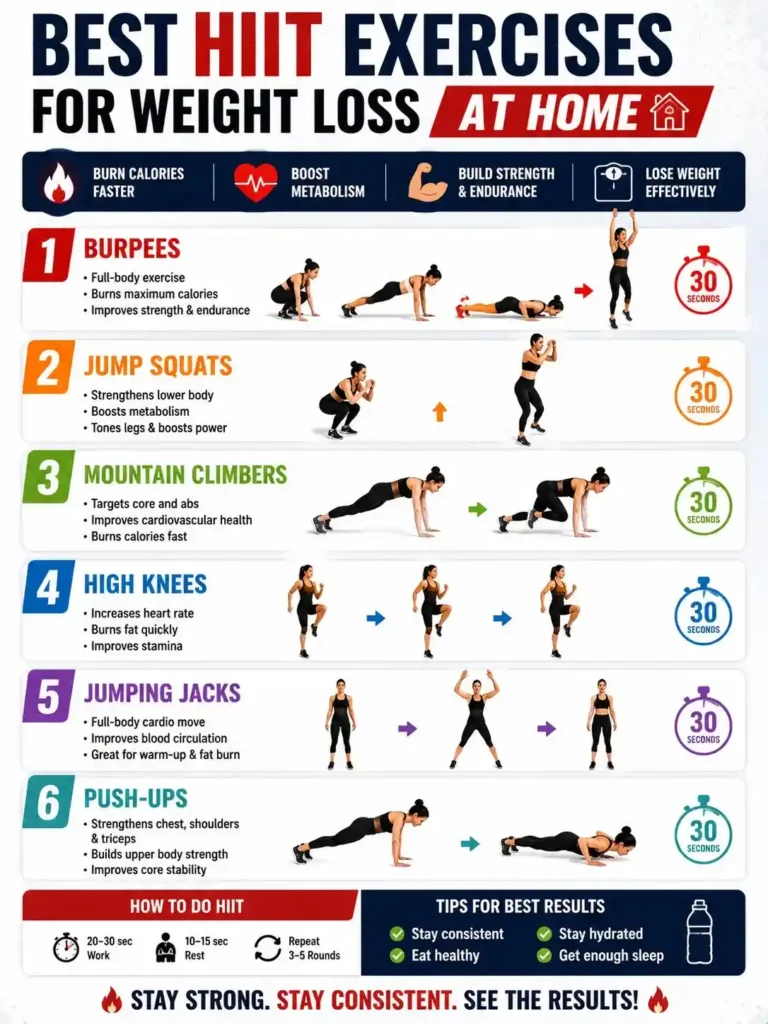
No gym. No equipment. No excuses. These are the best HIIT exercises you need to get started:
Burpees
The one exercise people love to hate, but for good reason. It works your arms, chest, core, and legs all at once, and nothing spikes your heart rate faster. If you only pick one move, pick this one.
Jump Squats
Take a regular squat and add an explosive jump at the top. Your legs and glutes will feel it instantly, and your heart rate won’t have a chance to come back down.
Mountain Climbers
Think of it as running while staying in a plank position. Your core is working overtime the entire time, and your lungs won’t let you forget it either.
High Knees
Exactly what it sounds like: move your knees up fast, alternating legs, like you’re running in place. Simple, brutal, and gets the job done in seconds.
Jumping Jacks
Don’t underestimate these. They’re easy to learn, gentle on your joints, and a genuinely solid way to warm up or keep moving between harder exercises.
Push-Ups
The classic for a reason. Go slow and controlled to build upper-body strength. Speed them up, and they become a full cardio challenge. Either way, your arms, chest, and core all show up to work.
Beginner HIIT Workout for Weight Loss
This is the best HIIT workout for weight loss designed for people who already work out a little but are new to high‑intensity workouts. The goal is to do 10–15 minutes of intervals, plus warm‑up and cool‑down.
1. Warm-Up (5–8 minutes)
Never skip the warm-up! It gets your blood flowing and prepares your muscles for the work ahead.
- March in place at a normal pace.
- Do some big shoulder rolls and arm swings.
- Try a few easy squats (just lowering yourself to chair height).
2. The Intervals (Your Work/Rest Pattern)
As a beginner, start with 20 seconds of an intense workout session and then 40 seconds of a recovery interval. Repeat this for 8 to 10 rounds. As your stamina improves, push yourself to do 30 seconds of hard work and 30 seconds of rest.
During your “hard” intervals, pick 1 or 2 of these moves:
- Fast marching in place with a strong arm drive.
- Low-impact standing knee lifts.
- Fast step-touch from side to side.
- Slightly faster bodyweight squats (only go as low as feels comfortable).
During your “recovery” intervals:
- Do gentle marching or slow side steps. Don’t stand completely still!
- Focus on calm, deep breathing to bring your heart rate down.
3. Cool‑down (5 minutes)
- Very light marching.
- Calf, thigh, and hip stretches, holding each gently for 15–30 seconds.
At first, try to do this workout two times a week. You can do it three times a week if you feel better and aren’t too exhausted or sore.
HIIT vs. Regular Cardio: Which Actually Burns More Fat?
It is the most common question in fitness: Should you run on a treadmill or do 15 minutes of intense HIIT? If we are talking strictly about losing stubborn fat, both methods work, but they do it in completely different ways.
Here is a quick breakdown of how they compare:
| Feature | Regular Cardio (The Slow Burn) | HIIT (The Afterburn Effect) |
| How It Burns Fat | Uses oxygen to burn fat while you are moving. | Creates an energy debt that forces your body to burn fat for hours after you finish. |
| Time Commitment | High. Requires 45-60+ minutes to see major calorie burn. | Low. Only requires 15-20 minutes for maximum effectiveness. |
| Intensity Level | Moderate. You can usually hold a conversation while doing it. | Maximum. You should be completely breathless during the active intervals. |
| Best For | Building baseline heart health and people who enjoy long, steady workouts. | Busy schedules and melting stubborn body fat quickly. |
Common Mistakes To Avoid With HIIT Workouts For Weight Loss
HIIT is very effective and is very famous, but people often make these common mistakes, which affect their progress. Here is what to watch out for:
- Doing HIIT every day
Your body needs time to recover. That’s why you should stick to 2–3 sessions a week. More isn’t always better. Sometimes it can make things worse.
- Skipping the warm-up and cool-down
An extra five minutes before and after your workout can save you weeks of dealing with unnecessary pain and injury. This step is very important; don’t skip it.
- Going too hard too soon
Start simple. Short intervals, easier exercises, longer rest. Build up gradually instead of burning out in the first three days.
- Using poor form
Moving fast with bad form is how people get hurt. Learn each move slowly first, then speed up once it feels natural.
- Ignoring your diet
HIIT supports weight loss, but it doesn’t rule out poor eating. That’s why a proper diet is as important as exercising regularly.
Tips to Stay Consistent With HIIT Workout at Home
Starting this workout for weight loss is the easy part. Issues start with staying consistent with the plan. Here are some tips that can help you stay consistent with a HIIT workout plan.
- Schedule it like a meeting
Don’t leave your workout to “whenever I feel like it.” Pick your days, set a reminder, and treat it like something you can’t cancel.
- Start smaller than you think you need to
Ten minutes done consistently beats thirty minutes done once. Start slow and small because it adds up faster than you’d expect.
- Keep your space ready
If you have to move furniture and find your shoes every time, you’ll talk yourself out of it. Have your workout area ready to go.
- Monitor how you feel, not just how you look
Progress on the scale is slow. But better sleep, more energy, and less breathlessness after climbing stairs? Those show up fast. Notice these signs that tell you the workout is working.
- Don’t aim for perfection. Aim for being consistent
Missed a session? No worry. Just don’t miss the next one. One skipped workout doesn’t zero your progress. But a week of skipped workouts can change everything.
Final Thoughts
You started this blog because life got busy and working out felt impossible. That’s completely understandable, and honestly, that’s exactly what a HIIT workout for weight loss was designed for.
You don’t need a gym. You don’t need an hour. You don’t need to be in perfect shape before you start. You need a few minutes a day, a small space, and the willingness to show up a few times a week.
It won’t always feel easy. Some days you might feel like skipping it, and that’s okay. What matters is that you stay consistent.
Start small. Stay consistent. And let the results follow naturally. That’s really all there is to it.
Frequently Asked Questions
What is the best HIIT workout for fat loss at home?
The best routine is one that works your whole body without needing any equipment. Think burpees, jump squats, high knees, and mountain climbers. Keep your sessions around 15 to 25 minutes, push hard when it is time to work, and stay consistent.
How often should I do a HIIT workout for weight loss?
For most people, 2-3 times a week is the best. HIIT puts a lot of toll on your body, which takes days to recover from. Pushing yourself to do it every day can make the situation worse.
Are HIIT workouts good for women?
Yes, 100%. HIIT is just as incredible for women as it is for men. It delivers the same fat-burning, digestive metabolism-boosting, and heart-health benefits. It is a fantastic way to build stamina and tone up without spending hours at the gym.
Can I do HIIT on a running machine?
You sure can. Doing a HIIT workout on a running machine is actually a favorite for a lot of people. Just sprint as fast as you can for 20 to 30 seconds, then slow it way down to a comfortable walk to catch your breath, and repeat.
Is HIIT safe for everyone?
Not always. Because it pushes your heart rate so high, you should definitely check with your doctor first if you have a heart condition, high blood pressure, or bad joints. Once you get the all-clear, start slow with a low-impact HIIT workout.
How HIIT treadmill workouts can help with weight loss
HIIT treadmill workouts can support weight loss by increasing calorie burn in a shorter amount of time. They may also boost metabolism and improve cardiovascular fitness.
References & Sources
American College of Sports Medicine

Daniel Brooks
Men's Health & Blood Sugar Writer
Better Health Focus
Expertise
Men's Health • Blood Sugar Management • Type 2 Diabetes Education • Prediabetes • Healthy Lifestyle • Nutrition • Metabolic Health • Preventive Wellness • Evidence-Based Health Content
About Daniel Brooks
Daniel Brooks is a Men's Health & Blood Sugar Writer at Better Health Focus, where he develops evidence-based educational content focused on men's wellness, blood sugar management, diabetes prevention, metabolic health, and healthy lifestyle habits.
With more than five years of experience writing health content, Daniel specializes in transforming complex medical research into practical, reader-friendly articles that help people better understand chronic disease prevention and long-term wellness. His work emphasizes realistic lifestyle changes, balanced nutrition, physical activity, and sustainable habits rather than quick fixes or unsupported health claims.
Daniel has completed professional education in Lifestyle Medicine through the American College of Lifestyle Medicine (ACLM) and has undertaken extensive independent study of evidence-based guidance, clinical recommendations, and educational resources published by the American Diabetes Association (ADA). His writing reflects current research and established best practices related to blood sugar management, diabetes prevention, cardiovascular health, and men's health.
Before publishing an article, Daniel reviews reputable medical literature and guidance from organizations including the National Institutes of Health (NIH), PubMed, the American Diabetes Association (ADA), the American Heart Association (AHA), the Centers for Disease Control and Prevention (CDC), and peer-reviewed scientific journals whenever applicable.
His goal is to help readers understand the science behind healthy living while making evidence-based information clear, practical, and accessible.
Education & Professional Development
- Professional education in Lifestyle Medicine through the American College of Lifestyle Medicine (ACLM)
- Ongoing study of evidence-based resources and clinical guidance published by the American Diabetes Association (ADA)
- Continuing education in nutrition science, metabolic health, and preventive medicine
- Regular review of peer-reviewed medical research and public health guidance
Areas of Focus
- Men's Health
- Blood Sugar Management
- Prediabetes Education
- Type 2 Diabetes Prevention
- Metabolic Health
- Heart Health
- Healthy Weight Management
- Nutrition & Healthy Eating
- Exercise & Lifestyle Medicine
- Preventive Health
Editorial Approach
Every article written by Daniel Brooks follows the editorial standards of Better Health Focus and is based on current scientific evidence from reputable medical organizations and peer-reviewed research whenever available.
His content is guided by the principles of:
- Evidence-based health education
- Scientific accuracy and transparency
- Balanced discussion of benefits, risks, and research limitations
- Clear and practical language for everyday readers
- Responsible reporting without exaggerated health claims
- Alignment with Google E-E-A-T principles for health content
Daniel believes that trustworthy health information should empower readers to make informed decisions in partnership with qualified healthcare professionals.
Research Sources
Daniel regularly consults information from:
- National Institutes of Health (NIH)
- PubMed
- American Diabetes Association (ADA)
- American College of Lifestyle Medicine (ACLM)
- Centers for Disease Control and Prevention (CDC)
- American Heart Association (AHA)
- U.S. Department of Agriculture (USDA)
- Office of Dietary Supplements (ODS)
- Peer-reviewed scientific journals
Editorial Disclaimer
The information published by Daniel Brooks on Better Health Focus is intended for educational and informational purposes only. It is not a substitute for professional medical advice, diagnosis, or treatment. Readers should consult a qualified healthcare professional before making decisions regarding medications, diabetes care, supplements, diet, or lifestyle changes.