

If you had a question running in your mind, “Is eczema contagious through touching?” The answer is no, eczema is not contagious. You will not catch it by touching, hugging, kissing, sharing a towel, or making love with someone who has it. Rather, this common skin disorder is an interplay of genetics, immune overactivity, and environmental triggers, not bacteria, viruses, or fungi.
However, it’s a completely normal question to ask. When we see a red, irritated rash from a rash guard, our human instinct is to protect ourselves from catching a bug. But there is absolutely zero need to worry.
Let’s dive into what actually triggers this condition, how to spot the different types, and everything else you need to know to manage it safely.
Table of Contents
What Exactly Causes Eczema?
So, if eczema isn’t an infection from a contagious virus, bacteria, or fungus, what is it then? The National Eczema Association defines it as an inflammatory skin disease in a chronic form. Instead of being transmitted from the external environment, it is an internal development. So here are the major contributors to eczema:
- An overactive immune system
The immune system mistakes a harmless trigger, such as pollen, a fragrance, or pet dander, for a harmful threat and responds with inflammation to eliminate it. Inflammation is what causes the redness, swelling, and itching.
- Genetics
If eczema runs in your family, your risk of developing the condition is higher than average. Research shows that genetics play an important role, but environmental factors also influence whether eczema develops. Scientists have identified more than 60 genetic regions associated with eczema risk, with loss-of-function mutations in the filaggrin (FLG) gene being among the strongest and most consistently confirmed genetic risk factors because they weaken the skin’s protective barrier.
- Environmental triggers
Dry air, harsh soaps, wool clothing, stress, sweat, and excessive sunburn can sometimes irritate the skin and trigger eczema flare-ups in people who are already prone to the condition. These factors damage or irritate the skin barrier but do not spread eczema from one person to another.
None of these factors involves a virus, bacteria, or fungus being transmitted through physical contact. Inheriting eczema because of genetics is completely different from “catching” it from someone else.
The Different Types of Eczema
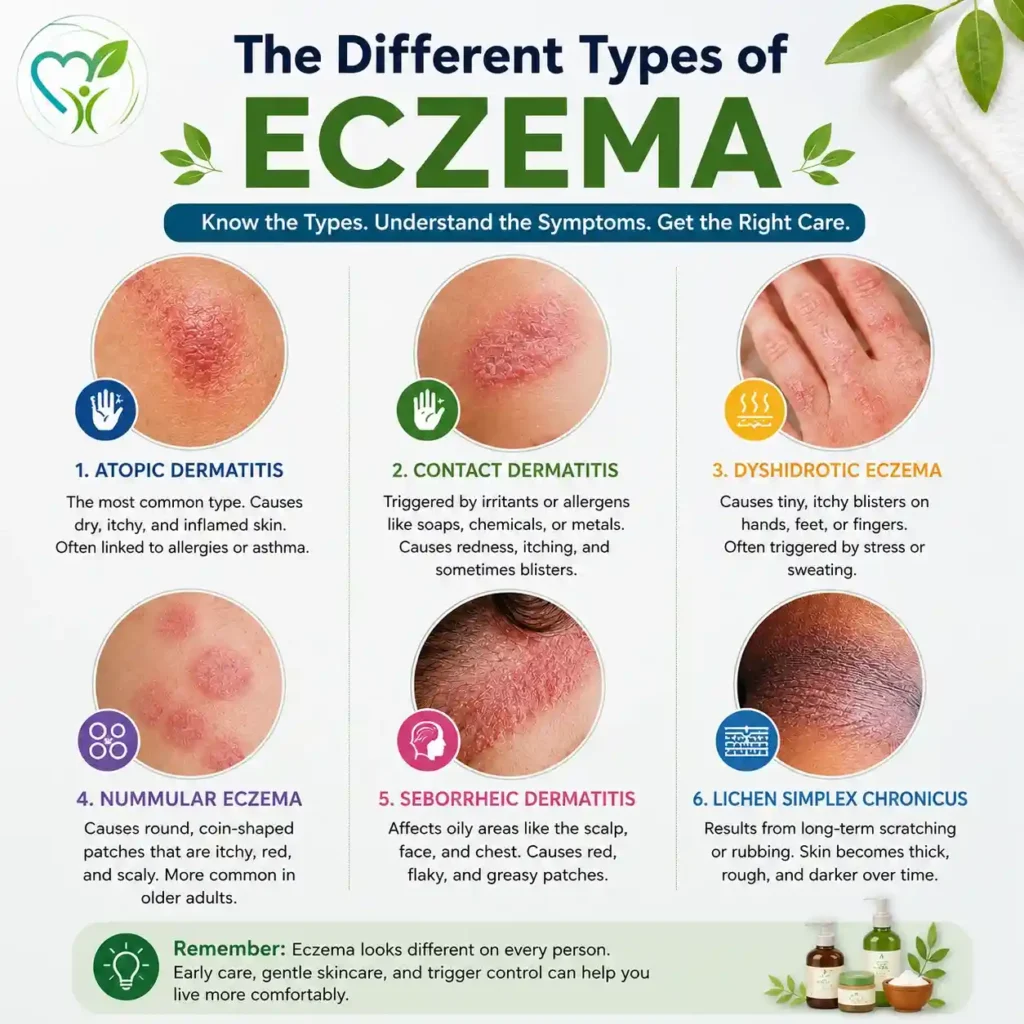
Eczema is a big umbrella term. There is not just one single type of condition. In fact, dermatologists have put them in several different types of eczema. Knowing which type of eczema you have can help you treat it better and properly. Here are the most common kinds of eczema:
1. Atopic Dermatitis
This is the most common type, which often starts in childhood. It usually happens in the curves of the elbows, behind the knees, and on the neck. It is heavily linked to genetics, asthma, and hay fever (also known as the atopic triad).
2. Dyshidrotic Eczema
This type of eczema is famous for causing tiny, incredibly itchy, fluid-filled blisters on the palms, fingers, and soles of the feet. Because hands are our most used part of the body to touch everything and everyone, people naturally start wondering if it won’t spread by touching, right?
But no, it won’t spread by touching. The dyshidrotic eczema is usually triggered by stress, allergies, or having constantly moist hands, not by germs.
3. Seborrheic Dermatitis (Scalp Eczema)
If you have ever had stubborn, severe dandruff, you might have dealt with this. Scalp eczema causes scaly, yellowish, or white patches on the scalp, eyebrows, and sometimes the sides of the nose. It is believed to be an overreaction to a type of yeast that naturally lives on everyone’s skin.
4. Contact Dermatitis
This happens when your skin touches something that irritates it or causes an allergic reaction. Think of the rash you get from poison ivy, cheap nickel jewelry, or a highly fragranced lotion. It only appears exactly where the irritant touched your skin.
5. Nummular Eczema
This type forms distinct, coin-shaped spots on the skin that are highly irritated, red, and itchy. It is often triggered by an insect bite or incredibly dry winter skin.
Is Eczema Contagious Sexually?
Because skin-to-skin contact is a huge part of romantic relationships, a common cause people worry about is, “Is eczema contagious sexually?”
If you have this condition and are worried that your partner might catch it, you can take a breath of relief. No type of eczema spreads through touching or sexually. It is not a sexually transmitted infection (STI). According to Healthline, you can’t catch it through hugging, cuddling, or having sex.
This question often comes to mind because eczema can sometimes develop on the genitals. While eczema on the genitals is really uncomfortable, it is the same in nature as eczema anywhere in your body. It can’t spread through touch.
However, keep in mind that intimacy can sometimes make conditions worse. Friction, sweating, and scented massage oils can irritate the skin. To stay comfortable, keep the room cool, choose fragrance-free lotions, and take a quick cool rinse.
Remember, if you notice a new rash in the genital area and aren’t sure what it is, get it checked by a doctor because some conditions are actually contagious.
When Eczema Can Lead to Something Contagious
While eczema itself isn’t contagious, cracked or broken skin from the spots can sometimes cause an infection that is contagious. Scratching too much eczema can sometimes break the skin’s surface, giving bacteria, viruses, or fungi a way to spread. Here are some secondary infections that you need to be wary of:
| Secondary Infection | What Causes It | Is It Contagious |
| Impetigo | Staphylococcus aureus bacteria | Yes, through direct touch |
| Eczema herpeticum | Herpes simplex virus (HSV) | Yes, through direct touch |
| Fungal infections | Ringworm or yeast (Candida) | Yes, through direct touch |
If someone has eczema with an open, cracked, or crusted sore, it’s the infection, not the eczema, which can spread by contact. You should watch out for spreading redness, pus or yellow discharge, fever, or pain that feels worse than normal itching. If any of these issues show up, definitely go to a doctor for proper treatment.
Eczema vs. Psoriasis: What’s the Difference?
Often, many people get confused between eczema and psoriasis. Even doctors sometimes need a closer look to tell them apart. Both of these conditions cause red, inflamed, itchy skin, but the main difference between eczema and psoriasis is what’s triggering the reaction in the first place.
Psoriasis is an autoimmune condition where your immune system speeds up skin cell production, so new cells build up faster than the body can remove the old ones. Eczema is different. It’s an overactive immune response and a broken skin barrier, usually triggered by an irritant or allergen, not the body attacking itself.
| Feature | Eczema | Psoriasis |
| Root cause | Immune overreaction + weak skin barrier | Autoimmune condition. Skin cells grow too fast |
| Appearance | Red, dry patches, sometimes oozing | Thick, well-defined plaques with silvery-white scales |
| Common spots | Elbow and knee creases, face, neck, hands | Outer elbows, knees, scalp, lower back |
| Itch level | Often intense; can disrupt sleep | Present, but often milder; more burning or stinging |
| Typical onset | Usually starts in infancy or childhood | Often begins between ages 15 and 35, though it can start anytime |
| Is It Contagious? | No | No |
So, the difference between psoriasis and eczema is that psoriasis tends to form thicker, more defined plaque, while eczema looks softer and shows up mainly in skin curves. Neither of them is contagious. But still, you should go to a doctor if it’s not getting better.
If Touch Isn’t the Problem, Could It Be Your Food?
Wondering if your daily meals are the cause? Due to the connection between gut and skin, a mild food sensitivity can easily cause angry, red rashes. But don’t panic and discard everything you have been eating.
While everyday staples like milk, eggs, gluten, sugary snacks, or even trace minerals in your cocoa can spark an eczema flare-up, dropping them all at once isn’t the answer. It might leave you missing out on important daily nutrition.
So, instead, start a simple food diary. Write down what you eat and monitor how your eczema reacts. If you notice a pattern that it’s getting worse, consult with your doctor for a solution. They can safely help you plan your meals so that you can avoid triggering the condition and find the real culprit causing the issue.
How to Manage and Treat Eczema
There is no permanent cure for eczema, but the treatments available today are more advanced than they have ever been. Treatment aims to repair the skin barrier, reduce immune system activity, and prevent further deterioration.
This is how doctors typically recommend treating eczema these days:
Prioritize Your Moisture Routine
When it comes to controlling your eczema, the single most important step is moisturizing your skin.
- Take short, lukewarm showers. Hot water removes natural oils.
- Use the Soak & Seal Method. After that, when your skin is still damp, pat it dry gently and then apply a thick ointment or cream within 2-3 minutes.
- Discard the thin, watery lotions. Opt for cream or ointment formulations having ceramides, preferably thick ones.
Identify and Dodge Triggers
Find what affects your skin. Stay away from those triggers and do everything naturally. Wear soft, breathable clothes and avoid itchy ones that may increase itching. Stress is a significant trigger of eczema, so exercise, meditation, or therapy can be useful tools to keep your stress levels in check.
Medical Interventions
If conventional methods do not help you, visit a doctor for treatment. They have tools that can be better at this, for example:
- Topical Corticosteroids
Such creams immediately calm down the redness and inflammation during a relapse.
- Topical Calcineurin Inhibitors (TCIs)
Other creams that are not steroids but alter the immune system to control itching.
- Biologics
These are injectable medications that aim at the very parts of the immune system that cause eczema.
- Phototherapy
This is where, in a controlled way, you are subjected to defined ultraviolet (UV) light, with the aim of calming an aggressive skin inflammation.
The Bottom Line
Eczema can be very uncomfortable and worrying, but it’s not contagious through touching, hugging, sharing a towel, or having sex. It’s a chronic condition developed from genetics, the immune system’s activity, and environmental factors, not an infection from bacteria or fungus that can be spread through touching.
Whether it is atopic dermatitis on a child’s arm, dyshidrotic blisters on a coworker’s hand, or scalp eczema, it cannot be passed from person to person. By understanding what this condition actually is, we can replace fear with empathy and support and manage it more effectively.
Frequently Asked Questions
Can you catch eczema from someone else?
No, touching or other physical contact will not cause you to develop eczema because it’s not caused by a virus, fungus, or bacteria that can spread through physical contact with the infected.
What’s the difference between eczema and psoriasis?
Eczema involves an overactive immune system and a weakened skin barrier, leading to dry, itchy, cracked skin, while psoriasis quickens the cell growth too much, leading to thick, scaly plaques, often on the elbows, knees, and scalp.
Is eczema contagious sexually?
No, it’s not. While eczema can develop on the genitals, it doesn’t spread through sexual activity. This condition doesn’t come under sexually transmitted infection (STI).
What causes eczema in adults?
Stress, hormonal changes, dry weather, harsh soaps and laundry detergents, sweat, and a genetic history are common causes of eczema.
Do certain foods trigger eczema?
Foods do not cause eczema directly, but if a food allergy is present, then you will get a flare or make it worse by eating it. These generally include dairy, eggs, peanuts, soy, and wheat.
Can laundry detergent cause eczema?
It can, but it depends on which type of eczema you have. From a medical perspective, common laundry detergents contain heavy surfactants, and chemical fragrances and dyes can cause contact dermatitis (eczema).
References & Sources
https://pmc.ncbi.nlm.nih.gov/articles/PMC10842541/

Olivia Reed
Women's Health & Skincare Writer
Better Health Focus
Expertise
Women's Health • Skincare • Hormonal Health • Beauty & Skin Science • Preventive Wellness • Healthy Aging • Nutrition for Skin Health • Lifestyle Medicine • Evidence-Based Health Education
About Olivia Reed
Olivia Reed is a Women's Health & Skincare Writer at Better Health Focus, where she creates evidence-based educational content focused on helping readers better understand women's wellness, hormonal health, skincare, healthy aging, and preventive self-care.
Her writing combines scientific research with practical lifestyle guidance, making complex health and skincare topics easy to understand without relying on misleading beauty trends or unrealistic health claims. Olivia Reed believes that informed readers make better health decisions, and she strives to present balanced information that reflects current scientific evidence.
Before publishing an article, Olivia Reed reviews guidance and research from respected organizations, including the National Institutes of Health (NIH), PubMed, the World Health Organization (WHO), the American Academy of Dermatology (AAD), the American College of Obstetricians and Gynecologists (ACOG), the Office on Women's Health (OWH), and peer-reviewed medical journals whenever applicable.
Her work regularly explores women's hormonal changes throughout different life stages, skincare science, acne, eczema, pigmentation, menopause, nutrition for healthy skin, reproductive wellness, hair health, and evidence-based approaches to beauty and preventive healthcare.
Olivia Reed is committed to separating scientific evidence from social media trends and marketing claims, helping readers understand what current research supports—and where evidence is still emerging.
Education
Bachelor of Arts (B.A.) in Health Communication
Professional Development
- Continuing education in Women's Health and Skin Science
- Ongoing study of dermatology research and preventive healthcare
- Regular review of peer-reviewed publications related to dermatology, endocrinology, nutrition, women's health, and public health
- Continuous monitoring of clinical guidance from leading medical organizations
Areas of Focus
- Women's Health
- Hormonal Health
- Menstrual & Reproductive Wellness
- Pregnancy & Postpartum Education
- Menopause & Healthy Aging
- Skincare & Dermatology Education
- Acne, Eczema & Sensitive Skin
- Hair & Scalp Health
- Nutrition for Healthy Skin
- Preventive Health & Lifestyle Medicine
Editorial Standards
Every article written by Olivia Reed Ward follows the editorial standards of Better Health Focus and is developed using reputable medical references and current scientific literature whenever available.
Her editorial approach emphasizes:
- Evidence-based health education
- Scientific accuracy
- Balanced discussion of benefits, risks, and research limitations
- Clear, accessible language for everyday readers
- Responsible reporting without exaggerated claims
- Alignment with Google E-E-A-T principles for health content
Rather than promoting miracle treatments or viral beauty trends, Olivia Reed focuses on practical, research-informed guidance that supports informed decision-making and long-term wellness.
Research Sources
Articles may reference information from organizations and databases such as:
- National Institutes of Health (NIH)
- PubMed
- World Health Organization (WHO)
- American Academy of Dermatology (AAD)
- American College of Obstetricians and Gynecologists (ACOG)
- Office on Women's Health (OWH)
- American Academy of Pediatrics (AAP)
- U.S. Food & Drug Administration (FDA)
- Peer-reviewed scientific journals
Editorial Disclaimer
The information published by Olivia Reed Ward on Better Health Focus is intended for educational and informational purposes only. It should not replace professional medical advice, diagnosis, or treatment. Readers should consult a qualified healthcare professional or dermatologist regarding personal medical concerns, medications, skincare treatments, or significant health decisions.