

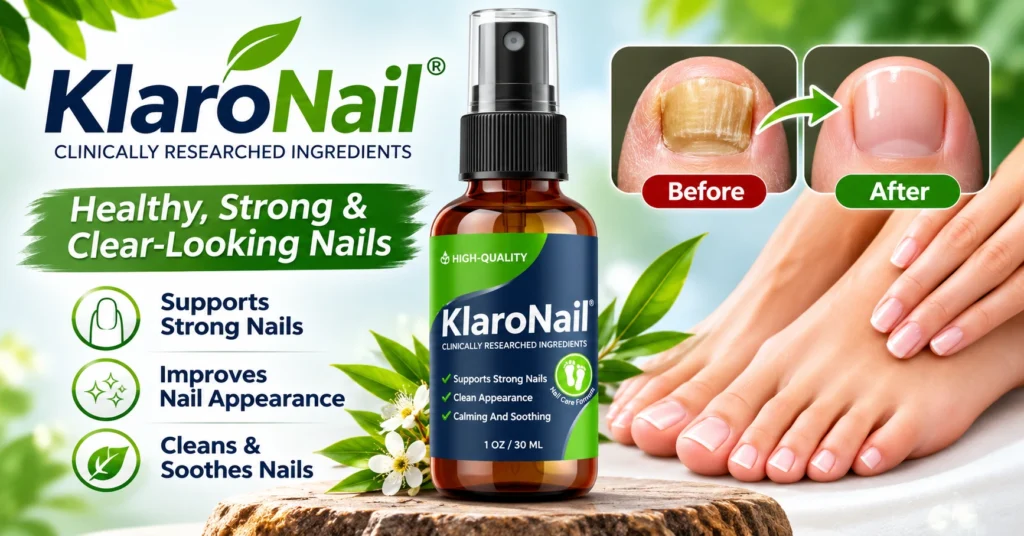
Thick, yellow, brittle, or discolored toenails can be frustrating. While these changes are sometimes caused by fungal infections, nail trauma, psoriasis, and other conditions can produce similar symptoms. Finding a product that genuinely addresses the problem is therefore important.
Klaro Nail is a topical nail-care spray marketed for people concerned about unhealthy-looking nails, recurring nail problems, and possible fungal buildup. Its advertised formula combines undecylenic acid, tea tree oil, clove bud oil, lavender oil, and several skin-conditioning ingredients.
But is KlaroNail worth considering? Can it actually help with nail fungus, or does it mainly support the appearance and condition of the surrounding skin?
In this KlaroNail review for November 2026, we examine its ingredients, advertised benefits, application instructions, customer feedback, pricing, refund policy, and available scientific evidence. We also consider what a 30-day evaluation can realistically tell you before spending money on the product.
Table of Contents
Quick Overview
| Product Detail | Information |
| Product name | KlaroNail |
| Product category | Topical nail-care spray |
| Product format | Spray |
| Advertised purpose | Nail appearance and surrounding-skin care |
| Featured ingredients | Undecylenic acid, tea tree oil, clove bud oil, lavender oil, aloe vera, vitamin E |
| Application | Four times daily, according to seller instructions |
| Main target users | Adults concerned about unhealthy-looking nails |
| Guarantee | 60-day money-back guarantee advertised |
| Purchase type | One-time payment, according to seller |
| Availability | Online through the seller’s website |
The product information is based on the supplied competitor pages and KlaroNail’s published customer-support information. Exact formulation details should be checked against the label accompanying the bottle.

What Is KlaroNail?
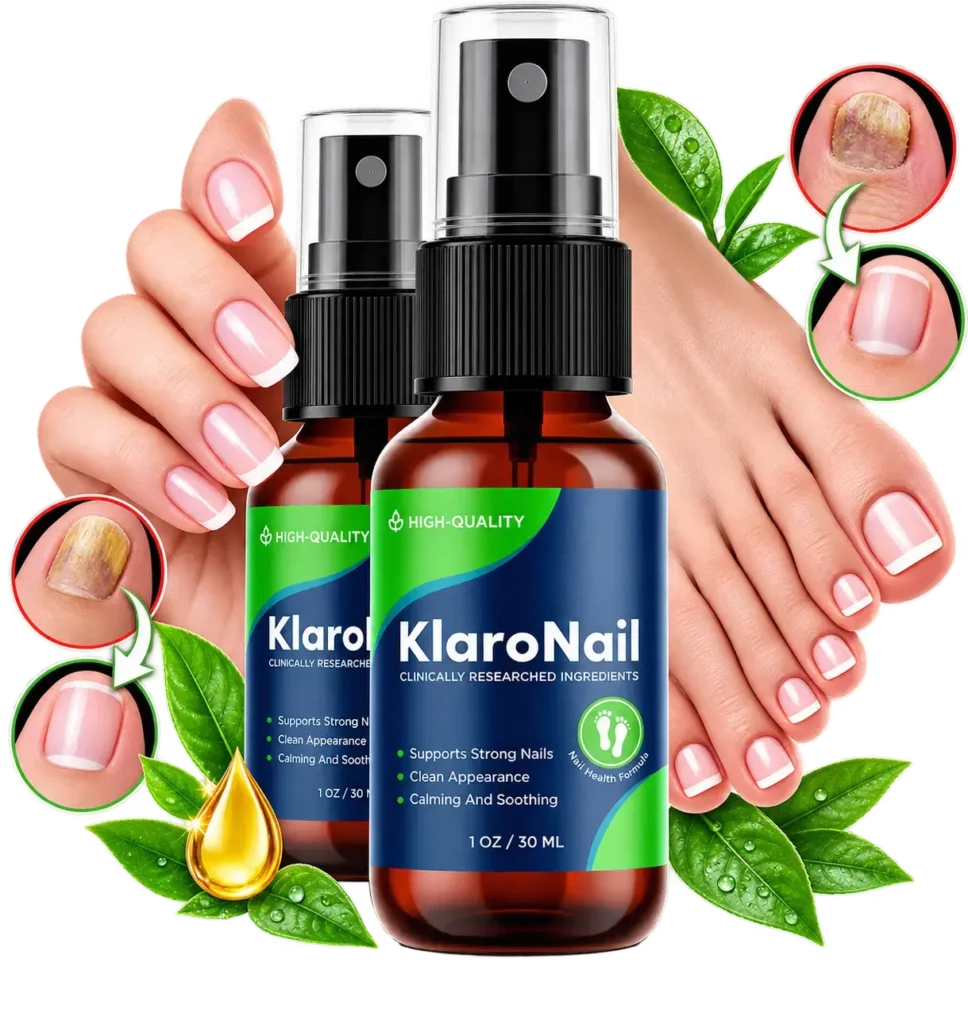
KlaroNail is a topical spray designed for application to toenails, cuticles, and surrounding skin. The manufacturer markets it as a convenient alternative to traditional nail-care creams and thicker topical products.
Its formula combines a fatty acid used in some antifungal preparations with botanical oils and skin-conditioning ingredients.
The product is promoted for people experiencing:
- Yellow or discolored-looking toenails.
- Brittle or rough nail surfaces.
- Thickened or damaged-looking nails.
- Dry skin around the cuticles.
- Concerns about recurring nail fungus.
However, these symptoms do not automatically indicate a fungal infection. A proper diagnosis matters because a cosmetic nail-care product cannot be assumed to treat an underlying medical condition.
KlaroNail Ingredients: What Is Inside?
The published product descriptions identify several ingredients intended to support nail and skin care. However, there is an important transparency issue: the competitor pages do not present a completely consistent ingredient list.
One review identifies 13 ingredients, including Manuka honey and chia seed oil. Another describes a formulation containing 5% undecylenic acid and lists mineral oil and canola oil among its supporting ingredients.
These differences should be resolved using the actual product label before publishing a definitive ingredient table.
The following are the main ingredients repeatedly highlighted in the available descriptions.
1. Undecylenic Acid
Undecylenic acid is a fatty acid used in certain topical antifungal products. It is included in KlaroNail because of its antifungal-related properties.
However, concentration matters. A product containing undecylenic acid cannot automatically be considered equivalent to an established antifungal medication.
One competitor reports a 5% concentration, but that figure should be verified against the current bottle label before being presented as confirmed.
2. Tea Tree Oil
Tea tree oil is a botanical ingredient frequently used in topical skin and nail-care products.
Laboratory research has identified antimicrobial properties, but human evidence for treating fungal nail infections remains limited. The National Center for Complementary and Integrative Health states that the available research is insufficient to establish its effectiveness against nail fungus.
Tea tree oil can also cause skin irritation or allergic reactions in some people.
3. Clove Bud Oil
Clove bud oil contains eugenol, a compound investigated for antimicrobial activity.
Its inclusion may contribute to the product’s botanical positioning, but laboratory findings do not establish that KlaroNail eliminates fungal infections in human nails.
4. Lavender Oil
Lavender oil is commonly used in personal-care formulations for its fragrance and skin-conditioning properties.
Some laboratory studies have examined its antimicrobial activity. However, there is insufficient clinical evidence to establish that lavender oil in KlaroNail cures toenail fungus.
5. Aloe Vera
Aloe vera is commonly included in topical products because of its moisturizing and skin-conditioning properties.
It may help support the feel and appearance of dry surrounding skin, but it should not be confused with a proven antifungal treatment.
6. Vitamin E
Vitamin E is an antioxidant commonly used in skin-care products. It contributes conditioning properties and may help support the skin’s moisture barrier.
Its presence does not demonstrate that the formula can remove a fungal infection beneath the nail.
7. Other Supporting Oils and Ingredients
Published product descriptions also mention flaxseed oil, sweet almond oil, walnut oil, chia seed oil, Manuka honey, camphor oil, menthol, and other conditioning ingredients.
These ingredients are primarily presented as supporting nail and surrounding-skin care. Their exact quantities and inclusion in the current formulation should be confirmed from the packaging.
Ingredient assessment: KlaroNail includes ingredients with plausible topical-care uses, but the inconsistent published ingredient lists and missing concentration details make it difficult to evaluate the complete formula confidently.
How Does Klaro Nail Work?
KlaroNail is designed to coat the nail surface, cuticle, and surrounding skin through a spray application.
Its advertised approach combines two main functions.
Topical antifungal-related support: Undecylenic acid and tea tree oil are included because of their association with antimicrobial or antifungal activity.
Skin conditioning: Aloe vera, vitamin E, and various plant oils are intended to support the appearance and moisture of the skin surrounding the nail.
The important limitation is that nail fungus can develop within the nail plate and underneath it. A spray that coats the surface is not automatically capable of reaching the infection effectively.
No product-specific clinical trial was identified in the reviewed sources demonstrating that KlaroNail eliminates onychomycosis.
I Tried Klaro Nail for 30 Days: What Can You Realistically Expect?
A 30-day review is useful for assessing practical features, but it is not enough to establish that a topical product has cured a fungal nail infection.
Here is what a careful 30-day evaluation should examine.
Days 1–7: Application and Product Experience
The first week is mainly about understanding the product’s application process.
Check whether the spray is easy to apply, whether the packaging works properly, and whether the formula causes redness, itching, burning, or other irritation.
Do not interpret a cooling sensation or pleasant fragrance as evidence that the product is eliminating fungus.
Days 8–14: Routine and Skin Comfort
During the second week, evaluate whether the recommended application schedule is practical.
The seller recommends four applications daily. This may be inconvenient for people with busy schedules.
Also observe whether the surrounding skin feels comfortable or develops irritation. Discontinue use if a significant reaction occurs.
Days 15–21: Nail Appearance
At this stage, some users may be tempted to judge the product by changes in nail appearance.
However, natural nail growth is slow. Small changes in surface appearance do not prove that an infection has been eliminated.
Photographs taken under similar lighting can help document changes without relying entirely on memory.
Days 22–30: Overall Evaluation
At the end of one month, assess:
- Ease of daily application.
- Packaging and spray performance.
- Skin comfort and tolerance.
- Whether the product matches its advertised description.
- Whether the seller’s customer support responds clearly.
- Whether the purchase price and refund conditions remain acceptable.
30-day conclusion: One month can provide information about usability, convenience, and skin tolerance. It cannot reliably establish a fungal cure or guarantee that a damaged toenail will grow back clear.
Can KlaroNail Really Fight Nail Fungus?
This is the most important question for potential buyers.
Fungal nail infection, medically known as onychomycosis, can cause yellowing, thickening, brittleness, and changes in nail shape.
The American Academy of Dermatology explains that nail fungus can be difficult to treat because the infection develops within the nail and underlying tissue. It also notes that tea tree oil research is limited and larger studies are needed to establish its effectiveness.
Established treatments include prescription topical medications such as efinaconazole and tavaborole, as well as oral antifungal medicines in appropriate cases. Treatment depends on the severity of the infection and the patient’s medical circumstances.
Our assessment: KlaroNail may be considered a topical nail-care product, but the available evidence does not establish it as a clinically proven cure for fungal nail infections.
Read More Nail Cleaning Supplement Reviews
KlaroNail Potential Benefits
Based on the advertised formula and application method, potential advantages include:
- Convenient spray application to nails and cuticles.
- Botanical ingredients commonly used in topical personal-care products.
- Undecylenic acid included for antifungal-related support.
- Conditioning ingredients for surrounding skin.
- A simple product format that can be incorporated into a nail-care routine.
These are potential product and ingredient-related benefits, not guaranteed medical outcomes.
KlaroNail Pros and Cons
- Convenient topical spray
- Several named ingredients
- Includes undecylenic acid
- Contains skin-conditioning ingredients
- 60-day guarantee advertised
- One-time payment advertised
- No verified clinical trial on the complete formula
- Published ingredient lists are inconsistent
- Concentration should be verified
- Not established as a fungal infection cure
| Pros | Cons |
| Convenient topical spray | No verified clinical trial on the complete formula |
| Several named ingredients | Published ingredient lists are inconsistent |
| Includes undecylenic acid | Concentration should be verified |
| Contains skin-conditioning ingredients | Four daily applications may be inconvenient |
| 60-day guarantee advertised | Return requirements need careful review |
| One-time payment advertised | Not established as a fungal infection cure |
KlaroNail Customer Reviews: What Do Buyers Say?
The product’s promotional material displays positive customer testimonials and reports a high number of customer reviews.
One competitor reports a rating of 4.9 out of 5 and describes gradual improvements in nail appearance after several weeks. Another review reports a 4.6 out of 5 rating based on 13,872 reviews. These are published claims, not independently verified customer-rating datasets.
The seller also includes a disclaimer stating that testimonials may not represent the typical purchaser’s experience.
When evaluating KlaroNail reviews, look beyond star ratings. Pay attention to comments about delivery, packaging, application convenience, customer service, and refund experiences.
Most importantly, customer testimonials cannot establish that a product cures a fungal infection.
KlaroNail Price and Money-Back Guarantee

KlaroNail is marketed through online sales pages offering multiple bottle packages.
One competitor lists a price of $49 per bottle in a six-bottle package, while another describes different bundle offers. The exact current price should be confirmed on the seller’s checkout page rather than copied from an older promotional listing.
The seller’s customer-support page advertises a 60-day money-back guarantee and describes the product as a one-time purchase without recurring charges.
Before ordering, confirm:
- The total amount charged.
- The number of bottles included.
- Whether shipping is free.
- Whether opened or empty bottles must be returned.
- The deadline for requesting a refund.
- Who pays return shipping.
- The correct return address and support contact.
The seller also states that US shipping is free and estimates delivery within five to seven business days. International delivery and shipping charges may differ.
Is KlaroNail Safe?
Topical products containing essential oils and other active ingredients can cause irritation or allergic reactions.
Tea tree oil may cause redness, itching, or contact dermatitis. Menthol and camphor may produce a cooling sensation but can irritate sensitive or damaged skin.
People with known allergies should review the full label before applying the product. Avoid contact with the eyes and do not swallow topical formulations.
People with diabetes, poor circulation, weakened immunity, or painful nail changes should seek professional advice rather than relying on an unverified nail-care spray.
Scam or Legit: Is KlaroNail Worth Buying?
KlaroNail has an identifiable product website, published ingredient information, application instructions, and an advertised refund policy. These details alone, however, do not establish clinical effectiveness or independently verify every marketing claim.
There are two important issues buyers should investigate:
First, ingredient transparency. The reviewed pages do not consistently present the same formula or ingredient concentrations.
Second, medical evidence. No product-specific clinical trial was identified demonstrating that KlaroNail cures nail fungus.
It would therefore be premature to call the product a scam solely because its evidence is limited. Equally, it would be misleading to describe it as a proven antifungal treatment.
Frequently Asked Questions
1. What is KlaroNail used for?
KlaroNail is a topical spray marketed for nail appearance, cuticle conditioning, and surrounding-skin care. It is also promoted to people concerned about fungal nail problems.
2. Does KlaroNail cure toenail fungus?
There is insufficient product-specific clinical evidence to establish that KlaroNail cures toenail fungus. Its ingredients should not be treated as equivalent to proven prescription antifungal treatments.
3. How often should KlaroNail be applied?
The product descriptions recommend four applications daily, twice in the morning and twice in the afternoon. Follow the instructions on the current packaging.
4. How long does KlaroNail take to work?
The seller recommends consistent use, but there is no established clinical timeline for this product. Toenails grow slowly, so visible changes may take several months.
5. Does KlaroNail contain undecylenic acid?
Yes, undecylenic acid is identified in the published ingredient descriptions. One competitor reports a 5% concentration, but buyers should verify that figure against the current product label.
6. Does KlaroNail offer a money-back guarantee?
The seller advertises a 60-day money-back guarantee. Confirm the exact return conditions and eligibility requirements before purchasing.
7. Can KlaroNail cause side effects?
Potential reactions include redness, itching, irritation, or allergic contact dermatitis. Individual tolerance varies, particularly with essential oils and menthol-containing products.
8. Is KlaroNail FDA-approved?
The reviewed product information does not establish FDA approval of KlaroNail as a treatment for nail fungus. An FDA-registered manufacturing facility is not the same as FDA approval of a finished product.
9. Can I use KlaroNail if I have diabetes?
People with diabetes should consult a healthcare professional before relying on a nail-care product for suspected fungal infection or damaged toenails. Foot problems can require prompt medical attention.
10. Where can I buy KlaroNail?
The seller’s customer-support website states that KlaroNail is sold through its official website and warns buyers about unauthorized listings. Verify the website address and checkout terms before ordering.
Final Verdict: Should You Try KlaroNail in 2026?
KlaroNail is a topical nail-care spray containing undecylenic acid, tea tree oil, and several botanical and skin-conditioning ingredients. Its spray format may appeal to people looking for a convenient addition to their nail-care routine.
However, the evidence does not establish that the complete formula eliminates fungal nail infections. The inconsistent ingredient descriptions and lack of independently verified product-specific clinical results are meaningful limitations.
A 30-day evaluation can help assess convenience, packaging, application, and skin tolerance, but it cannot prove a fungal cure.
Our verdict: KlaroNail may be considered for topical nail-care purposes, but consumers should not rely on it as a proven treatment for onychomycosis. If your toenails are persistently thick, yellow, painful, or damaged, seek a professional diagnosis and discuss evidence-based treatment options.
Medical Disclaimer
This article is for educational purposes only and does not provide medical diagnosis or treatment. KlaroNail should not replace professional evaluation or established treatment for fungal nail infections. Consult a qualified healthcare professional before using a topical product if you have a medical condition, allergies, or persistent nail symptoms.
Affiliate Disclosure
This article may contain affiliate links. The publisher may earn a commission from qualifying purchases at no additional cost to the reader. This does not change the importance of evaluating product claims and verifying the seller’s terms.
Research and Source
American Academy of Dermatology’s nail fungus guidance
NIH’s tea tree oil evidence review

Olivia Reed
Women's Health & Skincare Writer
Better Health Focus
Expertise
Women's Health • Skincare • Hormonal Health • Beauty & Skin Science • Preventive Wellness • Healthy Aging • Nutrition for Skin Health • Lifestyle Medicine • Evidence-Based Health Education
About Olivia Reed
Olivia Reed is a Women's Health & Skincare Writer at Better Health Focus, where she creates evidence-based educational content focused on helping readers better understand women's wellness, hormonal health, skincare, healthy aging, and preventive self-care.
Her writing combines scientific research with practical lifestyle guidance, making complex health and skincare topics easy to understand without relying on misleading beauty trends or unrealistic health claims. Olivia Reed believes that informed readers make better health decisions, and she strives to present balanced information that reflects current scientific evidence.
Before publishing an article, Olivia Reed reviews guidance and research from respected organizations, including the National Institutes of Health (NIH), PubMed, the World Health Organization (WHO), the American Academy of Dermatology (AAD), the American College of Obstetricians and Gynecologists (ACOG), the Office on Women's Health (OWH), and peer-reviewed medical journals whenever applicable.
Her work regularly explores women's hormonal changes throughout different life stages, skincare science, acne, eczema, pigmentation, menopause, nutrition for healthy skin, reproductive wellness, hair health, and evidence-based approaches to beauty and preventive healthcare.
Olivia Reed is committed to separating scientific evidence from social media trends and marketing claims, helping readers understand what current research supports—and where evidence is still emerging.
Education
Bachelor of Arts (B.A.) in Health Communication
Professional Development
- Continuing education in Women's Health and Skin Science
- Ongoing study of dermatology research and preventive healthcare
- Regular review of peer-reviewed publications related to dermatology, endocrinology, nutrition, women's health, and public health
- Continuous monitoring of clinical guidance from leading medical organizations
Areas of Focus
- Women's Health
- Hormonal Health
- Menstrual & Reproductive Wellness
- Pregnancy & Postpartum Education
- Menopause & Healthy Aging
- Skincare & Dermatology Education
- Acne, Eczema & Sensitive Skin
- Hair & Scalp Health
- Nutrition for Healthy Skin
- Preventive Health & Lifestyle Medicine
Editorial Standards
Every article written by Olivia Reed Ward follows the editorial standards of Better Health Focus and is developed using reputable medical references and current scientific literature whenever available.
Her editorial approach emphasizes:
- Evidence-based health education
- Scientific accuracy
- Balanced discussion of benefits, risks, and research limitations
- Clear, accessible language for everyday readers
- Responsible reporting without exaggerated claims
- Alignment with Google E-E-A-T principles for health content
Rather than promoting miracle treatments or viral beauty trends, Olivia Reed focuses on practical, research-informed guidance that supports informed decision-making and long-term wellness.
Research Sources
Articles may reference information from organizations and databases such as:
- National Institutes of Health (NIH)
- PubMed
- World Health Organization (WHO)
- American Academy of Dermatology (AAD)
- American College of Obstetricians and Gynecologists (ACOG)
- Office on Women's Health (OWH)
- American Academy of Pediatrics (AAP)
- U.S. Food & Drug Administration (FDA)
- Peer-reviewed scientific journals
Editorial Disclaimer
The information published by Olivia Reed Ward on Better Health Focus is intended for educational and informational purposes only. It should not replace professional medical advice, diagnosis, or treatment. Readers should consult a qualified healthcare professional or dermatologist regarding personal medical concerns, medications, skincare treatments, or significant health decisions.