
Introduction
The feeling of watching yourself from the outside, as if you were an actor in your own film, or the sense that the world around you suddenly feels like it’s behind foggy glass, is one of the most unsettling psychological experiences a person can go through. This is exactly how depersonalization disorder is often described — a state that can frighten even otherwise mentally stable people, because it disrupts the very foundation of how we perceive ourselves and the reality around us. Depersonalization is not a rare curiosity found only in psychiatry textbooks. It’s estimated that nearly half to three-quarters of the population will experience a transient episode resembling this experience at some point in their lives, most often in connection with stress, exhaustion, or a panic attack. In a smaller portion of people, however, depersonalization becomes a recurring or persistent problem that significantly interferes with work, relationships, and everyday functioning. This article takes a detailed look at what depersonalization means, how it presents, what triggers it, how it’s diagnosed, and which treatment approaches experts currently recommend.
Table of Contents
What Exactly Does the Term Depersonalization Disorder Mean
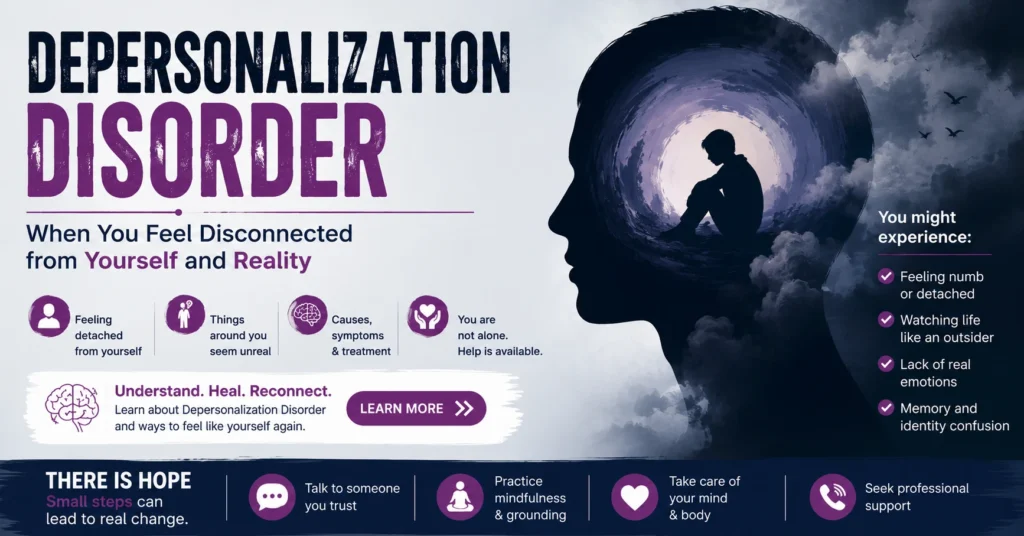
Depersonalization Disorder is a psychological state characterized by a feeling of detachment from one’s own body, thoughts, emotions, or actions. A person experiencing depersonalization has the sense that they are not fully present in their own body, that their movements or speech are happening automatically, outside their control, or that they are watching themselves from a distance, as if playing the role of an observer. Depersonalization is often described as a feeling of emotional numbness — emotions are present, but as if muted, distant, wrapped in an invisible layer. The condition differs from ordinary anxiety in that the core of the experience isn’t fear itself, but rather that particular sense of unreality in one’s own experience.
Clinical literature classifies depersonalization disorder among dissociative phenomena. Dissociation, broadly speaking, means that normally interconnected mental processes — perception, memory, identity, consciousness — temporarily separate from one another. Depersonalization is one of the most frequently described manifestations of this dissociation and is closely linked to derealization, which is discussed further below.
Depersonalization and derealization: what’s the difference
Depersonalization and derealization are two closely related but distinct phenomena that very often occur together. While depersonalization concerns detachment from one’s own self — body, thoughts, and feelings — derealization describes a feeling that the outside world seems unreal, foreign, flat, or dreamlike. People experiencing derealization often describe their surroundings as foggy, artificial, like a movie set, or as though they were looking at the world through glass or a veil. Depersonalization disorder is inward-facing, centered on the experience of one’s own self, while derealization is outward-facing, centered on external reality. In clinical practice, the two phenomena overlap so extensively that international disease classifications group them under a single diagnostic category — depersonalization-derealization disorder.
Main Symptoms of Depersonalization Disorder
The condition presents somewhat differently in different people, but there are several typical features that appear repeatedly in descriptions:
● A sense of detachment from one’s own body — the feeling that the body doesn’t fully belong to you, that it feels somehow foreign or mechanical.
● Emotional numbness — feelings are present, but muted, distant, as if wrapped in cotton wool.
● The sense of watching yourself from the outside, as though you were a character in a film or a stranger.
● Distorted perception of one’s own thoughts — thoughts may feel as though they aren’t entirely your own, or as if they flow automatically, without your conscious involvement.
● The feeling that speech or movements are happening automatically, outside personal control.
● Distorted perception of time — minutes may feel like hours, or entire stretches of the day blur together into one vague sensation.
● Doubts about one’s own existence and a constant urge to “check” whether reality is real.
It’s important to emphasize that depersonalization disorder itself does not involve losing touch with reality in the psychotic sense. People experiencing depersonalization disorder almost always remain aware that their perception is distorted — they know they “don’t feel normal,” but they don’t believe they have actually turned into a different person or that reality has objectively ceased to exist. This preserved capacity for reality testing is what distinguishes the condition from psychotic disorders and is one of the key diagnostic clues.
When an episode becomes a disorder
Brief, transient episodes resembling depersonalization disorder are a common part of the human experience, especially during periods of extreme stress, sleep deprivation, after using certain substances, or during a panic attack. Depersonalization-derealization disorder is only diagnosed when episodes recur, persist for a longer period, or become a constant state, and when they cause significant distress or interfere with the ability to function at work, school, or in relationships. Episodes of depersonalization can last anywhere from a few hours to days and weeks, and in rare cases even months; in isolated cases, the state of this experience becomes nearly continuous and lasts for years.
Causes of Depersonalization Disorder
The exact cause of depersonalization disorder is not fully understood, but experts consistently describe a combination of biological, psychological, and environmental factors that contribute to its development. The most commonly cited triggers and risk factors include:
● Severe psychological stress and trauma. Depersonalization often develops as a reaction to intense stress, particularly traumatic experiences from childhood, such as emotional neglect or abuse. In such situations, the brain may “disconnect” from full emotional experience as a form of protection against being overwhelmed.
Anxiety and panic attacks. The condition very often accompanies anxiety disorders. During a panic attack, many people experience a brief episode of depersonalization, which further intensifies fear, since the person often doesn’t realize it’s a common, if unpleasant, manifestation of anxiety.
● Depression. During depressive episodes, depersonalization may appear alongside feelings of emotional distance and loss of interest in one’s surroundings.
Use of psychoactive substances. Cannabis, hallucinogens, or ketamine in particular can trigger an episode of the condition in some individuals, even after a single use.
● Extreme fatigue and sleep deprivation. Prolonged sleep deprivation is among the most commonly cited triggers of transient episodes resembling depersonalization.
● Personality traits. People who tend to avoid stressful situations or who have difficulty expressing emotions may be more prone to developing depersonalization.
Neurobiological factors. Research suggests that this experience may be linked to altered activity in brain regions involved in processing emotions and bodily sensations, including the limbic system and the insular cortex.
It’s worth emphasizing that depersonalization can also be a symptom of other physical or neurological conditions, such as epilepsy, migraine, or inner ear disorders, so ruling out physical causes is advisable when episodes recur.
How common is this condition
According to available estimates, a substantial portion of the population will experience a transient episode resembling depersonalization disorder at some point in life, yet only about one to two percent of people ever meet the full diagnostic criteria for depersonalization-derealization disorder. The disorder appears to be equally common in men and women and most often begins in late adolescence or early adulthood. Sources point to growing attention being paid to the condition among adolescents and young adults in particular, especially in recent years, as mental health has generally moved further into the spotlight.
Diagnosing depersonalization
A diagnosis of depersonalization-derealization disorder is established through a detailed psychiatric evaluation and interview, during which a clinician assesses the nature, frequency, and duration of episodes. Because depersonalization can accompany a wide range of other psychological and physical conditions, ruling out other possible causes — from anxiety disorders to epilepsy to substance effects — is a critical step. Diagnostic criteria include persistent or recurrent episodes of depersonalization or derealization, preserved reality testing (the person knows the experience is subjective rather than an objective change in reality), and clinically significant distress or impairment that cannot be better explained by another diagnosis. Doctors may also recommend blood tests, brain imaging, or neurological testing if a physical cause is suspected.
Treatment for depersonalization
Treatment for the condition depends on the underlying causes, severity, and the degree to which the condition interferes with daily life. There is no single medication approved specifically for depersonalization-derealization disorder, so treatment usually centers on a combination of psychotherapy, along with medication aimed at co-occurring issues such as anxiety or depression.
Psychotherapy
Psychotherapy is considered the cornerstone of depersonalization treatment. Cognitive-behavioral therapy (CBT) is among the most well-researched approaches, helping people recognize and reframe the distorted thought patterns associated with depersonalization, such as catastrophic beliefs like “I’m losing my mind” or “this will never go away.” Specialized forms of CBT adapted specifically for this experience and derealization have shown promising results in studies for reducing both the intensity and frequency of episodes. Therapy often also focuses on practicing grounding techniques, working through the anxiety that frequently accompanies depersonalization, and gradually reducing the avoidant behaviors that keep the condition going long-term.
Alongside CBT, psychodynamic therapy is also used, helping people uncover and process unresolved emotional conflicts or traumatic experiences that may have contributed to the onset of depersonalization. For people whose the condition is closely tied to trauma, body-centered approaches such as somatic experiencing can also be effective, helping restore a connection with bodily sensations.
Medication
There is no standalone medication for depersonalization itself, but doctors may prescribe antidepressants or anti-anxiety medications if depersonalization is accompanied by significant anxiety or depression. The goal of medication is usually not to eliminate the condition directly, but to ease the accompanying symptoms that worsen and sustain the condition.
Grounding techniques for managing episodes
Beyond professional treatment, a number of practical techniques can help ease the intensity of a depersonalization episode in the moment it occurs. These techniques, often referred to as “grounding,” work by activating the senses and bodily awareness to help the mind return to the present moment:
● The five senses technique — consciously noticing five things you can see, four things you can touch, three sounds, two smells, and one taste.
● Temperature-based grounding — holding an ice cube or splashing cold water on your face, which helps the body and mind quickly “return” to the present.
● Slow, mindful breathing paired with awareness of bodily sensations, such as the feeling of your feet on the ground.
● Physical movement — walking, stretching, or any activity that requires focused attention on the body.
● Verbal grounding — describing your surroundings out loud or repeating calming statements such as, “this is just a temporary feeling, this is just depersonalization, not real danger.”
These techniques are not a substitute for professional treatment, but they can significantly help ease the panic that often accompanies this experience itself and that tends to deepen it further. An important part of managing the condition is also psychoeducation — understanding that depersonalization, however unpleasant and frightening, is not dangerous on its own and is not a sign of serious brain damage.
How depersonalization affects everyday life
Recurring or long-lasting depersonalization can significantly impact quality of life. People with this condition often describe difficulty concentrating and remembering things, since the sense of detachment from their own thoughts makes it harder to process and retain them. Many begin avoiding social situations out of fear that they’ll have to explain their condition to someone, or that no one will believe them. The condition is also often linked with secondary anxiety — the fear of “going crazy” or that the symptoms will never lift can create a vicious cycle, in which anxiety itself further reinforces the depersonalization. This is exactly why early professional help matters so much — the longer the condition goes untreated, the more it becomes entangled with additional anxious and avoidant patterns of behavior.
Depersonalization in children and adolescents
Depersonalization in adolescents deserves particular attention, as research suggests these symptoms occur more frequently in this age group than in adults. Adolescence is a period of significant emotional and physical change, with identity formation, hormonal shifts, social pressures, and increasing academic demands all contributing to higher stress levels. Exam stress, in particular, can become a major source of anxiety for some students. During periods of intense academic pressure, sleep deprivation, or chronic stress, some adolescents may experience temporary feelings of depersonalization or derealization.
Parents and educators should take it seriously if a child describes feeling “like I’m not real,” “like my body isn’t listening to me,” or “like everything feels dreamlike.” Rather than dismissing these experiences as a normal part of growing up or a reaction to exam stress alone, they should seek guidance from a qualified child psychologist or psychiatrist. Early evaluation can help identify the underlying cause and ensure appropriate support if symptoms become persistent or interfere with daily life.
Myths about depersonalization
A number of misconceptions surround depersonalization, and they can stand in the way of people seeking timely help. The first widespread myth is the belief that depersonalization means an oncoming psychosis or “losing one’s mind” — in reality, it involves an entirely different mechanism, and people experiencing this experience remain aware throughout that their perception is distorted. The second myth is the idea that depersonalization is rare and that no one else experiences it — the opposite is true; transient experiences resembling depersonalization are a common part of human experience. The third myth is the belief that nothing can be done about the condition — in fact, a combination of psychotherapy, grounding techniques, and mental health care brings noticeable relief to most people.
When to seek professional help
A short-lived, isolated feeling of detachment from oneself typically doesn’t require treatment and resolves on its own. Professional help is worth seeking, however, if depersonalization recurs, lasts longer than a few weeks, significantly interferes with the ability to work, study, or maintain relationships, or if it’s accompanied by strong anxiety or depressive symptoms. Since depersonalization can also be a symptom of other conditions, it’s advisable to first consult a primary care physician, who can refer you to a psychiatrist or clinical psychologist as needed. Early diagnosis and treatment significantly improve the outlook and shorten the length of time the condition limits a person’s life.
Outlook and prognosis
The good news is that depersonalization resolves on its own for a large share of people, particularly when it was a reaction to temporary stress, sleep deprivation, or an anxiety episode. Even with the more chronic form of depersonalization-derealization disorder, appropriate therapy leads to a marked reduction in both the intensity and frequency of episodes for most patients. Recovery tends to be gradual and requires patience — depersonalization often eases in smaller steps rather than disappearing suddenly overnight. A key element of successful management is consistent work with a professional, practicing anxiety-management skills, and taking care of overall mental and physical wellbeing, including quality sleep, regular physical activity, and limiting substances that can trigger episodes of this experience.
A scientific look: what happens in the brain during depersonalization
Modern neuroscience research is working to clarify exactly what happens in the brain during a moment of depersonalization. Imaging studies suggest that during episodes of depersonalization, there is altered activity in brain regions responsible for processing emotions and bodily awareness, particularly the prefrontal cortex, the amygdala, and the insular cortex. Put simply, the brain appears to temporarily “dampen” emotional signals and the connection between bodily awareness and conscious experience in response to overload or perceived threat, creating the characteristic sense of detachment typical of the condition. This mechanism is often compared to a protective, if dysfunctional, reflex — much as the body numbs itself against pain, the mind, under extreme strain, protects itself through emotional numbing. Researchers believe that this adaptive, originally protective response becomes “stuck” in some people and turns into a persistent depersonalization-derealization disorder, even long after the original trigger has passed.
The difference between depersonalization and related conditions
It’s important to distinguish depersonalization from other psychological states with which it’s sometimes confused. Unlike psychotic disorders such as schizophrenia, a person with depersonalization remains aware throughout that their perception is distorted — there are no delusions or hallucinations involved. The condition also differs from dissociative identity disorder, which involves more pronounced fragmentation of identity and memory; depersonalization, by contrast, doesn’t disrupt identity itself, only the way it’s experienced. It differs from classic generalized anxiety disorder in that the central experience isn’t fear itself, but rather that distinctive sense of unreality. In practice, though, anxiety and depersonalization frequently intertwine, and one can trigger the other, which complicates both diagnosis and treatment and calls for an experienced clinician.
Lifestyle and prevention of depersonalization disorder episodes
While this experience can’t always be entirely prevented, a number of lifestyle measures can reduce how often and how intensely episodes occur. Regular, adequate sleep is among the most important protective factors, since sleep deprivation is one of the most frequently cited triggers. Limiting or eliminating substances such as cannabis, heavy alcohol use, or hallucinogens significantly lowers the risk of triggering an episode in more sensitive individuals. Regular physical activity and time spent outdoors help regulate the nervous system and reduce the overall stress levels that often precede depersonalization disorder. Mindfulness practice and regular relaxation exercises, such as progressive muscle relaxation or breathing exercises, help keep the body and mind anchored in the present moment and reduce the likelihood that anxiety will develop into a depersonalization episode. Building a supportive social network also plays an important role — openly communicating with loved ones about what you’re experiencing reduces the sense of isolation that typically accompanies and worsens the condition.
Support for loved ones
If someone close to you is going through episodes of depersonalization disorder, it can be hard to understand exactly what they’re experiencing, since it’s such an abstract and difficult-to-describe state. The most helpful approach is to listen without minimizing what they’re going through and without immediately jumping to quick fixes — phrases like “you’re just imagining it” or “just snap out of it” can deepen the feeling of detachment. What helps is patiently supporting them through grounding techniques, encouraging them to seek professional help, and reminding them that depersonalization, however extremely unpleasant, is a manageable and, for most people, temporary condition. At the same time, loved ones should also look after their own wellbeing, since supporting someone through chronic the condition can be emotionally demanding.
Frequently asked questions about depersonalization
Is depersonalization disorder dangerous?
Depersonalization itself is not physically dangerous and does not mean brain damage. It’s a subjectively very distressing but medically non-life-threatening condition that can be eased through treatment.
Can depersonalization go away on its own?
Yes, for many people a transient episode of depersonalization resolves without treatment once the stress that triggered it passes or sleep improves. For recurring or long-lasting cases, however, seeking professional help is advisable.
Is depersonalization always related to anxiety?
This experience is very often linked with anxiety, but not always. It can also appear alongside depression, extreme fatigue, substance use, or as an isolated experience without any obvious underlying psychological condition.
How long does treatment for depersonalization take?
The length of treatment varies from person to person. Some people feel relief after just a few weeks of therapy, while more chronic forms may take several months to years, with gradual improvement being more typical than a sudden disappearance of symptoms.
Can depersonalization be mistaken for another condition?
Yes. Because the symptoms of depersonalization disorder can overlap with anxiety disorders, depression, epilepsy, or the effects of certain substances, a proper evaluation to rule out or confirm these possibilities is essential before a final diagnosis is made.
Do anti-anxiety medications help with depersonalization?
Anti-anxiety medications can ease the accompanying symptoms that worsen a depersonalization episode, but they typically don’t resolve the underlying depersonalization-derealization disorder itself; psychotherapy specifically targeting the condition plays the primary role.
Key takeaways
The condition is a complex but manageable psychological phenomenon that affects far more people than it might initially seem. The key points worth taking away from this article are these: brief episodes resembling depersonalization disorder are a common part of the human experience and are not, on their own, a cause for concern; recurring or long-lasting depersonalization, however, does warrant professional attention, since without treatment it can significantly impact quality of life; a combination of psychotherapy, grounding techniques, and lifestyle adjustments brings noticeable relief to the vast majority of people; and finally, the condition, however extremely unpleasant, is not a sign of personal failure or serious brain damage, but a signal that the nervous system needs support and time to recover.
References & Sources
The following medical and scientific sources were used in preparing this article and can serve as further reading on depersonalization-derealization disorder:
● Mayo Clinic – Depersonalization-derealization disorder: Symptoms and causes (mayoclinic.org)
● Merck Manual, Professional Edition – Depersonalization/Derealization Disorder (merckmanuals.com)
Conclusion
Depersonalization Disorder remains one of the least understood, yet surprisingly common, psychological phenomena. For someone experiencing it for the first time, the sense of detachment from their own body and thoughts can feel absolutely terrifying, especially given the general lack of awareness about how widespread — and, in the vast majority of cases, harmless — this condition actually is. Understanding what depersonalization disorder means, what causes it, and what treatment options exist is the first step toward no longer fearing one’s own experience and being able to seek effective help. Whether it’s a brief, stress-related episode or a recurring depersonalization-derealization disorder, the reality is that with professional support, grounding techniques, and patient work on one’s mental health, the vast majority of people are able to return to a sense of fully inhabiting their own body and perceiving the world around them as real again.
For many people going through this for the first time, the greatest relief comes simply from learning that they are not alone, and that thousands of others around the world describe a similar experience. Sharing experiences in support groups, whether in person or online, can reduce the sense of isolation and fear that “something is deeply wrong” with them. Experts agree that open communication about mental health in general — including lesser-known phenomena like this particular sense of detachment from one’s own self — helps break down stigma and encourages people to seek help sooner, before the difficulties deepen. Investing in your own mental health, whether through therapy, lifestyle changes, or simply a more informed approach to your own experience, pays off in the long run and is among the most effective steps toward managing these episodes with greater calm and confidence.

Noah Ross
Health & Wellness Writer
Better Health Focus
Expertise
Weight Management • Gut Health • Nutrition • Metabolic Health • Healthy Lifestyle • Mental Wellness • Preventive Health • Dietary Supplement Research • Evidence-Based Health Education
About Noah Ross
Noah Ross is a Health & Wellness Writer at Better Health Focus, where he creates evidence-based educational content focused on helping readers make informed decisions about their health. His work covers weight management, gut health, nutrition, metabolism, preventive wellness, and healthy lifestyle strategies.
With a background in health communication, Noah specializes in translating complex medical research into clear, practical, and easy-to-understand articles. He believes reliable health information should be accessible to everyone without relying on sensational claims or misleading marketing.
Before publishing an article, Noah reviews scientific literature and guidance from respected health organizations, including the National Institutes of Health (NIH), PubMed, the World Health Organization (WHO), the Centers for Disease Control and Prevention (CDC), the Office of Dietary Supplements (ODS), and other peer-reviewed medical journals. His writing emphasizes transparency by distinguishing well-established scientific evidence from preliminary findings and promotional claims.
At Better Health Focus, Noah regularly researches topics related to digestive wellness, metabolism, healthy eating, blood sugar management, dietary supplements, weight loss strategies, healthy aging, and preventive healthcare. His content is designed to help readers understand both the potential benefits and limitations of current scientific evidence while encouraging realistic expectations and sustainable lifestyle habits.
Education
Bachelor of Arts (B.A.) in Communications
Professional Development
- Continuing education in Nutrition Science and Public Health
- Ongoing study of evidence-based medicine and clinical research
- Regular review of peer-reviewed research related to nutrition, metabolism, obesity, digestive health, and preventive medicine
- Continuous monitoring of updates from major public health organizations and medical research databases
Areas of Focus
- Weight Loss & Healthy Weight Management
- Gut Microbiome & Digestive Wellness
- Nutrition & Healthy Eating
- Blood Sugar & Metabolic Health
- Mental Wellness & Lifestyle Habits
- Preventive Health Education
- Dietary Supplement Reviews
- Evidence-Based Wellness Research
Editorial Standards
Every article written by Noah Ross follows the editorial standards of Better Health Focus. Content is developed using current scientific evidence, reputable medical references, and trusted public health resources whenever applicable.
Each article is written with a commitment to:
- Accuracy and factual reporting
- Evidence-based health education
- Transparent discussion of scientific findings
- Balanced coverage of benefits, risks, and research limitations
- Clear, reader-friendly language
- Compliance with Google E-E-A-T principles for health content
Noah avoids unsupported health claims, miracle cures, and exaggerated promises. When evidence is limited or still emerging, that uncertainty is clearly communicated so readers can make informed decisions based on the best available research.
Research Sources
Articles may reference information from organizations and databases such as:
- National Institutes of Health (NIH)
- PubMed
- World Health Organization (WHO)
- Centers for Disease Control and Prevention (CDC)
- Office of Dietary Supplements (ODS)
- U.S. Department of Agriculture (USDA)
- American Heart Association (AHA)
- Peer-reviewed scientific journals
Editorial Disclaimer
The information published by Noah Ross on Better Health Focus is intended for educational and informational purposes only. It should not be considered medical advice and is not a substitute for consultation with a qualified physician or other licensed healthcare professional. Readers should seek professional medical guidance before making decisions regarding diagnosis, treatment, medications, supplements, or significant lifestyle changes.