

The secret is catching early warning signs, like red or bleeding gums, and improving your daily oral care.
We often focus on white teeth, but healthy gums are just as important. Because early gum diseases are mostly painless, they are easily missed. But not treating them for a long time can trigger serious overall health issues.
Fortunately, spotting it early means you can often reverse it at home. Let’s explore these early signs and the simple daily habits needed to protect your smile.
Table of Contents
What Exactly Is Gum Disease?
Gum disease (periodontal disease) is an infection of the tissue that holds your teeth in place. While there are a few different types of gum problems, they all start with one main root cause known as plaque.
Plaque is a sticky film of bacteria that constantly forms on our teeth. If it isn’t cleaned away with daily brushing and flossing, it hardens into tartar. Once tartar forms, it traps bacteria right against your gum line, causing redness, swelling, and irritation. At that point, it becomes too tough to remove at home.
If your gums are bothering you, you are far from alone. According to the CDC, nearly half (47.2%) of all American adults over 30 have some level of this infection. For folks over 65, that number jumps to about 70%.
What Are the Different Gum Disease Stages?
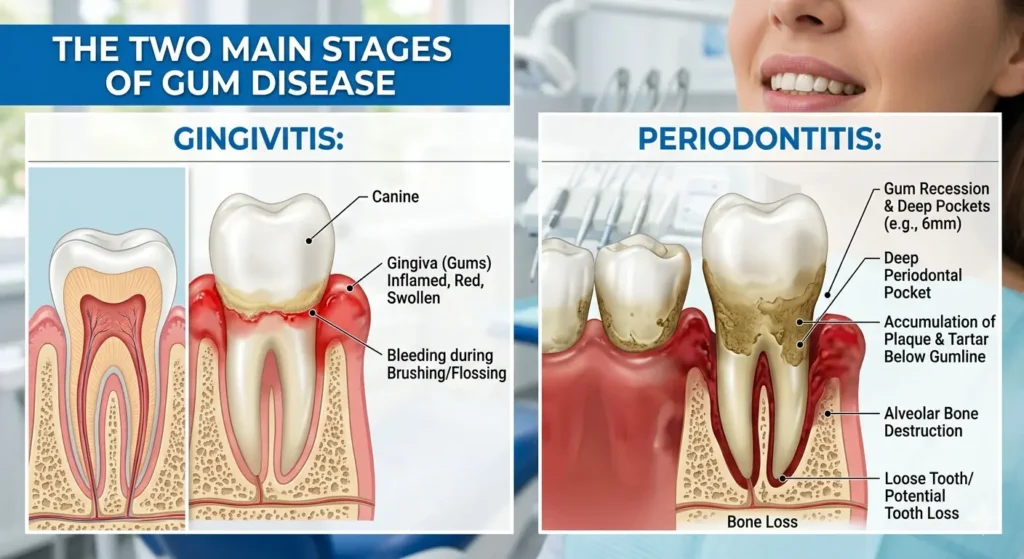
1. Gingivitis (The Early Stage)
This is the earliest stage of gum disease. In this your gums might look red, feel tender, or bleed easily when you brush them. But the good news is that the damage is not serious right now. With a better oral hygiene routine and healthy habits, you can easily reverse this early stage at home.
2. Periodontitis (The Advanced Stage)
If you ignore gingivitis for a long time, it can turn into periodontitis (advanced stage). Your gums actually start to pull away from your teeth. It creates deep small hollow areas that bacteria use to hide. Over time, infection can lead to serious damage such as tooth loss. If you are already in this stage, you will need proper dental care from a dentist to recover.
Early Signs You Might Have Gum Disease
Gum disease is often called a silent problem because it doesn’t cause pain in the early stages. Since it’s caused by bacteria, many people ask if gum inflammation is contagious. While bacteria can spread through saliva, you can reduce the risk of it with a good oral routine.
According to the National Institute of Dental and Craniofacial Research (NIDCR), these are some early signs you should watch out for:
1. Bleeding Gums
This is the most common symptom of gum disease. If during brushing or flossing you see blood, your ums are likely to be inflamed. Healthy gums are tough and simply won’t bleed with the right brushing force.
2. Red, Swollen, or Tender Gums
Having red, swollen, or tender gums is another early sign of gum disease. Healthy gums should be firm and pale pink. However, if your gums look bright red or purplish or feel swollen and painful while touching, there is a high chance you have a gum infection.
3. Persistent Bad Breath
Everyone gets smelly breath in the morning. But if you have a foul taste or smelly breath that doesn’t go away the whole day even after doing a perfect oral routine, it’s not normal. It is usually caused by teh compounds released by bacteria present in the hollow space in your gums. There is a high chance you have developed gum disease.
4. Shrinking Gums
If your teeth are looking bigger than usual suddenly, there is a good chance you have developed gum disease. This happens when irritated gums shrink away from the teeth. Thai receding gum lines leave them vulnerable to tooth decay.
5. Sensitive Teeth
With the receding gum line, the sensitive layer under your enamel, known as dentin, gets exposed. This can cause a sharp pain through your teeth when you eat or drink something really cold or hot. This is another early sign of gum disease.
What Causes Gum Disease?
As we already know, gum disease starts when sticky plaque is not cleaned properly and turns into tartar. But poor oral routine is not the only cause that triggers it. Other habits, health conditions, and natural body changes can increase the risk of developing gum disease.
Diabetes
When your blood sugar is unbalanced, your body isn’t able to fight off infections because of a weakened immune system. That’s why diabetic people have a much higher risk of developing serious gum disease.
Hormonal Change
Natural hormonal changes such as during pregnancy, puberty, or menopause can cause your gums to become more sensitive. Fluctuating female hormones increase blood flow to your gums, which also increases the risk of swelling, redness, and irritation.
Dry Mouth and Medications
Saliva is your mouth’s natural defense system because it constantly cleans food particles and bacteria. However, if you are on certain medications, they can cause dry mouth. And without enough saliva, bacteria grow faster.
Genetics
Sometimes, you can do everything perfect but still develop gum disease. This happens mostly if you have a family history of gum disease because your genes become vulnerable. However, it doesn’t mean it’s 100% confirmed that you will develop it. It does mean that a daily oral routine and healthy habits matter more for you.
Smoking and Tobacco Use
Tobacco and smoking are significant risk factors for developing gum disease. Not only does smoking increase your risk of gum infections, but it also reduces the effectiveness of treatment. It restricts blood flow and weakens your immune system, making it difficult to recover. Smoking and tobacco use can even spread infection into your bloodstream.
How to Treat Early Gum Disease at Home
While you can treat gum disease at home, only if it’s in the early stage (gingivitis). The goal of treatment is simple: remove plaque daily, stop it from hardening into tartar, and give your gums time to heal. According to teh CDC and the NIDCR, building these five daily habits can actually help reverse early gum damage.
1. Brush Gently Twice a Day
Brush your teeth for at least two minutes twice a day. Use a soft-bristled toothbrush and focus on the gumline, where plaque usually loves to stick. Use a fluoride toothpaste for gum disease. If your gums bleed at first, reduce the pressure but keep brushing regularly. But if bleeding doesn’t stop even after a few weeks, you should go to a dentist for proper treatment.
2. Clean Between Your Teeth Daily
A toothbrush can’t reach every corner and tight space between your teeth. According to NIDCR, flossing or using an interdental brush once a day is necessary. Plaque can easily hide just under your gumline, making your gums irritated. That’s why properly removing plaque is important to lower the risk of gum disease.
3. Keep Sugar in Control
Bacteria in your mouth love and grow on sugar. That’s why you should keep sugar intake in a limited amount. But it doesn’t mean you have to restrict sugar completely. Just make sure you are eating sugary things only on some occasions, not as your everyday snack. And always drink water after eating something sweet to wash away particles before bacteria feeds on them.
4. Stop Smoking or Using Tobacco
Quitting tobacco is one of the most powerful steps you can take for your oral health. The CDC reports that smokers have double the risk of developing severe gum issues compared to non-smokers. Smoking restricts blood flow, making it incredibly hard for your gums to heal themselves.
5. Rinse Your Mouth and Be Gentle
A warm salt-water rinse can temporarily relieve sore gums, but it will not treat the infection. For better daily protection, consider adding an over-the-counter antiseptic mouthwash for gum disease to your routine to help flush out lingering bacteria. Above all, do not scrub your teeth aggressively. Scrubbing harder does not make them cleaner—it just damages your gums further.
When to See a Dentist
While upgrading your oral routine can help to treat early gingivitis, it has a limit. If your gum disease has reached an advanced stage (periodontitis), you need proper dental treatment to get better.
According to the NIDCR, you should schedule a dental visit immediately if you notice any of these severe warning signs:
- Your teeth feel loose or look like they are shifting out of place.
- You see pus oozing from between your teeth and gums.
- Your gums are severely receding (pulling far away from your teeth).
- You have a persistent bad taste or foul breath that won’t go away.
- It hurts to chew, or you develop painful sores in your mouth.
A dentist has tools that can help to remove plaque, which is not possible at home. That’s why in severe gum disease it’s recommended to visit a dentist for proper treatment.
Final Thoughts
Treating gum disease depends on when you notice it. If you can catch gum disease in its early stage, you can easily reverse it at home. Simple, everyday habits like brushing, flossing, eating healthy, and visiting the dentist once in a while are your best defense and treatment against all types of gum disease.
But remember, if after doing everything your gums are still not getting better, you should visit a dentist for proper treatment before it’s too late.
FAQs
What are the very first signs of gum disease?
Bleeding when you brush or floss is usually the earliest red flag. You might also notice slight redness or puffy swelling. Because it rarely hurts at first, people often ignore it—but that is exactly when you should start paying extra attention to your brushing habits.
What is the best toothpaste for gum disease?
Any ADA-approved fluoride toothpaste for gum disease is best. As an added layer of protection, finish your oral care routine with an antiseptic mouthwash for gum disease to get rid of any hidden bacteria and bad smells.
Is gum disease contagious?
Yes and, at same time no. The bacteria causing gum disease can spread through saliva, such as when sharing foods, drinks, or just kissing. However, the infection won’t actually start to develop in your mouth if you are consistent with your oral hygiene routine.
Can gum disease kill you?
No, the infection can’t kill you directly. But, if not treated for years, severe cases can kill you indirectly. The hidden bacteria can travel to your bloodstream, which can increase your risk of heart attacks, strokes, and other serious health issues, but remember, these are very rare cases.
How to cure gum disease without a dentist at home?
Brushing, flossing, and using an antiseptic mouthwash to reduce bacteria can help you cure gum disease at home, but only if it’s still in the early stage (gingivitis). However, if your gums still bleed and don’t improve, you need to visit a dentist.
References & Sources
CDC: Centers for Disease Control and Prevention
College of Dentistry | University of Illinois Chicago
NIH MedlinePlus Magazine (.gov)
National Institute of Dental and Craniofacial Research (.gov)

Olivia Reed
Women's Health & Skincare Writer
Better Health Focus
Expertise
Women's Health • Skincare • Hormonal Health • Beauty & Skin Science • Preventive Wellness • Healthy Aging • Nutrition for Skin Health • Lifestyle Medicine • Evidence-Based Health Education
About Olivia Reed
Olivia Reed is a Women's Health & Skincare Writer at Better Health Focus, where she creates evidence-based educational content focused on helping readers better understand women's wellness, hormonal health, skincare, healthy aging, and preventive self-care.
Her writing combines scientific research with practical lifestyle guidance, making complex health and skincare topics easy to understand without relying on misleading beauty trends or unrealistic health claims. Olivia Reed believes that informed readers make better health decisions, and she strives to present balanced information that reflects current scientific evidence.
Before publishing an article, Olivia Reed reviews guidance and research from respected organizations, including the National Institutes of Health (NIH), PubMed, the World Health Organization (WHO), the American Academy of Dermatology (AAD), the American College of Obstetricians and Gynecologists (ACOG), the Office on Women's Health (OWH), and peer-reviewed medical journals whenever applicable.
Her work regularly explores women's hormonal changes throughout different life stages, skincare science, acne, eczema, pigmentation, menopause, nutrition for healthy skin, reproductive wellness, hair health, and evidence-based approaches to beauty and preventive healthcare.
Olivia Reed is committed to separating scientific evidence from social media trends and marketing claims, helping readers understand what current research supports—and where evidence is still emerging.
Education
Bachelor of Arts (B.A.) in Health Communication
Professional Development
- Continuing education in Women's Health and Skin Science
- Ongoing study of dermatology research and preventive healthcare
- Regular review of peer-reviewed publications related to dermatology, endocrinology, nutrition, women's health, and public health
- Continuous monitoring of clinical guidance from leading medical organizations
Areas of Focus
- Women's Health
- Hormonal Health
- Menstrual & Reproductive Wellness
- Pregnancy & Postpartum Education
- Menopause & Healthy Aging
- Skincare & Dermatology Education
- Acne, Eczema & Sensitive Skin
- Hair & Scalp Health
- Nutrition for Healthy Skin
- Preventive Health & Lifestyle Medicine
Editorial Standards
Every article written by Olivia Reed Ward follows the editorial standards of Better Health Focus and is developed using reputable medical references and current scientific literature whenever available.
Her editorial approach emphasizes:
- Evidence-based health education
- Scientific accuracy
- Balanced discussion of benefits, risks, and research limitations
- Clear, accessible language for everyday readers
- Responsible reporting without exaggerated claims
- Alignment with Google E-E-A-T principles for health content
Rather than promoting miracle treatments or viral beauty trends, Olivia Reed focuses on practical, research-informed guidance that supports informed decision-making and long-term wellness.
Research Sources
Articles may reference information from organizations and databases such as:
- National Institutes of Health (NIH)
- PubMed
- World Health Organization (WHO)
- American Academy of Dermatology (AAD)
- American College of Obstetricians and Gynecologists (ACOG)
- Office on Women's Health (OWH)
- American Academy of Pediatrics (AAP)
- U.S. Food & Drug Administration (FDA)
- Peer-reviewed scientific journals
Editorial Disclaimer
The information published by Olivia Reed Ward on Better Health Focus is intended for educational and informational purposes only. It should not replace professional medical advice, diagnosis, or treatment. Readers should consult a qualified healthcare professional or dermatologist regarding personal medical concerns, medications, skincare treatments, or significant health decisions.