

From a young age we are taught to brush our teeth daily, limit sugar intake, and visit the dentist. But today, a busy routine tends to make you rush through brushing or skip flossing. But oral care isn’t just about bright teeth. It also affects our overall health.
Even though cavities and gum disease are very common, they are also highly preventable. You don’t need expensive treatments or hours. All you need is a few simple daily habits. In this blog, we will discuss how you can protect and improve your oral health. Let’s break down the best daily morning oral hygiene routine for a strong, healthy smile.
Table of Contents
What A Good Oral Hygiene Routine Should Do
A good morning oral hygiene routine has four main functions:
- To remove plaque from your teeth, which is a sticky layer of bacteria on them.
- To help fluoride remain on your teeth to make your enamel stronger.
- To clean the tight spaces that a toothbrush can’t reach.
- To minimize the risk of small oral problems like cavities, gum disease, and any infection.
Understanding Plaque and Tartar
Before discussing an oral routine, you should understand what it will be fighting against. Every time you eat or drink, many bacteria enter your mouth. Your mouth is home to millions of bacteria. And when these bacteria mix with protein and food byproducts, they form a sticky layer on your teeth called plaque.
According to the NIDCR, plaque bacteria feed on sugar. As they feed, they produce harmful acids. Over time, these acids break down the outer layer of your teeth, known as enamel, which leads to cavities or tooth decay.
If this plaque is not eliminated daily with a good oral routine, over time it hardens into a tough layer called tartar (or calculus). Tartar builds up on the gum line, which makes it difficult to clean your teeth. Once it forms, it cannot be removed by brushing and flossing. You will need to go to a dentist for proper treatment. Without treatment, it can cause gum disease (gingivitis), resulting in the loss of teeth.
The main goal of your morning oral hygiene routine is to remove plaque and prevent it from turning into tartar.
The Best Morning Oral Hygiene Routine for Healthy Teeth
A good morning oral hygiene routine has a proper combination of the right tools, the right timing, and the right technique. It should help you to keep your teeth strong and gums healthy. Here is a simple step-by-step oral hygiene routine you can follow.
Step 1: Brushing
Brushing your teeth is the most basic step of an oral care routine. But most people don’t even do this basic step correctly or long enough.
- How often:
According to the CDC and the American Dental Association, you should brush your teeth exactly two times a day. Once in the morning and once at night before going to bed.
- Duration:
You should brush your teeth for a full two minutes. A simple trick is to divide your mouth into four parts (upper right, upper left, lower right, and lower left) and give 30 seconds to each one of them.
- Technique:
Don’t just scrub your teeth forcefully. Hold your toothbrush at a 45-degree angle, and your aim should be toward the gumline. Now make small circular movements with the brush. Make sure you brush the outside, inside, and chewing surface of every tooth.
- The Right Brush:
Don’t choose any toothbrush. Always go for a toothbrush with soft bristles. Hard ones can damage your gums and protective tooth enamel over time.
- Replacement:
Change your toothbrush every 3 or 4 months, or sooner if the bristles start to look worn out.
Step 2: Choose Fluoride Toothpaste
When you buy toothpaste, make sure it contains an important ingredient called fluoride. It’s like an invisible shield on your teeth.” It makes teeth stronger, helps prevent cavities, and can repair minor damage before it becomes a problem.
Step 3: The “Spit, Don’t Rinse” Rule
Many people might be surprised, but after you finish brushing, spit out the excess toothpaste and do not rinse your mouth with water.
Even the National Health Service (NHS) strongly recommends this method. Rinsing your mouth with water removes the concentrated fluoride from your toothpaste before it works. Leaving that fluoride on your teeth allows it more time to do its work and strengthen your enamel.
Step 4: Cleaning Between Your Teeth (Flossing)
Brushing is not enough for a morning oral hygiene routine. Your tooth has five surfaces, and by brushing, you are only able to clean 3 of them (the front, back, and top). If you don’t clean the space between your teeth, you’re leaving 40% of your teeth uncleaned.
The CDC suggests cleaning between your teeth at least once a day. It helps to remove plaque and trapped food that your toothbrush can’t reach.
You have a few options for interdental cleaning:
- Traditional String Floss:
This process is the most common and traditional method. Take about 18 inches of floss string, wind most of it around your middle fingers, and gently guide it between your teeth to clean those areas.
- Floss Picks:
These are best for those who are unable to do the traditional flossing method. Though with these, you must be careful not just to push food deeper into the gums.
- Interdental Brushes:
These brushes look like tiny pipe cleaners and are best for people with larger gaps between their teeth, braces, or dental bridges.
- Water Flossers:
These cleaning devices shoot a stream of water to blast away plaque and food particles. These are best for people who don’t like traditional flossing or have sensitive gums.
Step 5: Clean Your Tongue
Your tongue is like a sponge, and the rough surface of it holds bacteria and bits of food. This bacterium is one of the main reasons people have bad breath (halitosis), and it can easily move to your teeth.
After brushing and flossing, take time to clean your tongue. You can use your soft-bristled toothbrush to brush your tongue gently, or you can buy a plastic or metal tongue scraper.
Step 6: Mouthwash
Mouthwash is not a replacement for your brushing and flossing, but doing it can be a beneficial addition to your morning oral hygiene routine.
If you want to use mouthwash, try to look for a therapeutic mouthwash rather than a cosmetic one. According to the FDA, therapeutic mouthwashes are those that contain ingredients like fluoride to prevent cavities or cetylpyridinium chloride to kill bacteria, which actually helps to remove plaque, gingivitis, and tooth decay. Cosmetic mouthwashes just hide bad breath temporarily without killing bacteria.
Avoid using mouthwash immediately after brushing. Use it at different times of the day, like after lunch.
Nighttime Oral Hygiene Routines for Healthy Teeth
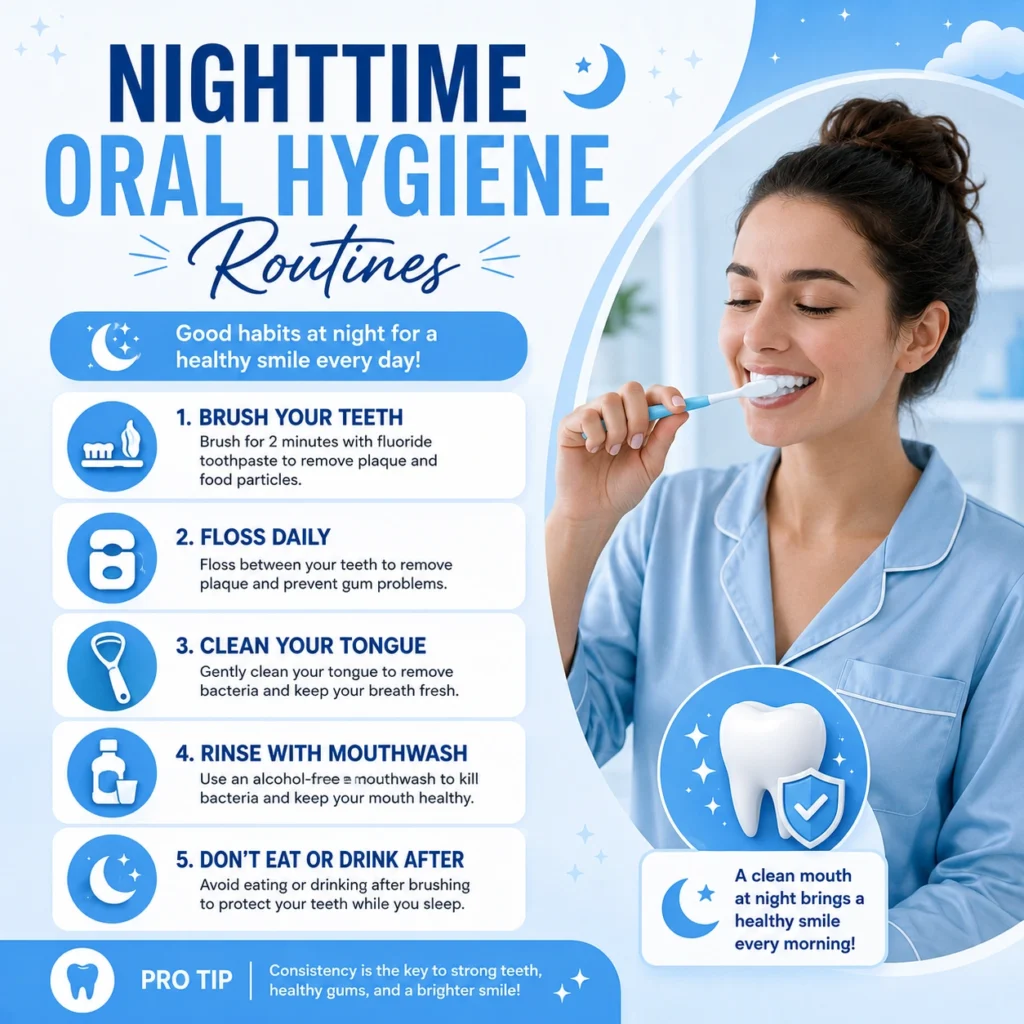
While opinions differ, nighttime brushing is vital for your oral health. Throughout the day, your teeth are exposed to everything. If you go to sleep without brushing, the bacteria in your mouth get to feed on leftover sugar or food particles the whole night. Due to slow saliva flow, your teeth are highly vulnerable during sleep. That’s why you should never skip your nighttime oral hygiene routine.
Common Dental Hygiene Routine Mistakes You Might Be Making
Even if you believe you are doing well, there are common mistakes that can be detrimental to your oral health. Here are some common mistakes you have to avoid.
Brushing Too Hard:
Brushing harder doesn’t make your teeth any cleaner. Actually, it can damage your enamel and gums, which may result in tooth sensitivity. You should brush with a gentle force.
Brushing After Eating Acidic Foods:
Don’t brush your teeth right after having acidic foods. Acidic foods make your enamel soft. Brushing when your enamel is soft can hurt your teeth. Wait 30 to 60 minutes before you brush.
Using a Toothbrush for a Long Time:
Replace your toothbrush every 3 to 4 months, because the bristles wear down over time and don’t clean your teeth as well.
Ignoring Bleeding Gums:
Bleeding gums when you brush or floss are often one of the first signs of gum disease (gingivitis). You do not need to stop your morning oral hygiene routine, but you should definitely go to a dentist instead of ignoring it.
Special Care Tips for Braces
Having braces means more places for food and plaque to hide from cleaning. If you have braces, you might have also searched for the best oral hygiene routine for braces. There is not much difference, just a few extra things to keep in mind:
- Brush after every meal:
Unlike normal people, you have to brush after every meal. It prevents food from getting settled around your brackets and wires for too long.
- Use special tools:
You’ll need either a water flosser or tiny interdental brushes. They will help you clean under wires where regular floss can’t clean.
- Check your work:
After your oral routine, always look closely in the mirror to make sure there are no food particles left.
Taking a little bit of extra time to follow these steps can help you have a perfect, healthy smile when you remove those braces.
When to See a Dentist
While a daily oral hygiene routine is important to have good oral health, you still sometimes need professional help. You should immediately go to a dentist if you have any of these below-given symptoms:
- Persistent tooth pain or sensitivity to hot/cold.
- Bleeding, red, or swollen gums.
- A bad taste in your mouth or bad breath that won’t go away.
- A loose permanent tooth.
- Unusual sores or lumps in the mouth.
Final Thoughts
At the end of the day, your teeth are built to last a lifetime, but they need your help consistently. You don’t need a complicated oral hygiene routine. For the best oral hygiene routine, a few minutes every morning and night of properly brushing, flossing, and removing plaque is more than enough. With these simple steps you will have a strong and healthy smile for years to come.
Frequently Asked Questions
How often should I brush my teeth?
According to experts, usually, it is more than enough to brush twice a day for two minutes. Try to use a soft-bristled brush and toothpaste that has fluoride. These are important parts of a daily oral hygiene routine.
Do I really need to floss every single day?
Yes. A toothbrush can’t reach the spaces between your teeth. That’s why flossing every day is important. This helps to remove trapped food particles and plaque and lowers the risk of oral diseases.
How to reduce plastic waste in my oral hygiene routine?
It is very easy to build a zero waste oral hygiene routine. You simply start by swapping your regular plastic toothbrush for a wooden one and using biodegradable silk floss.
How often should I go to the dentist?
It depends on your needs. One or two visits to the dentist per year are usually sufficient. However, if you are at risk for dental problems, you may need to see your dentist more often.
What is the best oral hygiene routine for braces?
When it comes to the best oral hygiene routine for braces, it is almost the same as regular but with some extra steps. Brush after every meal and underneath the wires and brackets with a water flosser or small interdental brushes.
References & Sources
CDC: Centers for Disease Control and Prevention
World Health Organization (WHO)

Olivia Reed
Women's Health & Skincare Writer
Better Health Focus
Expertise
Women's Health • Skincare • Hormonal Health • Beauty & Skin Science • Preventive Wellness • Healthy Aging • Nutrition for Skin Health • Lifestyle Medicine • Evidence-Based Health Education
About Olivia Reed
Olivia Reed is a Women's Health & Skincare Writer at Better Health Focus, where she creates evidence-based educational content focused on helping readers better understand women's wellness, hormonal health, skincare, healthy aging, and preventive self-care.
Her writing combines scientific research with practical lifestyle guidance, making complex health and skincare topics easy to understand without relying on misleading beauty trends or unrealistic health claims. Olivia Reed believes that informed readers make better health decisions, and she strives to present balanced information that reflects current scientific evidence.
Before publishing an article, Olivia Reed reviews guidance and research from respected organizations, including the National Institutes of Health (NIH), PubMed, the World Health Organization (WHO), the American Academy of Dermatology (AAD), the American College of Obstetricians and Gynecologists (ACOG), the Office on Women's Health (OWH), and peer-reviewed medical journals whenever applicable.
Her work regularly explores women's hormonal changes throughout different life stages, skincare science, acne, eczema, pigmentation, menopause, nutrition for healthy skin, reproductive wellness, hair health, and evidence-based approaches to beauty and preventive healthcare.
Olivia Reed is committed to separating scientific evidence from social media trends and marketing claims, helping readers understand what current research supports—and where evidence is still emerging.
Education
Bachelor of Arts (B.A.) in Health Communication
Professional Development
- Continuing education in Women's Health and Skin Science
- Ongoing study of dermatology research and preventive healthcare
- Regular review of peer-reviewed publications related to dermatology, endocrinology, nutrition, women's health, and public health
- Continuous monitoring of clinical guidance from leading medical organizations
Areas of Focus
- Women's Health
- Hormonal Health
- Menstrual & Reproductive Wellness
- Pregnancy & Postpartum Education
- Menopause & Healthy Aging
- Skincare & Dermatology Education
- Acne, Eczema & Sensitive Skin
- Hair & Scalp Health
- Nutrition for Healthy Skin
- Preventive Health & Lifestyle Medicine
Editorial Standards
Every article written by Olivia Reed Ward follows the editorial standards of Better Health Focus and is developed using reputable medical references and current scientific literature whenever available.
Her editorial approach emphasizes:
- Evidence-based health education
- Scientific accuracy
- Balanced discussion of benefits, risks, and research limitations
- Clear, accessible language for everyday readers
- Responsible reporting without exaggerated claims
- Alignment with Google E-E-A-T principles for health content
Rather than promoting miracle treatments or viral beauty trends, Olivia Reed focuses on practical, research-informed guidance that supports informed decision-making and long-term wellness.
Research Sources
Articles may reference information from organizations and databases such as:
- National Institutes of Health (NIH)
- PubMed
- World Health Organization (WHO)
- American Academy of Dermatology (AAD)
- American College of Obstetricians and Gynecologists (ACOG)
- Office on Women's Health (OWH)
- American Academy of Pediatrics (AAP)
- U.S. Food & Drug Administration (FDA)
- Peer-reviewed scientific journals
Editorial Disclaimer
The information published by Olivia Reed Ward on Better Health Focus is intended for educational and informational purposes only. It should not replace professional medical advice, diagnosis, or treatment. Readers should consult a qualified healthcare professional or dermatologist regarding personal medical concerns, medications, skincare treatments, or significant health decisions.