
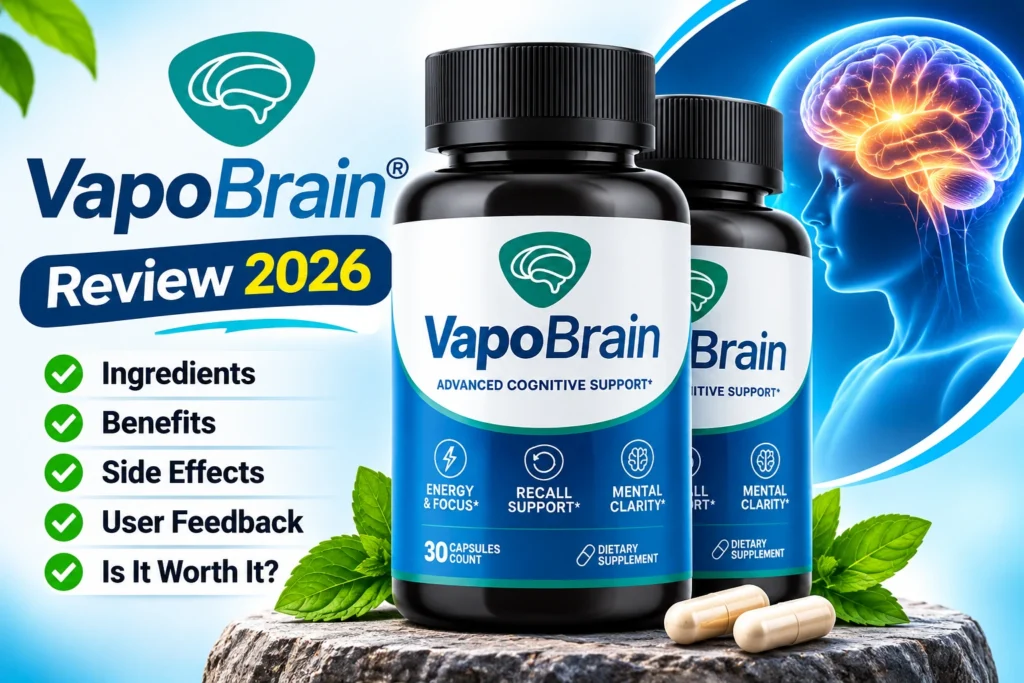
Vapo Brain is a brain-support dietary supplement sold in capsule form. It contains six listed ingredients, including ginkgo biloba, turmeric, green tea, and glucosamine. In this VapoBrain review, we examine its ingredient doses, potential benefits, side effects, pricing, and advertised 60-day guarantee. The formula has not been established as effective through clinical trials on the finished product, so buyers should understand what the ingredients can—and cannot—tell us before ordering.
Table of Contents
VapoBrain Quick Overview
Here is a quick overview of the product based on the supplied product information. These details should be checked against the current official website and product label before purchasing.
| Feature | Details |
| Product name | VapoBrain |
| Product type | Cognitive and brain-support dietary supplement |
| Format | Capsules |
| Daily serving | 2 capsules |
| Ingredients count | 6 listed ingredients |
| Price from | $49 per bottle (6-bottle package) |
| Money-back guarantee | Advertised 60 days |
| Support email | contact@vapobrain.com |
| Best for | Adults exploring general brain-support supplements |
Important: These are manufacturer-supplied product details, not independently verified findings. Confirm the serving size, ingredient quantities, current price, and refund conditions before ordering.
What Is VapoBrain?
VapoBrain is marketed as a dietary supplement designed to support cognitive wellness and general brain health. Its formula combines six listed ingredients from different categories, including a joint-health ingredient, botanical extracts, and plant-derived compounds.
The product is intended for adults interested in maintaining their everyday cognitive wellness as part of a broader healthy lifestyle.
Some of its ingredients have been studied for antioxidant activity, circulation, or other biological functions. However, research involving individual ingredients does not establish that Vapo Brain improves memory, concentration, or cognitive performance.
It is also important to understand what Vapo Brain Supplement is not. It should not be considered a treatment for Alzheimer’s disease, dementia, or any other neurological condition. People experiencing persistent memory or concentration problems should seek an appropriate medical evaluation rather than relying on supplements.
VapoBrain Ingredients: What the Research Says
VapoBrain lists six ingredients per daily serving. Their individual research backgrounds vary, and the amounts included in the formula matter.
Here is a closer look at each ingredient.
1. D-Glucosamine Sulfate Potassium Chloride – 250 mg
What it is: Glucosamine is a naturally occurring compound involved in the formation and maintenance of cartilage. It is commonly sold as a dietary supplement for joint health.
What research says: Glucosamine has mainly been studied for osteoarthritis and joint-related outcomes. It is not an established memory-support ingredient. MedlinePlus discusses its uses, safety, and possible medication interactions.
Honest caution: The listed 250 mg is below the 1,500 mg daily amount commonly used in glucosamine research. More importantly, evidence about joint health does not establish a cognitive benefit.
Read:MedlinePlus – Glucosamine Supplements.
2. Ginkgo Biloba Leaf Extract – 100 mg
What it is: Ginkgo biloba is a botanical extract commonly included in supplements marketed for circulation and brain health.
What research says: Researchers have studied ginkgo for cognitive function and age-related cognitive concerns. However, the National Center for Complementary and Integrative Health (NCCIH) reports that there is no conclusive evidence that ginkgo improves cognitive performance in healthy people or prevents dementia.
Honest caution: The 100 mg amount in VapoBrain does not establish that it provides a particular cognitive benefit. Ginkgo may also increase bleeding risk, particularly when combined with blood-thinning medication.
Read:NCCIH – Ginkgo: Usefulness and Safety.
3. Turmeric Root Extract – 50 mg
What it is: Turmeric is a plant traditionally used in food and herbal preparations. It contains curcuminoids, including curcumin.
What research says: Studies have explored turmeric and curcumin for antioxidant activity, inflammation-related processes, and other health areas. However, NCCIH notes that available evidence is not sufficient to establish clear benefits for many health conditions.
Honest caution: The product information does not specify the curcumin concentration or standardization of its 50 mg turmeric extract. Therefore, it is difficult to compare this amount with doses used in research.
Turmeric supplements may cause digestive problems and can interact with medications. Some enhanced-bioavailability formulations have also been associated with liver injury.
Read:NCCIH – Turmeric: Usefulness and Safety.
4. Marigold Flower Extract – 25 mg
What it is: Marigold flower extracts are used in some dietary supplements. Certain marigold extracts provide lutein and zeaxanthin, carotenoids associated with eye health.
What research says: Lutein and zeaxanthin have been investigated for their role in eye health and protection against oxidative stress. However, the presence of marigold extract does not automatically establish that a product contains a meaningful amount of either compound.
Honest caution: Vapo Brain lists 25 mg of marigold flower extract, but the supplied information does not disclose its lutein or zeaxanthin content. Without that information, its nutritional contribution cannot be assessed accurately.
5. Green Tea Leaf Extract – 15 mg
What it is: Green tea leaf extract contains plant compounds called catechins, including epigallocatechin gallate (EGCG). Depending on the preparation, it may also contain caffeine.
What research says: Green tea compounds have been studied for antioxidant activity and several aspects of general health. Some research has also examined their relationship with cognitive function, but findings do not establish that Vapo Brain improves memory or concentration.
Honest caution: The listed amount is only 15 mg. The product information does not specify its EGCG concentration or caffeine content. These details matter when evaluating the ingredient’s potential effects and safety.
6. Bamboo Leaf Extract – 5 mg
What it is: Bamboo leaf extract is a plant-derived ingredient used in some dietary supplements. Certain bamboo preparations contain silica and other plant compounds.
What research says: Bamboo-derived compounds have attracted interest in nutritional and antioxidant research. However, there is limited human evidence establishing specific cognitive benefits from bamboo leaf extract.
Honest caution: The listed amount is 5 mg, and the supplied information does not identify its active compounds or standardization. There is not enough information to determine whether this quantity provides a meaningful nutritional contribution.
An Honest Look at the Formula
The most important question about VapoBrain is whether its ingredient combination is supported by evidence for cognitive health.
There are several points worth considering.
First, glucosamine is mainly associated with joint-health research. It is not a conventional memory-support ingredient. Its inclusion does not automatically make the formula more effective for cognitive wellness.
Second, some ingredient amounts are relatively small. For example, the formula lists 15 mg of green tea extract, 5 mg of bamboo leaf extract, and 25 mg of marigold extract. Without standardized active-compound amounts, it is difficult to assess their relevance.
Third, ginkgo has been researched more extensively than some of the other ingredients. However, research results are mixed, and findings from one standardized ginkgo preparation cannot automatically be applied to another product.
Fourth, there are no verified clinical trials on the finished VapoBrain formula. This means there is no established product-specific evidence showing that the six ingredients work together to improve memory, attention, or cognitive performance.
Overall, the formula contains recognizable ingredients, but its cognitive effectiveness remains unproven.
Read: Memosalt Reviews Brain Health Supplement
How VapoBrain Is Meant to Work
VapoBrain is marketed around several general nutritional and biological concepts.
- Antioxidant support: Certain plant compounds in green tea and turmeric have been studied for antioxidant activity.
- Circulation: Ginkgo is commonly investigated for its relationship with blood circulation and vascular function.
- General brain nutrition: The formula combines botanical extracts and other compounds marketed for everyday wellness.
These are proposed areas of support, not demonstrated outcomes for VapoBrain.
Healthy cognitive function also depends on sleep, nutrition, physical activity, cardiovascular health, and other lifestyle factors. A supplement should not replace these foundations.
How to Take VapoBrain
According to the supplied product information, the recommended serving is two capsules daily.
Before starting:
- Read the current product label.
- Follow the serving instructions provided by the manufacturer.
- Check the ingredient list and potential allergens.
- Do not exceed the recommended serving.
- Ask a healthcare professional whether the formula is appropriate for you.
The supplied information does not establish whether the capsules should be taken with food or at a particular time of day. Follow the current label rather than assuming a schedule.
VapoBrain Side Effects & Who Should Avoid It
Natural ingredients can still cause side effects and medication interactions. VapoBrain should not be described as risk-free.
Here are the main precautions associated with its listed ingredients.
Ginkgo and bleeding risk: Ginkgo may increase bleeding risk, especially when used with anticoagulants such as warfarin. People taking blood-thinning medication or preparing for surgery should seek medical advice before using it.
Glucosamine and shellfish allergy: Some glucosamine is manufactured from shellfish. People with shellfish allergies should confirm its source. Glucosamine may also affect blood glucose levels, so people with diabetes should discuss its use with their healthcare provider.
Turmeric and digestive effects: Turmeric supplements may cause nausea, reflux, stomach discomfort, diarrhea, or constipation. Certain concentrated formulations have also been associated with liver injury.
Green tea extract: Concentrated green tea extracts can cause adverse effects, and some preparations contain caffeine. The exact concentration in VapoBrain is not disclosed in the supplied information.
Pregnancy and breastfeeding: Ginkgo and turmeric supplements may be unsuitable during pregnancy. Safety information for the complete formula is insufficient, so pregnant or breastfeeding individuals should avoid starting it without professional advice.
Prescription medications: People taking prescription drugs, particularly blood thinners, diabetes medications, or medicines with potential herb interactions, should consult a healthcare professional.
Before surgery: Tell your surgeon about all supplements you use. Ask whether VapoBrain should be stopped before a planned procedure.
If you experience an unexpected reaction after taking a supplement, stop using it and seek appropriate medical advice.
Is VapoBrain Legit or a Scam?
Based on the supplied product information, VapoBrain is presented as a labelled dietary supplement with a defined serving size, six listed ingredients, advertised package prices, and a 60-day guarantee.
However, being a real product listing does not prove that its advertised cognitive benefits are effective.
There are three separate questions buyers should consider:
- Is the product real? The supplied information describes a specific capsule product, but the manufacturer and product listing should be independently verified.
- Does the formula work? No verified clinical trials on the finished VapoBrain formula have been established.
- Is the purchase trustworthy? Buyers should confirm the seller’s identity, customer service details, payment terms, and refund conditions.
Our assessment is that VapoBrain cannot be confidently classified as a scam based on the available information. However, its effectiveness for cognitive support is also not proven.
What Customers Say
When researching VapoBrain customer reviews, it is important to separate independently verified feedback from testimonials published on promotional websites.
The supplied product information does not include an independently verified customer-review database or reliable review count. Therefore, we cannot assign VapoBrain a genuine customer rating or present invented testimonials.
General themes to investigate in available customer feedback include:
- Results: Some supplement buyers report that changes are gradual or difficult to notice.
- Shipping costs: Shipping charges can affect the final purchase price, particularly with smaller packages.
- Individual experiences: Responses to dietary supplements vary depending on personal circumstances and other factors.
- Customer service: Buyers should check whether refund requests and order-related questions receive clear responses.
These are purchasing considerations, not verified findings about every VapoBrain customer. Individual experiences vary, and testimonials do not prove effectiveness.
VapoBrain Price & Money-Back Guarantee
According to the supplied pricing information, VapoBrain is advertised in three purchasing packages.
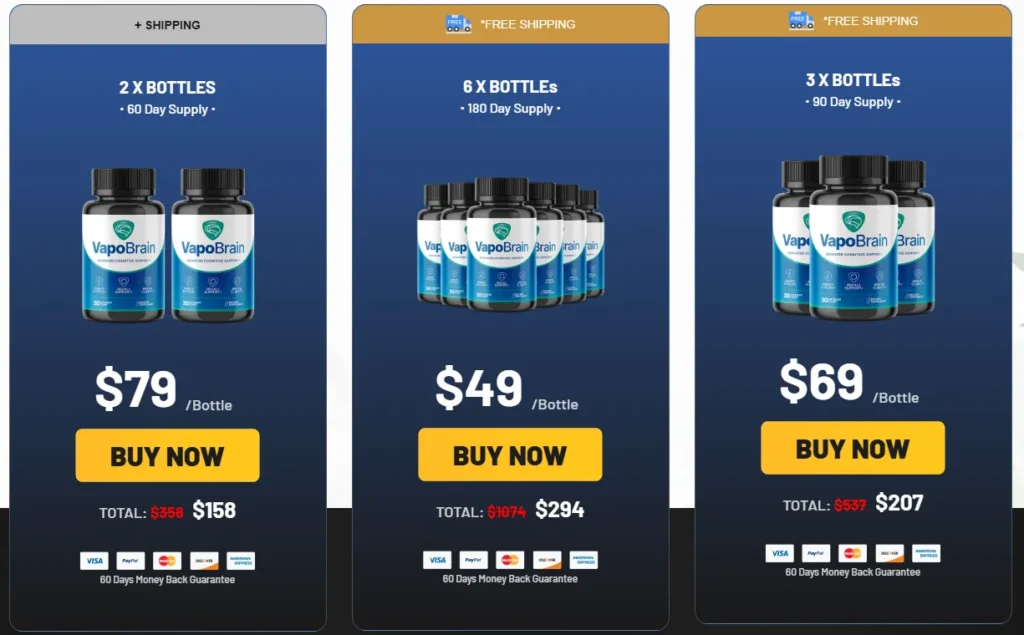
| Package | Total Price | Price Per Bottle | Shipping |
| 2 bottles | $158 | $79 | Extra |
| 3 bottles | $207 | $69 | Free |
| 6 bottles | $294 | $49 | Free |
Lowest advertised price
6-bottle package: $49 per bottle.
The manufacturer also advertises a 60-day money-back guarantee.
Before choosing a package, consider the total amount you will pay rather than looking only at the per-bottle price.
Check these details on the official website:
- Whether the guarantee starts from the purchase date or delivery date.
- Whether opened bottles qualify for refunds.
- Whether return shipping is the buyer’s responsibility.
- Whether a return authorization is required.
- Whether shipping charges are refundable.
- Whether the transaction involves recurring billing.
Official website:
Customer support email supplied: contact@vapobrain.com
The website, contact email, current prices, and guarantee terms should all be verified before placing an order.
Pros and Cons
- Six listed ingredients
- Convenient two-capsule serving
- Includes ginkgo biloba extract
- Three advertised package options
- Advertised 60-day guarantee
- Provides a listed support email
- Some ingredient doses are relatively small
- Ginkgo evidence for healthy cognitive performance is uncertain
- Shipping costs apply to the two-bottle package
- Refund conditions require verification
Who Might Consider VapoBrain? / Who Should Skip It?
VapoBrain may be worth researching for adults interested in general nutritional support who understand the limitations of botanical supplements.
It may appeal to people who:
- Prefer a capsule-based supplement.
- Want to examine a formula containing ginkgo and other plant extracts.
- Are comfortable evaluating ingredient evidence before purchasing.
- Understand that results are not guaranteed.
However, certain people should be more cautious.
Consider skipping it or seeking medical advice first if you:
- Take blood-thinning medication.
- Have a shellfish allergy.
- Have diabetes or blood-glucose management concerns.
- Are pregnant or breastfeeding.
- Have a bleeding disorder.
- Are preparing for surgery.
- Take prescription medications that may interact with herbal ingredients.
People experiencing new or worsening memory problems should seek medical evaluation instead of attempting to manage those symptoms with supplements.
Final Verdict
VapoBrain is a six-ingredient dietary supplement marketed for cognitive and brain-support wellness. Its formula includes ginkgo biloba, turmeric, green tea, marigold, bamboo leaf, and glucosamine.
The main concern is the gap between its marketing purpose and the available ingredient evidence.
Ginkgo has been studied for cognitive health, but research has not established consistent benefits for healthy people. Glucosamine is primarily associated with joint-health research, while several other ingredients have limited product-specific cognitive evidence.
The absence of clinical trials on the finished VapoBrain formula also means its effectiveness cannot be established.
Our verdict: VapoBrain may interest adults researching botanical brain-support supplements, but we cannot recommend it as a proven memory or cognitive-performance solution. Review the ingredient doses, discuss potential interactions with your healthcare professional, and verify the seller’s current purchasing terms before making a decision.
For anyone concerned about memory or cognitive changes, an appropriate medical assessment is more important than relying on an unproven supplement.
FAQs
1. What Is VapoBrain Used For?
VapoBrain is marketed as a cognitive-support dietary supplement intended to complement general brain wellness. It contains six listed ingredients, including ginkgo biloba and turmeric. However, there is insufficient clinical evidence to establish that the finished formula improves memory, attention, or cognitive performance.
2. What Are the Main VapoBrain Ingredients?
The six listed ingredients are D-Glucosamine Sulfate Potassium Chloride, ginkgo biloba leaf extract, turmeric root extract, marigold flower extract, green tea leaf extract, and bamboo leaf extract. Their quantities are provided in the product overview, but the complete label should be verified before purchase.
3. Does VapoBrain Have Side Effects?
Potential concerns include bleeding risk associated with ginkgo, possible blood-glucose effects from glucosamine, and digestive reactions associated with turmeric. Individual responses vary. People taking medication, preparing for surgery, or managing medical conditions should consult a healthcare professional before use.
4. Is VapoBrain Legit?
VapoBrain is presented as a specific dietary supplement with listed ingredients and advertised purchasing options. However, the manufacturer’s identity, product quality, and seller details require verification. Its effectiveness for cognitive support has not been established through clinical trials on the finished formula.
5. How Much Does VapoBrain Cost?
The advertised price starts at $79 per bottle in the two-bottle package, $69 per bottle in the three-bottle package, and $49 per bottle in the six-bottle package. Shipping is extra for two bottles and advertised as free for the larger packages. Verify current checkout prices.
6. Does VapoBrain Offer a Money-Back Guarantee?
VapoBrain advertises a 60-day money-back guarantee. However, customers should read the current official refund policy to understand eligibility, return shipping costs, required documentation, and the procedure for requesting a refund.
Disclaimer
These statements have not been evaluated by the FDA. This product is not intended to diagnose, treat, cure or prevent any disease. Not medical advice.

Better Health Focus Team
Health, Wellness & Supplement Research Team
The Better Health Focus Team researches and reviews health, wellness, nutrition, and dietary supplement products. Our goal is to provide readers with clear, practical, and research-informed information before they make a purchasing decision.
Our reviews examine product ingredients, potential benefits, usage instructions, available scientific research, customer feedback, pricing, refund policies, and manufacturer claims. We also look at potential limitations and highlight claims that may require additional evidence.
We believe supplement information should be presented realistically—not through exaggerated promises. Where scientific evidence is limited or conflicting, we make that clear so readers can make more informed decisions.
Areas We Cover:
Dietary Supplement Reviews
Nutrition & Wellness
Ingredient Research
Product Benefits & Potential Side Effects
Customer Reviews & Complaints
Pricing & Money-Back Policies
Evidence-Based Health Information
Editorial Approach: Our content is based on information available from reputable scientific, government, manufacturer, and consumer sources. Supplement reviews are informational and should not replace advice from a qualified healthcare professional.
Affiliate Disclosure: Some articles may contain affiliate links. If a reader purchases a product through one of these links, Better Health Focus may receive a commission at no additional cost to the reader. This does not determine how we evaluate or describe products.