
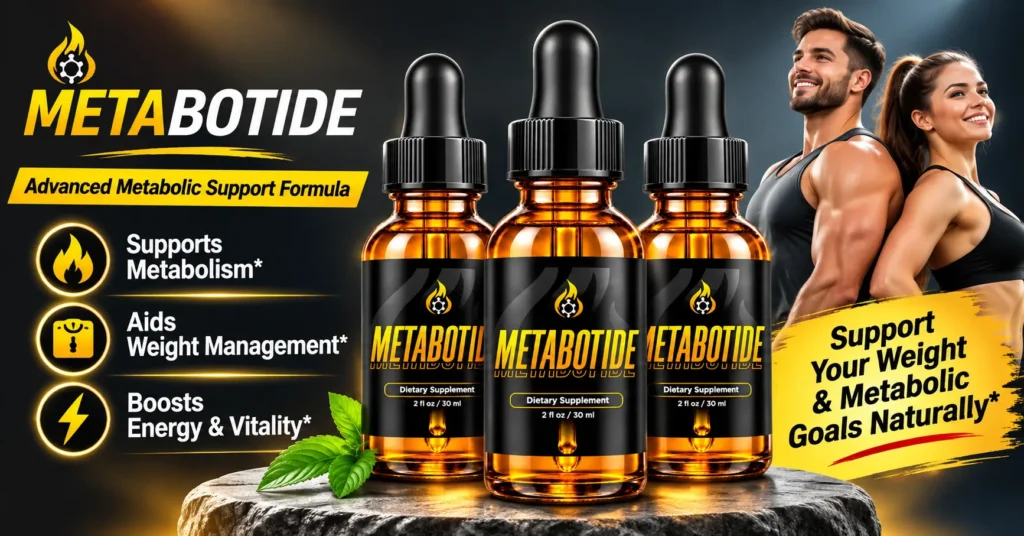
Search “Metabotide scam” and you will find near-identical reviews, several domains each calling itself official, and very little hard dosing data. This guide covers what is actually disclosed, where sources contradict each other, what the safety risks are, and what to check before you pay.
Short verdict: Metabotide appears to be a real product with a stated refund policy, so it doesn’t look like a fake store that takes money and ships nothing. But part of its formula is hidden inside a proprietary blend, it contains caffeine, the sources disagree on key details, and I found no clinical trial of the finished product. Treat it as an unproven supplement, not a treatment.
Quick Overview
| Metabotide | Quick Overview |
| Product Type | Liquid supplement in a 30 ml amber bottle with a built-in dropper, lemon flavored |
| Formula | Chromium plus African mango, green tea, guarana, maca and grape seed extracts; contains caffeine |
| Key Benefits (claimed) | Metabolic and weight-management support |
| Usage | 1 dropperful daily, preferably in the morning, shake well |
| Customer Ratings | No verified ratings found |
| Price | 3 bottles 177(59 each); 6 bottles 294(49 each) |
| Official Website | official Metabotide Drops Review |

Verdict in brief: a real product with a refund policy, but with partly hidden doses, caffeine and no clinical trial of the finished formula.
What Is Metabotide?
Metabotide Drops is described as a lemon-flavored liquid supplement in a 30 ml amber glass bottle with a built-in dropper. Another page lists it as a once-daily liquid containing chromium plus African mango, green tea, guarana, maca and grape seed extracts, taken as one dropperful, preferably in the morning, and says it contains caffeine.
It is marketed for metabolic and weight-management support. That wording matters. A dietary supplement can’t legally claim to treat disease, and “support” is not the same as proven weight loss. Any page promising dramatic results from drops alone is going beyond what the evidence allows.
Metabotide Ingredients
Here is what the pages disclose. Amounts weren’t visible, so confirm them on your bottle.
The proprietary blend problem: the label gives one total weight but not each ingredient’s dose. A 200 mg blend of five extracts averages at most 40 mg each, and the real split could be uneven. You can’t compare it with research doses or check interactions properly.
Potential Benefits Of Metabotide
The evidence, ingredient by ingredient, is weak. Metabotide itself has no published trial that I could find.
- Chromium: NIH’s fact sheet says it may help people lose a very small amount of weight and body fat. Harvard’s Nutrition Source says chromium supplements haven’t been found to produce significant weight loss.
- Overall category: The U.S. Government Accountability Office concluded that little is known about whether weight-loss supplements are effective, and some have been associated with potential harm.
- Multi-ingredient formulas: NIH notes most contain several ingredients, which makes it hard to isolate the effect of each or predict the combination.
Realistic expectation: any effect is likely small and varies from person to person.
Pros & Cons
- Stated 60-day refund policy
- Easy-to-use liquid format
- Distributor named on at least one page
- Priced at $49 per bottle on the 6-pack
- Partly undisclosed doses in a proprietary blend
- Contains caffeine, amount unknown
- Several “official” domains with conflicting details
- No finished-product clinical trial found
- U.S.-only shipping; shipping charge not found
Does it work? A benchmark for evidence
I found no published clinical trial of Metabotide as a finished product. Individual ingredients have been studied, but that isn’t the same thing.
To see what strong evidence looks like, compare AREDS2, a large National Eye Institute-sponsored trial of an eye-health formula. Its formula is vitamin C 500 mg, vitamin E 400 IU, lutein 10 mg, zeaxanthin 2 mg, zinc 80 mg and copper 2 mg. It has a demonstrated benefit in slowing progression in people who already have intermediate or advanced age-related macular degeneration, not in preventing it. It also shows how safety data shapes a formula: AREDS2 tested replacing beta-carotene with lutein and zeaxanthin because beta-carotene had been linked to increased lung cancer risk in smokers.
That is the standard to hold a supplement against: named doses, a defined condition, a tested formula and safety follow-up. Metabotide, as described, has partly hidden amounts, a vague goal and no trial of the whole product. This doesn’t prove it fails. It means you are relying on marketing rather than evidence.
How to Use Metabotide
The directions on one page: shake well and take one dropperful daily, preferably in the morning. Follow the directions on the label you receive, since I couldn’t verify the dropper volume. Avoid taking it late in the day because of the caffeine.
Are There Any Side Effects?
No product-specific side-effect data was found, so these are ingredient-level risks.
- Caffeine and stimulants: jitters, racing heart, anxiety, insomnia, especially with coffee or energy drinks.
- Green tea extract and the liver: NIH’s LiverTox says green tea extract, and more rarely large amounts of green tea, have been implicated in clinically apparent acute liver injury, including acute liver failure. Drinking ordinary green tea hasn’t been associated with liver injury. An NIH-linked study judged the injury idiosyncratic and immune-mediated. It is considered rare, and whether Metabotide’s dose is high isn’t known.
- Chromium: can affect blood sugar, so ask a doctor if you take diabetes medication.
- Medications: check with a doctor or pharmacist if you take blood pressure, thyroid, stimulant or blood-thinning drugs.
- Avoid if pregnant, nursing, under 18, caffeine-sensitive, or with heart rhythm or liver problems.
- Stop and get care for chest pain, palpitations, vomiting, dark urine or yellowing skin.
Is Metabotide a Scam or Legit?
Based on what I found, it doesn’t look like a fake store. There is a named distributor, ShippingCaps in Largo, Florida, with a support email, and a stated refund policy. But caution is warranted
Several “official” domains: Buy only from the checkout the seller confirms.
- Conflicting guarantee: one review site claims 180 days, while the seller pages say 60
- Conflicting servings: a third-party eBay listing describes “60 Serv” at $37.77 each, which doesn’t obviously match a one-dropperful-a-day directions.
Legit means “real product, real policy.” It does not mean “proven to work.”
Metabotide Customer Reviews & Complaints
I found no verifiable customer reviews. Metabotide’s own pages say they have no customer reviews, by design. One affiliate site shows named testimonials labeled “Verified Purchase,” but I couldn’t verify them and wouldn’t rely on them. Before buying, search Trustpilot, Reddit and the Better Business Bureau for complaints about refunds, shipping and billing, and weigh patterns over individual stories
Is It Worth Trying?
Possibly, if you are a healthy adult who tolerates caffeine, already eats well and moves regularly, and you’ve confirmed the label, seller and refund terms.
Probably not if you need exact doses, take prescription medication, are pregnant, have a liver or heart condition, or hope for a replacement for diet, activity or medical care. Habits with stronger evidence include enough protein and fiber, regular walking and strength training, and good sleep.
60 Days Money-Back Guarantee
The seller’s page says every order is covered by a 60-day money-back guarantee, and that you must contact support within 60 days of purchase for a refund according to its Refund Policy.
Check before buying:
- Do you have to return bottles, and who pays shipping?
- Do opened or used bottles qualify?
- Do the 60 days start at order or delivery?
- Are shipping fees refunded?
Screenshot your order and the refund terms on purchase day.
Metabotide Pricing
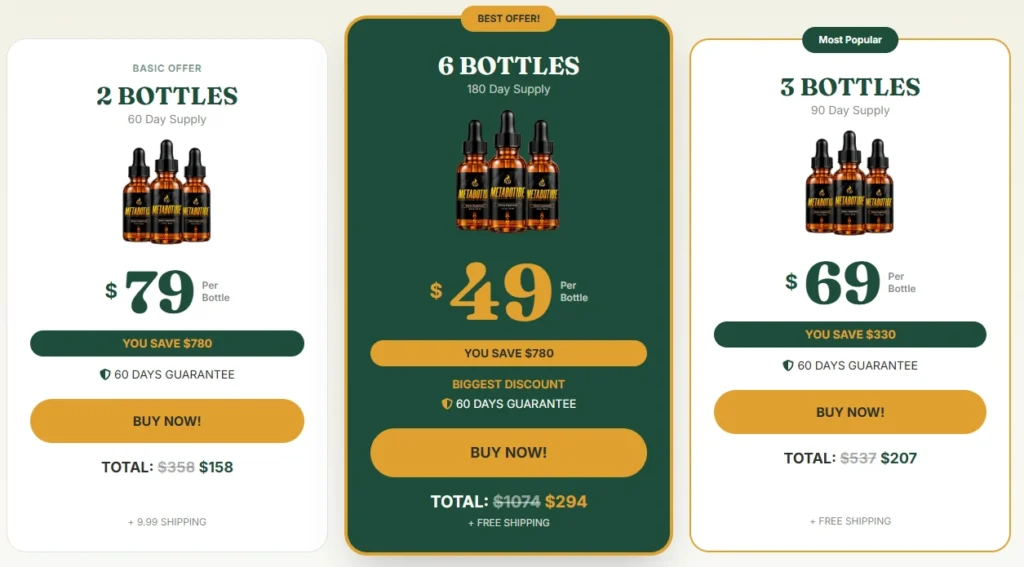
I didn’t find a shipping charge, so confirm the final total at checkout. Try one bottle before committing to a 6-pack if you can.
Limits of the guarantee to check:
- Whether you must return bottles and who pays return shipping
- Whether opened or used bottles qualify
- Whether the 60 days run from order date or delivery
- Whether shipping fees are refunded
- How fast refunds are processed, and how to reach support
Remember that the 6-bottle price only makes sense if you tolerate the product. Buying a big pack before trying one bottle raises your risk if you react badly or see no benefit.
A practical pre-purchase checklist
- Get the full Supplement Facts panel as an image, not a text summary.
- Ask support for the caffeine amount and the per-ingredient doses in the blend.
- Confirm the seller name, address and refund policy in writing.
- Screenshot the order page, price and guarantee on purchase day.
- Check that the site is on the domain your confirmation email uses.
- Talk to your doctor if you take any medication.
- Start with the smallest pack you can, and stop if you feel unwell.
Where to Buy Metabotide
Use the official checkout your seller or this page links to, and confirm the seller name against the distributor listed on the label. Be careful with marketplace resellers: you can’t check storage conditions or batch dates, and the seller’s refund policy may not apply.
Conclusion
Metabotide appears to be a real liquid supplement with a stated 60-day refund policy, not an obvious fake store. The cautions are real: part of the formula is hidden in a proprietary blend, caffeine content is unknown, the evidence for the ingredients is weak, and the sources disagree on the guarantee length and serving counts. It’s a “verify everything first” product.
Frequently Asked Questions
Is Metabotide a scam?
It doesn’t look like a fake store, but unverified testimonials, multiple “official” domains and hidden doses justify caution.
Does Metabotide contain caffeine?
Yes, according to its own pages. The amount wasn’t found.
Does Metabotide really work for weight loss?
No finished-product trial was found. Ingredient evidence is limited and small.
Is it FDA approved?
Supplements aren’t FDA-approved before sale. These statements have not been evaluated by the Food and Drug Administration. This product is not intended to diagnose, treat, cure or prevent any disease.
How long does a bottle last?
It depends on the dropper volume. Confirm with support, since sources conflict.
What if I’m not satisfied?
Contact support within the refund window and keep your order proof.
Science Research and Sources
- NIH Office of Dietary Supplements, Dietary Supplements for Weight Loss (health professional fact sheet): https://ods.od.nih.gov/factsheets/weightloss-healthprofessional
- NIH Office of Dietary Supplements, Chromium fact sheets: https://ods.od.nih.gov/factsheets/Chromium-Consumer
- Harvard T.H. Chan School of Public Health, Chromium: https://nutritionsource.hsph.harvard.edu/chromium
- NIH LiverTox, Green Tea: https://ncbi.nlm.nih.gov/books/NBK547925
- NIDDK, Green tea-associated liver injury (DILIN study): https://repository.niddk.nih.gov/publications/222

Noah Ross
Health & Wellness Writer
Better Health Focus
Expertise
Weight Management • Gut Health • Nutrition • Metabolic Health • Healthy Lifestyle • Mental Wellness • Preventive Health • Dietary Supplement Research • Evidence-Based Health Education
About Noah Ross
Noah Ross is a Health & Wellness Writer at Better Health Focus, where he creates evidence-based educational content focused on helping readers make informed decisions about their health. His work covers weight management, gut health, nutrition, metabolism, preventive wellness, and healthy lifestyle strategies.
With a background in health communication, Noah specializes in translating complex medical research into clear, practical, and easy-to-understand articles. He believes reliable health information should be accessible to everyone without relying on sensational claims or misleading marketing.
Before publishing an article, Noah reviews scientific literature and guidance from respected health organizations, including the National Institutes of Health (NIH), PubMed, the World Health Organization (WHO), the Centers for Disease Control and Prevention (CDC), the Office of Dietary Supplements (ODS), and other peer-reviewed medical journals. His writing emphasizes transparency by distinguishing well-established scientific evidence from preliminary findings and promotional claims.
At Better Health Focus, Noah regularly researches topics related to digestive wellness, metabolism, healthy eating, blood sugar management, dietary supplements, weight loss strategies, healthy aging, and preventive healthcare. His content is designed to help readers understand both the potential benefits and limitations of current scientific evidence while encouraging realistic expectations and sustainable lifestyle habits.
Education
Bachelor of Arts (B.A.) in Communications
Professional Development
- Continuing education in Nutrition Science and Public Health
- Ongoing study of evidence-based medicine and clinical research
- Regular review of peer-reviewed research related to nutrition, metabolism, obesity, digestive health, and preventive medicine
- Continuous monitoring of updates from major public health organizations and medical research databases
Areas of Focus
- Weight Loss & Healthy Weight Management
- Gut Microbiome & Digestive Wellness
- Nutrition & Healthy Eating
- Blood Sugar & Metabolic Health
- Mental Wellness & Lifestyle Habits
- Preventive Health Education
- Dietary Supplement Reviews
- Evidence-Based Wellness Research
Editorial Standards
Every article written by Noah Ross follows the editorial standards of Better Health Focus. Content is developed using current scientific evidence, reputable medical references, and trusted public health resources whenever applicable.
Each article is written with a commitment to:
- Accuracy and factual reporting
- Evidence-based health education
- Transparent discussion of scientific findings
- Balanced coverage of benefits, risks, and research limitations
- Clear, reader-friendly language
- Compliance with Google E-E-A-T principles for health content
Noah avoids unsupported health claims, miracle cures, and exaggerated promises. When evidence is limited or still emerging, that uncertainty is clearly communicated so readers can make informed decisions based on the best available research.
Research Sources
Articles may reference information from organizations and databases such as:
- National Institutes of Health (NIH)
- PubMed
- World Health Organization (WHO)
- Centers for Disease Control and Prevention (CDC)
- Office of Dietary Supplements (ODS)
- U.S. Department of Agriculture (USDA)
- American Heart Association (AHA)
- Peer-reviewed scientific journals
Editorial Disclaimer
The information published by Noah Ross on Better Health Focus is intended for educational and informational purposes only. It should not be considered medical advice and is not a substitute for consultation with a qualified physician or other licensed healthcare professional. Readers should seek professional medical guidance before making decisions regarding diagnosis, treatment, medications, supplements, or significant lifestyle changes.