
Table of Contents
Introduction
If you are following a recipe, tracking your daily sugar intake, or checking nutritional information, you may wonder: how many grams of sugar in a teaspoon?
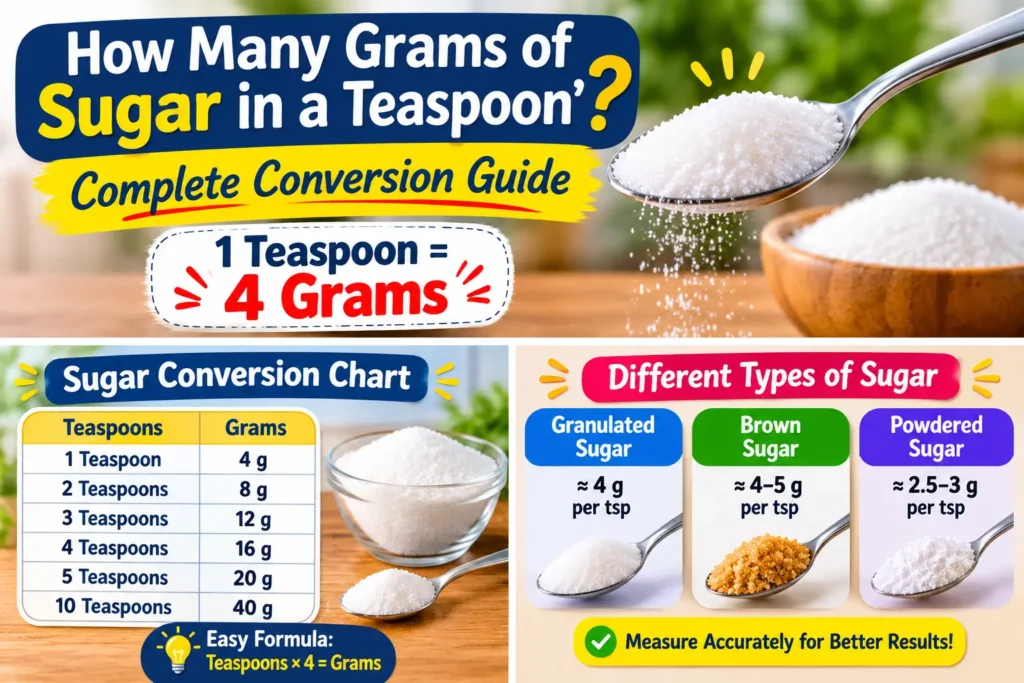
A standard level teaspoon of granulated white sugar contains approximately 4 grams of sugar. This is a useful kitchen conversion for measuring ingredients, calculating calories, and understanding the amount of added sugar in everyday foods and drinks.
Although 4 grams is the commonly used conversion, the actual weight can vary depending on the type of sugar, how tightly it is packed, and the size of the measuring spoon.
Understanding this simple measurement can make cooking easier and help you become more aware of your daily sugar consumption.
In this guide, you will learn about teaspoon-to-gram conversions, different types of sugar, accurate measuring techniques, and the importance of understanding sugar intake.
Quick Answer: How Many Grams of Sugar Are in a Teaspoon?
One level teaspoon of granulated white sugar weighs approximately 4 grams.
Here is a quick reference:
- 1 teaspoon of sugar = approximately 4 grams
- 2 teaspoons of sugar = approximately 8 grams
- 3 teaspoons of sugar = approximately 12 grams
- 4 teaspoons of sugar = approximately 16 grams
- 1 tablespoon of sugar = approximately 12 grams
These measurements are estimates based on granulated sugar. Actual weights may differ slightly depending on the sugar type and measuring technique.
For everyday cooking and nutrition calculations, using 4 grams per teaspoon is a convenient and practical method.
Understanding Sugar Measurements: Teaspoons, Tablespoons, and Grams
Before converting sugar measurements, it helps to understand the difference between teaspoons, tablespoons, and grams.
These units are commonly used in recipes, nutrition labels, and cooking instructions.
Teaspoon (tsp)
A teaspoon is a small unit of volume commonly used for measuring ingredients such as sugar, salt, spices, and baking powder.
One standard US teaspoon holds approximately 5 milliliters of liquid. When measuring granulated sugar, this volume weighs approximately 4 grams.
Tablespoon (tbsp)
A tablespoon is larger than a teaspoon and is frequently used in cooking and baking.
One standard US tablespoon equals 3 teaspoons or approximately 15 milliliters.
For granulated sugar, one tablespoon weighs approximately 12 grams.
Grams (g)
A gram is a metric unit used to measure weight or mass.
Unlike teaspoons and tablespoons, which measure volume, grams measure how much an ingredient weighs.
This difference matters because different ingredients have different densities. A teaspoon of sugar does not weigh the same as a teaspoon of flour or honey.
For greater accuracy, particularly when baking, a digital kitchen scale is recommended.
Sugar Conversion Chart: Teaspoons to Grams
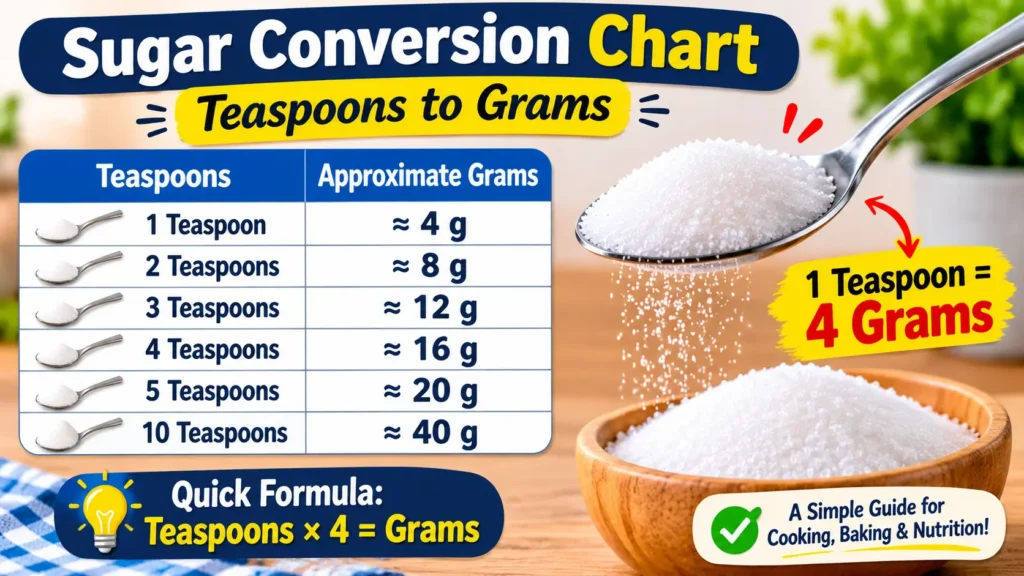
If you want to convert teaspoons into grams quickly, the following chart provides convenient estimates for granulated white sugar.
| Teaspoons | Approximate Sugar Weight |
|---|---|
| 1 teaspoon | 4 grams |
| 2 teaspoons | 8 grams |
| 3 teaspoons | 12 grams |
| 4 teaspoons | 16 grams |
| 5 teaspoons | 20 grams |
| 10 teaspoons | 40 grams |
Easy conversion formula:
Teaspoons × 4 = Approximate grams of granulated sugar.
For example:
If a recipe requires 5 teaspoons of sugar:
5 × 4 = 20 grams.
Therefore, 5 teaspoons of granulated sugar equal approximately 20 grams.
This simple formula is useful when adjusting recipes or converting kitchen measurements into metric units.
How Much Does One Teaspoon of Different Types of Sugar Weigh?
Not all types of sugar have exactly the same weight. Their texture, particle size, moisture content, and packing density can affect how much fits into a teaspoon.
Here are approximate kitchen estimates:
1. Granulated White Sugar
Granulated white sugar is commonly used in tea, coffee, desserts, cakes, and everyday cooking.
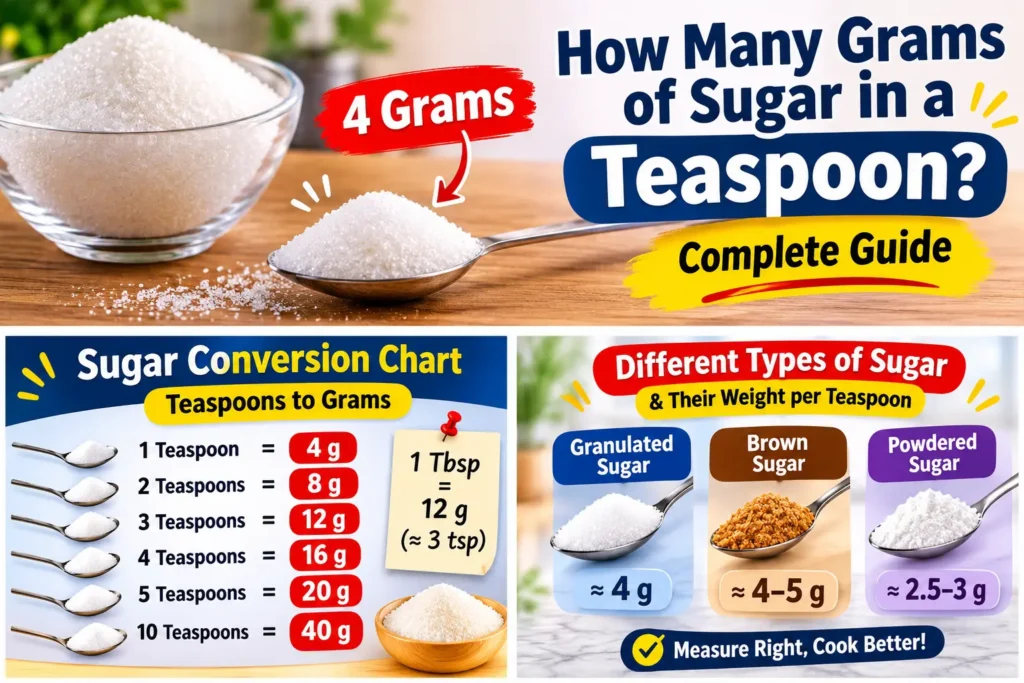
One level teaspoon weighs approximately 4 grams.
Its relatively consistent particle size makes it convenient for measuring and converting into grams.
2. Brown Sugar
Brown sugar contains molasses, which gives it a darker color and a moist texture.
One teaspoon of brown sugar may weigh approximately 4–5 grams, depending on whether it is loosely spooned or firmly packed.
Recipes often specify packed brown sugar because the amount can change significantly depending on how tightly it is pressed into the measuring spoon.
3. Powdered Sugar
Powdered sugar, also called confectioners’ sugar or icing sugar, has a fine, powder-like texture.
One teaspoon generally weighs approximately 2.5–3 grams, depending on the product and whether it has been sifted.
Because powdered sugar is less dense by volume than granulated sugar, it usually weighs less in the same measuring spoon.
Important: These figures are approximate kitchen estimates, not universal fixed weights. Always check the product packaging or use a kitchen scale when an exact measurement is necessary.
How to Measure Sugar Accurately
Accurate sugar measurement is important for achieving consistent results in cooking and baking.
Here are some practical tips to help you measure sugar correctly.
1. Use Standard Measuring Spoons
Use a proper measuring teaspoon instead of an ordinary eating spoon.
Household spoons can have different sizes, making them less reliable for measuring ingredients.
2. Level the Sugar
For granulated sugar, fill the measuring spoon and remove the excess with a straight edge, such as a butter knife.
This creates a level teaspoon and helps maintain consistency.
3. Avoid Packing Granulated Sugar
Granulated white sugar should generally be measured loosely and leveled unless the recipe specifically says otherwise.
Brown sugar is different because some recipes require it to be packed.
4. Use a Digital Kitchen Scale
A digital kitchen scale is one of the most reliable ways to measure sugar.
Instead of estimating the weight using a spoon, you can measure the exact number of grams required by your recipe.
5. Follow Recipe Instructions
Pay attention to whether the recipe specifies level, rounded, or packed measurements.
Following the correct instructions helps prevent differences in sweetness and baking results.
Why Do Sugar Measurements Matter?
Knowing how much sugar you are using is useful for several everyday activities.
Baking and Cooking
Sugar contributes more than sweetness to baked products. It can influence texture, moisture retention, browning, and the overall structure of certain recipes.
Using too much or too little sugar may change the final result.
For this reason, accurate measurements are particularly useful when preparing cakes, cookies, pastries, and desserts.
Nutrition Tracking
People who monitor their food intake may need to understand how many grams of sugar they consume throughout the day.
Knowing that one teaspoon of granulated sugar equals approximately 4 grams makes it easier to estimate sugar quantities.
For example, adding three teaspoons of sugar to a beverage contributes approximately 12 grams of sugar.
Understanding Food Labels
Packaged foods often display sugar quantities in grams.
Knowing the teaspoon-to-gram conversion helps you understand what those numbers represent in everyday terms.
For example:
- 4 grams of sugar = approximately 1 teaspoon.
- 8 grams of sugar = approximately 2 teaspoons.
- 12 grams of sugar = approximately 3 teaspoons.
- 20 grams of sugar = approximately 5 teaspoons.
This can make nutritional information easier to understand when comparing different food products.
Sugar and Daily Health: What Should You Know?
Sugar is commonly found in fruits, milk, sweetened beverages, desserts, and many packaged foods.
However, it is important to understand the difference between naturally occurring sugars and added sugars.
Naturally Occurring Sugar
Naturally occurring sugars are present in foods such as whole fruits and plain milk.
These foods also provide other nutrients, including vitamins, minerals, and, in the case of whole fruits, dietary fiber.
Added Sugar
Added sugars are introduced during food preparation or manufacturing.
Common examples include:
- White table sugar
- Brown sugar
- Sugar added to tea and coffee
- Sweetened soft drinks
- Cakes and cookies
- Sweetened breakfast cereals
- Syrups and sweetened desserts
The US Food and Drug Administration (FDA) explains that added sugars are listed separately on Nutrition Facts labels to help consumers understand how much sugar has been added to a product.
What Are the Recommended Added Sugar Limits?
According to the FDA, the Daily Value for added sugars is 50 grams per day, based on a 2,000-calorie daily diet.
The FDA also explains that the Dietary Guidelines for Americans recommend limiting added sugars to less than 10% of total daily calories for people aged two years and older.
The World Health Organization (WHO) recommends keeping free sugar consumption below 10% of total daily energy intake. It also suggests that reducing this amount to below 5% may provide additional health benefits.
These recommendations refer to added or free sugars, not all naturally occurring sugars in whole foods.
Practical Ways to Monitor Sugar Intake
You can become more aware of your sugar consumption by following a few simple habits:
- Check the added sugars section on packaged food labels.
- Measure sugar before adding it to tea or coffee.
- Compare the sugar content of similar products.
- Choose water instead of sugary drinks more often.
- Reduce the amount of added sugar gradually when preparing homemade food.
The goal is to understand your eating habits and make informed food choices rather than relying on guesswork.
Frequently Asked Questions About Sugar Measurements
1. How many grams are in 1 teaspoon of sugar?
One level teaspoon of granulated white sugar contains approximately 4 grams. The actual weight can vary slightly depending on the sugar type and measuring method.
2. How many grams are in 2 teaspoons of sugar?
Two teaspoons of granulated sugar contain approximately 8 grams.
3. How many grams are in 3 teaspoons of sugar?
Three level teaspoons of granulated sugar equal approximately 12 grams.
4. How many teaspoons are in 10 grams of sugar?
Ten grams of granulated sugar equal approximately 2.5 teaspoons.
5. How many teaspoons are in 20 grams of sugar?
Twenty grams of granulated sugar equal approximately 5 teaspoons.
6. Is 4 grams of sugar equal to one teaspoon?
Yes. Four grams is the commonly used approximate conversion for one level teaspoon of granulated white sugar.
7. Does brown sugar weigh the same as white sugar?
Not necessarily. Brown sugar contains molasses and has a different moisture content. Its weight depends on how tightly it is packed into the measuring spoon.
Conclusion: How Many Grams of Sugar in a Teaspoon?
Understanding how many grams of sugar in a teaspoon is a simple but useful way to improve your cooking measurements and become more aware of your daily sugar consumption.
The standard conversion for granulated white sugar is approximately 4 grams per level teaspoon. This means two teaspoons contain around 8 grams, five teaspoons contain around 20 grams, and ten teaspoons contain around 40 grams.
Remember that different sugar varieties have different densities, so their actual weights may vary.
For everyday cooking, the 4-gram conversion is a convenient reference. For more precise baking and nutritional calculations, use a digital kitchen scale and check the nutritional information on food packaging.
Small measurement differences can make a difference in recipes and help you better understand what you consume.
Authoritative References
For additional information about sugar measurements, nutrition labels, and recommended sugar intake, consult these reliable resources:
- USDA FoodData Central: https://fdc.nal.usda.gov/
- US Food and Drug Administration (FDA) – Added Sugars: https://www.fda.gov/food/nutrition-facts-label/added-sugars-nutrition-facts-label
- World Health Organization (WHO) – Healthy Diet: https://www.who.int/news-room/fact-sheets/detail/healthy-diet
- Harvard T.H. Chan School of Public Health – Added Sugar: https://nutritionsource.hsph.harvard.edu/carbohydrates/added-sugar-in-the-diet/

Better Health Focus Team
Health, Wellness & Supplement Research Team
The Better Health Focus Team researches and reviews health, wellness, nutrition, and dietary supplement products. Our goal is to provide readers with clear, practical, and research-informed information before they make a purchasing decision.
Our reviews examine product ingredients, potential benefits, usage instructions, available scientific research, customer feedback, pricing, refund policies, and manufacturer claims. We also look at potential limitations and highlight claims that may require additional evidence.
We believe supplement information should be presented realistically—not through exaggerated promises. Where scientific evidence is limited or conflicting, we make that clear so readers can make more informed decisions.
Areas We Cover:
Dietary Supplement Reviews
Nutrition & Wellness
Ingredient Research
Product Benefits & Potential Side Effects
Customer Reviews & Complaints
Pricing & Money-Back Policies
Evidence-Based Health Information
Editorial Approach: Our content is based on information available from reputable scientific, government, manufacturer, and consumer sources. Supplement reviews are informational and should not replace advice from a qualified healthcare professional.
Affiliate Disclosure: Some articles may contain affiliate links. If a reader purchases a product through one of these links, Better Health Focus may receive a commission at no additional cost to the reader. This does not determine how we evaluate or describe products.