
Quick answer: The 5/3/1 Boring But Big (BBB) program is a high-volume assistance template for Jim Wendler’s 5/3/1 system. After your main 5/3/1 sets, you perform 5 sets of 10 reps of the same lift at 50–60% of your training max, building strength and muscle size at the same time.
Table of Contents
What Is the 5/3/1 Boring But Big (BBB) Program?
Boring But Big (BBB) is the most widely used assistance template built on top of Jim Wendler’s original 5/3/1 strength program. Instead of adding a rotating menu of accessory lifts after your main work, BBB has you take the same main lift you just trained — squat, bench press, deadlift, or overhead press — and hit it again for 5 sets of 10 reps at a lighter percentage of your training max.
The logic is simple: your 5/3/1 main sets build strength through low-rep, high-intensity work, and the 5×10 supplemental volume builds muscle mass, work capacity, and technical repetition under load. The name comes directly from Wendler — it’s “boring” because there’s no variety or gimmick involved, and “big” because of the sheer training volume and the size gains it reliably produces.
BBB has become one of the most searched Wendler program boring but big variations precisely because it strips programming down to something almost anyone can run without a coach: pick a lift, hit your 5/3/1 numbers, then do 50 more reps of the same movement at lighter weight. It has been used by recreational lifters, some university strength and conditioning programs, and countless online lifting communities as a reliable bridge between pure strength training and hypertrophy-focused bodybuilding work.
Where BBB Fits in the 5/3/1 Ecosystem
Wendler’s 5/3/1 book and its follow-up, Beyond 5/3/1, contain dozens of assistance templates — First Set Last (FSL), Building the Monolith, Widowmaker sets, and more. BBB is generally considered the entry point: it’s the simplest to program, the easiest to understand, and the template most coaches recommend to lifters running 5/3/1 for the first time who want a size and strength hybrid rather than a pure-strength or pure-hypertrophy focus.
How the 5/3/1 BBB Program Works
BBB layers directly onto the standard 5/3/1 structure without changing the underlying main-lift progression. Each training day follows this sequence:
- Warm-up sets — the standard 5/3/1 warm-up ramp, typically 40%, 50%, and 60% of training max for 5 reps each
- Main 5/3/1 work — 3 working sets of your chosen rep scheme (5s week, 3s week, or 5/3/1 week) at increasing percentages of training max
- BBB supplemental work — 5 sets of 10 reps of the same lift, typically at 50–60% of training max
- Optional assistance work — light push, pull, and core movements added at the end of the session, not the focus of the day
Weekly Percentage Breakdown (Main Lift)
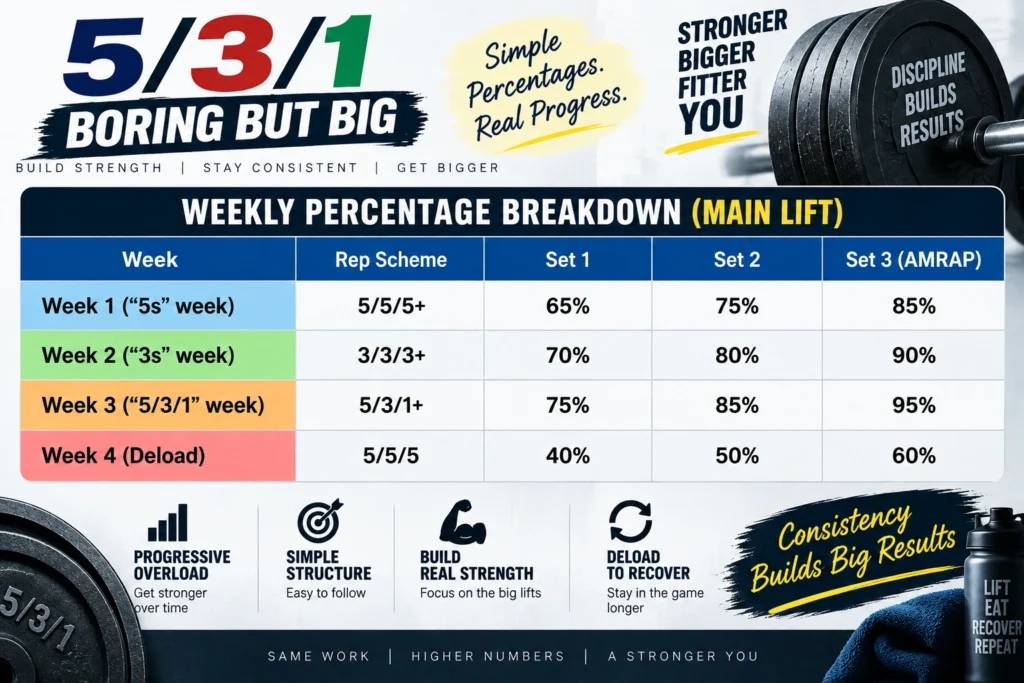
The “+” on the final set means it’s an AMRAP (as many reps as possible) set, a core feature of 5/3/1 used to track strength progress over time.
BBB Supplemental Percentage Progression
The 5×10 sets are performed at a fixed percentage of training max that typically increases cycle over cycle rather than staying static. A common progression looks like this:
- Cycle 1: 50% of training max for 5×10
- Cycle 2: 55% of training max for 5×10
- Cycle 3: 60% of training max for 5×10
- Cycle 4 (deload): back down to 40–50% of training max
Some lifters run BBB with an opposite-lift pairing instead of same-lift volume — for example, pairing bench press main work with 5×10 rows to balance pushing and pulling volume across the week. Both approaches are considered legitimate within the 5/3/1 community; same-lift BBB is the original and by far the most common version discussed online.
Training Max and Percentages Explained
Every percentage in 5/3/1 — including BBB — is calculated from your Training Max (TM), not your true one-rep max. Wendler recommends setting your TM at roughly 90% of your actual or estimated 1RM. This deliberate built-in buffer is a defining feature of the entire 5/3/1 system, including BBB: you’re always working slightly below your true maximum, which keeps bar speed faster, technique cleaner, and joint stress lower even under high accumulated volume.
Because BBB adds 50 extra reps per lift on top of already-demanding main work, using an accurate (not inflated) training max is one of the most important variables for staying injury-free and recovering well between sessions.
Progression on Boring But Big
Progression on BBB happens on two separate tracks running in parallel:
- Main lift progression — after each 4-week cycle, add 5 lbs to upper-body lifts (bench press, overhead press) and 10 lbs to lower-body lifts (squat, deadlift) to your training max.
- Supplemental volume progression — increase the BBB percentage cycle over cycle (e.g., 50% → 55% → 60%) rather than jumping straight into heavy 5×10 work in cycle one, which is where many lifters run into trouble.
This dual progression model — strength increasing on the main lifts while volume tolerance increases on the supplemental work — is exactly why BBB is considered one of the most effective 5/3/1 templates for building strength and muscle mass simultaneously, rather than sacrificing one for the other.
Is Conditioning Necessary When Doing a Boring But Big Program?
Short answer: Yes. Conditioning is not optional on the Boring But Big program — Jim Wendler has repeatedly emphasized it as a required component of 5/3/1, not an afterthought, and BBB’s high training volume makes conditioning even more important than on lower-volume 5/3/1 templates.
This is one of the most frequently searched questions related to the boring but big program, and the answer matters because skipping conditioning entirely tends to backfire in several specific ways:
Why Conditioning Supports BBB Recovery
- Faster recovery between sessions. Low-intensity conditioning — walking, sled drags, easy cycling — increases blood flow to recovering muscle tissue without adding significant fatigue, which actually speeds up recovery from the high rep volume in BBB rather than hindering it.
- Better body composition outcomes. Because BBB is calorie- and volume-demanding, lifters bulking on the program without any conditioning component often gain fat faster than they gain muscle, since total daily activity drops relative to intake.
- Maintained general work capacity. Wendler’s own writing consistently pairs 5/3/1 strength templates with “prowler pushes,” hill sprints, or simple walking programs as a built-in, non-negotiable part of the system — kept light enough that it doesn’t interfere with recovery from the heavier lifting days.
- Cardiovascular health. Pure strength training with zero conditioning work leaves an obvious gap in overall fitness; even minimal conditioning work helps offset this over a multi-month training block.
How Much Conditioning to Add
Practical guidance: 2–3 sessions per week of low-intensity conditioning is generally recommended alongside BBB:
- 20–30 minutes of brisk walking or incline treadmill work
- Easy stationary bike or rowing intervals
- Light sled pushes or drags (20–40 yards, moderate load)
- Prowler pushes at a conversational pace
What to avoid: High-intensity conditioning (sprints, heavy circuit training, hard HIIT sessions) on lifting days or the day immediately before a heavy squat or deadlift session, since it competes directly with recovery from BBB’s already-high rep volume. Save any higher-intensity conditioning for off days, and monitor overall fatigue — if squat or deadlift numbers start slipping week to week, conditioning volume is often the first variable to scale back.
The Bottom Line on Conditioning and BBB
Conditioning isn’t a separate program bolted onto BBB — it’s part of how Wendler designed 5/3/1 to function as a complete training system. Running BBB with zero conditioning is possible, but most coaches and long-term 5/3/1 users report better recovery, better body composition, and better long-term progress by including light, consistent conditioning work 2–3 times per week.
Pros of the 5/3/1 Boring But Big Program
- Simple to program and follow — no guesswork, no exercise-selection fatigue, and no need to plan complex accessory rotations
- Builds strength and hypertrophy simultaneously through the combination of low-rep strength work and high-rep supplemental volume
- Highly customizable — percentages, rep schemes, and lift pairings can all be adjusted to fit individual goals and recovery capacity
- Proven track record — one of the most widely run 5/3/1 templates among intermediate lifters, with adoption in some university strength and conditioning programs
- Built-in deload weeks every fourth week reduce burnout and overtraining risk automatically
- Minimal equipment requirements — a barbell, plates, and a rack are all that’s needed
Cons of the 5/3/1 Boring But Big Program
- High volume can be brutal, especially in the first cycle before the body adapts to 5×10 on squats and deadlifts
- Time-consuming — full sessions with warm-ups, main work, BBB sets, and assistance work often run 60–90+ minutes
- Not ideal for pure strength peaking — the added hypertrophy volume can leave lifters fatigued heading into max-effort or competition work
- Requires patience — like all 5/3/1 templates, BBB produces slow, steady gains rather than rapid short-term results
- Can interfere with conditioning and fat-loss goals if calories and recovery aren’t managed carefully alongside the program
- Repetitive by design — the “boring” in the name is accurate, and lifters who need exercise variety to stay motivated may find it monotonous over multiple cycles
Who Should Run Boring But Big?
BBB is best suited to early-to-intermediate lifters who already have reasonably solid technique on the four main barbell lifts — squat, bench press, deadlift, and overhead press — and want to add muscle mass without abandoning a strength-focused framework.
It’s less ideal for:
- Complete beginners who are still learning barbell technique, since 5×10 at even moderate percentages can reinforce poor form under fatigue
- Advanced powerlifters in a strength-peaking phase close to a meet, where recovery needs to be dedicated almost entirely to the competition lifts
- Lifters in an aggressive calorie deficit, since the accumulated volume is demanding to recover from without adequate food intake
Sample BBB Training Week
| Day | Main Lift (5/3/1) | Supplemental (BBB) | Assistance Work |
| Day 1 | Squat | Squat, 5×10 @ 50–60% TM | Leg curls, core |
| Day 2 | Bench Press | Bench Press, 5×10 @ 50–60% TM | Rows, curls |
| Day 3 | Deadlift | Deadlift, 5×10 @ 50–60% TM | Ab work, back extensions |
| Day 4 | Overhead Press | Overhead Press, 5×10 @ 50–60% TM | Pull-ups, triceps |
Assistance work is intentionally kept light in volume and intensity — it supports recovery and balanced development, but it is never the focus of a BBB session.
Boring But Big FAQ
How long should I run a BBB cycle? Most lifters run BBB for 2–3 full four-week cycles (8–12 weeks total) before switching to a different 5/3/1 template or taking a short deload, since the accumulated volume tends to increase fatigue significantly beyond that point.
What starting BBB percentage should beginners use? Start conservatively at 40–50% of training max, particularly on squats and deadlifts, and only increase the percentage once the volume feels genuinely manageable across a full cycle.
Can I run BBB on a 3-day-per-week schedule? Yes. Many lifters run a 3-day version by rotating the four main lifts across three weekly sessions, though the standard 4-day split (one main lift per day) is the most common and easiest to manage.
Is Boring But Big good for fat loss? It can work in a moderate calorie deficit, but the recovery demands are high. Most coaches recommend running BBB during a maintenance or slight caloric surplus phase rather than an aggressive cut, and pairing it with conditioning work as outlined above.
Do I need to do BBB on every lift, every week? Yes — the standard template applies BBB supplemental sets to whichever main lift you’re training that day, across all four lifts each week, though some lifters choose to run BBB only on select lifts (commonly squat and bench) while using lighter assistance work on the others.
What’s the difference between BBB and First Set Last (FSL)? FSL has you repeat your first main-lift set for additional volume sets (commonly 5×5) rather than a fixed 5×10 at a set percentage. FSL is generally lower in total volume than BBB, making it a common next step for lifters who find BBB too demanding.
References and Resource
- Jim Wendler’s official blog post on Boring But Big: jimwendler.com/blogs/jimwendler-com/101082438-boring-but-big-and-really-sore
- Garage Gym Reviews overview of the 5/3/1 system: garagegymreviews.com/5-3-1-workout

Better Health Focus Team
Health, Wellness & Supplement Research Team
The Better Health Focus Team researches and reviews health, wellness, nutrition, and dietary supplement products. Our goal is to provide readers with clear, practical, and research-informed information before they make a purchasing decision.
Our reviews examine product ingredients, potential benefits, usage instructions, available scientific research, customer feedback, pricing, refund policies, and manufacturer claims. We also look at potential limitations and highlight claims that may require additional evidence.
We believe supplement information should be presented realistically—not through exaggerated promises. Where scientific evidence is limited or conflicting, we make that clear so readers can make more informed decisions.
Areas We Cover:
Dietary Supplement Reviews
Nutrition & Wellness
Ingredient Research
Product Benefits & Potential Side Effects
Customer Reviews & Complaints
Pricing & Money-Back Policies
Evidence-Based Health Information
Editorial Approach: Our content is based on information available from reputable scientific, government, manufacturer, and consumer sources. Supplement reviews are informational and should not replace advice from a qualified healthcare professional.
Affiliate Disclosure: Some articles may contain affiliate links. If a reader purchases a product through one of these links, Better Health Focus may receive a commission at no additional cost to the reader. This does not determine how we evaluate or describe products.