
Table of Contents
Quick Answer
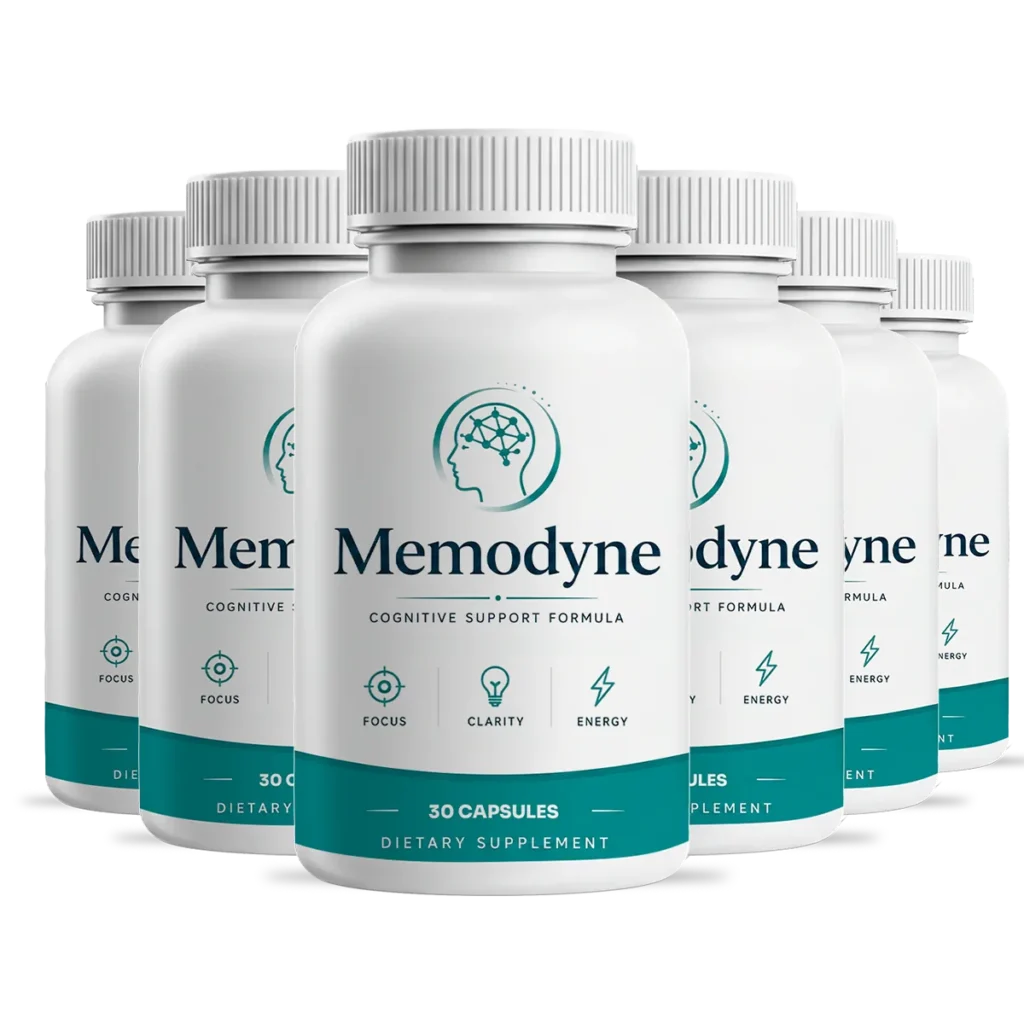
Memodyne is a once-daily vegetarian capsule from Apex Bioceuticals, LLC that takes a circulation-first approach to cognitive support — it’s built around nitric oxide precursors (L-Arginine and L-Citrulline) plus Beta-Alanine and Niacinamide, rather than caffeine or the bacopa/ginkgo-style herbal stack most memory supplements use. Based on its published batch documentation, disclosed dosing, and refund terms, Memodyne appears to be a legitimately manufactured product. It is not clinically proven to improve memory — no published trial has tested the finished formula itself — and results, where reported, build gradually over several weeks rather than immediately.
Memodyne Reviews | Quick Overview
| Product Type | Once-daily cognitive support capsule, built around cerebral blood flow rather than stimulation |
| Natural Formula | Yes — L-Arginine, L-Arginine AKG, L-Citrulline HCl, L-Citrulline Malate, Beta-Alanine, Niacinamide, Calcium; 665.5 mg active yield, zero caffeine |
| Key Benefits | Positioned to support memory recall, sustained focus, and afternoon mental stamina via cerebral microcirculation — see full breakdown below |
| Usage | One vegetarian capsule daily with 8 oz of water, ideally alongside breakfast |
| Customer Ratings | Brand reports 4.86/5 across 24,819 buyers on its own site as of September 2026 — this is a manufacturer-reported figure, not an independently audited score (see note below) |
| Price | $49/bottle on the 6-bottle pack, up to $79/bottle on the 2-bottle pack, against a stated $179 single-bottle retail price |
| Official Website | See current Memodyne pricing |
A note on that ratings figure: we’d rather be upfront that this number comes from the manufacturer’s own website than present it as if it were pulled from an independent platform like Trustpilot. Treat it as the brand’s self-reported customer data, not third-party-verified.
What Is Memodyne?
Memodyne is a once-daily dietary supplement in vegetarian capsule form, distributed by Apex Bioceuticals, LLC out of Seattle, Washington. It’s positioned in the cognitive health category — memory recall, focus, and mental stamina — but its formulation strategy is unusual for that category: rather than leaning on the familiar herbal nootropic stack (bacopa monnieri, ginkgo biloba, lion’s mane) or a caffeine-based stimulant approach, Memodyne is built entirely around supporting blood flow to the brain.
Each bottle holds a 30-day supply, with a single capsule taken each morning. The manufacturer publishes a documented production batch (MMD/26-0814-C for the current 2026 cycle) along with third-party lab testing from Cascadia BioAnalytical Laboratories, an ISO/IEC 17025-accredited facility, and manufactures in an FDA-registered, cGMP-compliant U.S. facility. As with every dietary supplement sold in the U.S., it carries the standard FDA disclaimer: statements about it haven’t been evaluated by the FDA, and it isn’t intended to diagnose, treat, cure, or prevent any disease.
Who Memodyne Is Actually Built For
Memodyne is aimed at adults — the brand’s own messaging skews toward people in their 40s, 50s, and 60s — who notice the everyday, gradual kind of cognitive friction: more “tip-of-the-tongue” moments, a foggy stretch after lunch, or difficulty holding focus through a long afternoon of meetings or detailed work. It’s not marketed toward, and isn’t appropriate for, anyone managing a diagnosed cognitive condition like dementia or Alzheimer’s disease — that’s squarely a conversation for a neurologist or physician, not a supplement aisle.
It also tends to suit people specifically looking to avoid caffeine-based focus products. If jittery energy, an afternoon crash, or disrupted sleep from stimulant-based nootropics is the problem you’re trying to solve, Memodyne’s non-stimulant approach is the more relevant comparison point than a caffeinated focus blend.
The Science Behind Memodyne: How It’s Meant to Work
Memodyne’s mechanism claim rests on a real, well-established piece of physiology: the brain is roughly 2% of total body weight but consumes about 20% of the body’s oxygen and glucose supply, making it unusually dependent on steady blood flow through its microcapillaries. The formula’s core ingredients — L-Arginine and L-Citrulline — are both nitric oxide precursors. Nitric oxide is the signaling molecule responsible for vasodilation, the relaxing and widening of blood vessels that allows more oxygenated blood to reach tissue, including brain tissue. This pathway is genuinely well-studied in cardiovascular and exercise physiology research, and it’s not a fringe or invented mechanism.
Where the claim gets more speculative is the jump from “supports healthy circulation generally” to “supports memory and focus specifically.” L-Arginine and L-Citrulline research is concentrated in cardiovascular health, blood pressure, and exercise performance contexts — not controlled trials measuring memory or recall in healthy adults. The logic connecting better peripheral and cerebral circulation to sharper cognition is reasonable and consistent with how these ingredients are generally understood to work, but it’s an extension of existing research, not a direct finding about Memodyne’s effect on memory.
The formula’s secondary ingredients target a different angle: cellular energy. Niacinamide is the direct precursor to NAD+, a coenzyme mitochondria need to generate ATP — relevant because neurons are metabolically demanding cells. Beta-Alanine is included as an intracellular buffer, more commonly associated with exercise endurance research than cognitive studies specifically.
The honest summary: every individual ingredient in Memodyne has real research behind it, but that research is largely about cardiovascular health and exercise performance, not memory or focus in healthy adults. No published clinical trial has tested the finished Memodyne formula itself. That’s standard for this entire supplement category — it isn’t a red flag unique to this brand — but it’s the difference between “plausible mechanism” and “proven outcome,” and it’s worth knowing rather than assuming otherwise.
Memodyne Ingredients: Full Breakdown
Memodyne discloses its complete ingredient panel with exact milligram amounts — no proprietary blend hiding the individual doses, which is worth noting as a transparency point in a category where many competitors don’t disclose exact amounts.
Dual Arginine Complex — 400 mg total 200 mg L-Arginine (free-form base) plus 200 mg L-Arginine AKG (alpha-ketoglutarate, 2:1). This is the primary nitric oxide precursor pairing, intended to support initial vascular dilation.
Dual Citrulline Synergy — 200 mg total 100 mg L-Citrulline HCl plus 100 mg L-Citrulline Malate. Citrulline converts to Arginine in the kidneys and bypasses first-pass liver metabolism, which is the formula’s rationale for pairing it with direct Arginine — the idea being sustained, rather than short-lived, nitric oxide support.
Beta-Alanine — 40 mg An amino acid more commonly studied in exercise-endurance contexts, included here as an intracellular buffering agent framed around resistance to mental fatigue.
Niacinamide — 7.5 mg NE (47% Daily Value) The active form of Vitamin B3, functioning as a precursor to NAD+, a coenzyme central to mitochondrial energy production.
Calcium — 18 mg A minor inclusion (1% DV), not a primary active ingredient in the formula’s stated mechanism.
Total active yield is listed at 665.5 mg per capsule. There is no caffeine, no synthetic stimulant, and the capsules are dairy-free, gluten-free, and non-GMO.
Benefits of Memodyne
Based on the formula’s ingredients and the brand’s stated positioning, here’s what Memodyne is designed to support — framed as intent, not a guaranteed outcome:
- Cerebral blood flow support — the core mechanism, via dual-stage nitric oxide precursors (Arginine and Citrulline).
- Sharper in-the-moment recall — the brand frames this as supporting the blood flow that feeds your brain when you’re trying to pull up a name or detail on the spot, rather than promising a vague “better memory.”
- Sustained afternoon focus — aimed at the mid-afternoon fog many adults describe, without a caffeine mechanism that could disrupt sleep.
- Cellular energy support — via Niacinamide’s role as an NAD+ precursor, relevant to neuronal ATP production.
- No stimulant crash — because there’s no caffeine, the brand positions this as steady support rather than a spike-and-crash pattern.
- Full label transparency — exact milligram dosing per ingredient, rather than an undisclosed proprietary blend total.
How to Use Memodyne
The instructions are simple: one vegetarian capsule daily, taken with 8 oz of water, ideally alongside breakfast. There’s no loading phase and no cycling on and off.
Because the mechanism is framed as cumulative — nitric oxide synthesis and NAD+ replenishment building over consistent daily use — the manufacturer specifically recommends a minimum of 30 consecutive days before judging results, with a fuller picture forming around the 60-day mark. Store the bottle in a cool, dry place away from direct sunlight.
Memodyne Side Effects and Safety
Memodyne is manufactured in an FDA-registered, cGMP-compliant facility, and the brand publishes third-party batch testing results (heavy metals below 0.4 ppm, microbial screening within USP limits). That’s a genuine quality signal, though it doesn’t replace a conversation with your own doctor if any of the following applies to you.
Because the core mechanism is built around nitric oxide and vasodilation, anyone taking blood pressure medication, vasodilators, or blood-thinning medication should talk to a doctor before starting — combining multiple vasodilating compounds, whether from a supplement or a prescription, is the kind of interaction worth checking on rather than guessing about. Niacinamide is generally well-tolerated at the dose used here (7.5 mg), which is modest compared to doses associated with niacin flushing.
The product is not intended for anyone under 18, and pregnant or nursing individuals should consult a physician before use, consistent with standard supplement labeling. If you notice any adverse reaction, stop use and check in with a healthcare provider.
What Realistic Results Look Like
Because Memodyne is built around a cumulative physiological mechanism rather than an immediate stimulant effect, the manufacturer itself sets expectations around a multi-week timeline rather than same-day results.
Days 1–10: Typically an adjustment window. The brand notes that users expecting the immediate jolt of an energy drink are “corrected in week one” — there’s no stimulant kick by design.
Days 10–20: The manufacturer states most users report their first perceptible improvements in mental clarity and reduced afternoon fatigue in this window.
Around day 30 and beyond: Deeper improvements in word recall and sustained focus during demanding tasks are described as consolidating during month two, with the brand recommending a minimum 30-day trial — and evaluating results around day 30 and day 45 rather than day two — before drawing conclusions.
As with any supplement, individual results vary substantially based on baseline health, consistency of use, and factors entirely outside the product — sleep quality, stress, diet, and overall cardiovascular health all influence cognitive performance independently of any capsule.
Memodyne Customer Reviews: What Buyers Report
The manufacturer’s own site reports a 4.86 out of 5 rating across 24,819 verified buyers as of September 2026, drawn from 3,142 written reviews. We want to be precise about what that number is and isn’t: it’s a statistic published by the brand on its own commerce site, not a figure independently audited by a third-party review platform. That doesn’t necessarily mean it’s inaccurate — but it should be read as manufacturer-reported data, the same way you’d treat any company’s self-published satisfaction numbers.
Reviewer accounts published by the brand describe a pattern broadly consistent with the stated timeline: adjustment in the first couple of weeks, followed by reports of reduced afternoon mental fatigue and sharper recall by roughly the three-week mark. Because these testimonials are selected and published by the manufacturer rather than pulled from an independent, unmoderated platform, they should be weighed as anecdotal marketing material rather than verified clinical evidence — a distinction worth keeping in mind regardless of which supplement you’re evaluating.
Memodyne Pricing and Packages
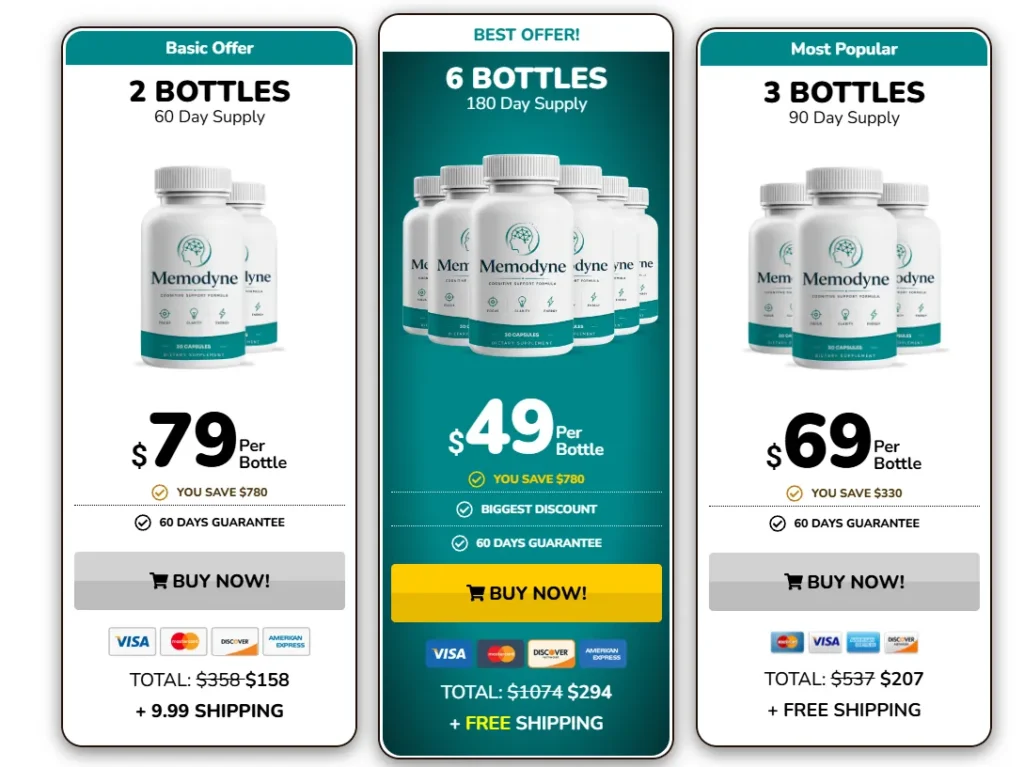
Memodyne is sold in three package sizes, exclusively through the official manufacturer site:
- 2 bottles (60-day supply): $79/bottle, $158 total, standard shipping calculated at checkout
- 3 bottles (90-day supply): $69/bottle, $207 total, free U.S. shipping
- 6 bottles (180-day supply): $49/bottle, $294 total, free U.S. shipping — the manufacturer’s best-value tier, said to be chosen by 68% of repeat buyers
The stated single-bottle retail price is $179, against which all three bundles are discounted. Since the mechanism is designed for sustained, multi-week use, the 3- or 6-bottle options make more practical sense than the 2-bottle starter pack if you’re planning a genuine trial through the full guarantee window. Pricing is subject to change — always confirm current numbers on the official checkout page.
👉 See current Memodyne pricing and package options
The Money-Back Guarantee
Memodyne is backed by a 60-day money-back guarantee starting from the parcel’s arrival date, and — per the manufacturer’s stated policy — does not require returning empty bottles or paying a restocking fee to receive a refund. The brand recommends at least 30 consecutive days of use before evaluating results, which lines up with the guarantee window giving you a full month beyond that minimum to decide.
If you do request a refund, keep your order confirmation and contact the manufacturer’s support desk with time to spare before the 60-day window closes.
Where to Buy Memodyne Safely
Memodyne is sold exclusively through its official website and is explicitly not distributed through Amazon, eBay, Walmart, or other third-party marketplaces, according to the manufacturer. Buying direct is what ties your order to the documented batch (MMD/26-0814-C for the current cycle), the published lab testing, and the 60-day refund window — bottles obtained elsewhere fall outside that chain of custody and aren’t covered by the guarantee.
👉 Check Memodyne’s current bundle pricing
Is Memodyne Legit or a Scam?
Based on what’s publicly documented, Memodyne reads as a legitimately manufactured product rather than an obvious scam. It discloses a real, named distributor (Apex Bioceuticals, LLC) with a physical Seattle address, publishes exact ingredient dosing instead of hiding behind a proprietary blend, documents a specific production batch with third-party lab testing from an accredited facility, and backs orders with a genuine no-hassle refund policy. Those are meaningfully different signals than the pattern you’d see from a fly-by-night operation.
That said, “legitimately manufactured” is a different claim than “clinically proven to work.” No independent, peer-reviewed trial has tested the finished Memodyne formula for memory or cognitive outcomes, the customer rating is self-reported by the brand rather than independently audited, and — as with any supplement — individual results will vary. The fair verdict: this appears to be a real, properly disclosed product built on a plausible (if not directly proven) mechanism, not a scam — but it’s also not a clinically validated memory treatment, and it shouldn’t be evaluated as one.
Pros and Cons
| Pros | Cons |
| Full ingredient disclosure with exact milligram dosing, no hidden proprietary blend | No published clinical trial on the finished Memodyne formula itself |
| Documented production batch with third-party ISO/IEC 17025 lab testing | Core ingredients are studied mainly in cardiovascular/exercise contexts, not memory specifically |
| Made in an FDA-registered, cGMP-compliant U.S. facility | Customer rating is brand-reported, not independently audited |
| No caffeine or stimulants — designed to avoid jitters or a crash | Vasodilating ingredients warrant caution if you’re on blood pressure or blood-thinning medication |
| 60-day money-back guarantee, no empty bottle return required | Effects are gradual — the brand itself recommends a 30-day minimum before judging results |
| No forced subscription or auto-ship, per the manufacturer | Only available through the official site, not retail stores |
| Named manufacturer with a physical U.S. address | Premium pricing relative to single-ingredient supplements |
Memodyne vs. Traditional Nootropic Supplements
Most memory supplements on the market — think bacopa monnieri, ginkgo biloba, lion’s mane, or phosphatidylserine blends — work primarily through neurotransmitter or neuroplasticity pathways: supporting how neurons signal to each other or how the brain forms new connections. Memodyne takes a structurally different route, focused on the vascular delivery system that feeds those neurons in the first place, via nitric oxide precursors rather than herbal neuro-active compounds.
Neither approach has a monopoly on being “more scientific” — both rest on real but indirect research applied to a cognitive use case. The practical difference for a buyer is mechanism, not superiority: if you’ve already tried a caffeine-based focus stack or a bacopa/ginkgo blend without the result you wanted, Memodyne’s circulation-first approach is a genuinely different angle to try, not a repackaged version of the same thing.
👉 Read More Supplement Reviews Check
Frequently Asked Questions
What is Memodyne? Memodyne is a once-daily vegetarian capsule formulated with nitric oxide precursors (L-Arginine, L-Citrulline) plus Beta-Alanine and Niacinamide, designed to support cerebral blood flow, memory recall, and mental stamina without stimulants.
Does Memodyne actually work? The individual ingredients have real research behind them in cardiovascular and exercise contexts, and the underlying mechanism — nitric oxide supporting vasodilation — is scientifically established. However, no clinical trial has tested the finished Memodyne formula specifically for memory or cognitive outcomes in healthy adults, so “does it work for cognition” remains an extension of adjacent research rather than a directly proven claim.
What are the main Memodyne ingredients? L-Arginine (free-form and AKG), L-Citrulline (HCl and Malate), Beta-Alanine, Niacinamide, and a small amount of Calcium, totaling 665.5 mg of active compounds per capsule.
Are there Memodyne side effects? The formula is generally well-tolerated based on its disclosed dosing, but because several ingredients affect blood vessel dilation, anyone on blood pressure or blood-thinning medication should consult a doctor before starting. No caffeine means no stimulant-related side effects like jitters or sleep disruption.
How do you use Memodyne — what’s the dosage? One capsule daily, taken with 8 oz of water, ideally with breakfast. No loading phase or cycling required.
Is Memodyne legit, or is it a scam? Based on its disclosed manufacturer, published batch testing, transparent ingredient dosing, and genuine refund policy, Memodyne presents as a legitimately manufactured supplement rather than a scam. It is not, however, an FDA-approved or clinically proven treatment for memory issues.
How much does Memodyne cost? $79/bottle on the 2-bottle pack, $69/bottle on the 3-bottle pack, and $49/bottle on the 6-bottle pack, against a stated $179 single-bottle retail price.
Is there a Memodyne money-back guarantee? Yes — a 60-day guarantee from the parcel’s arrival date, with no requirement to return empty bottles, according to the manufacturer’s stated policy. Confirm current terms on the official site before ordering.
Where can I buy Memodyne? Exclusively through the official manufacturer website. It is not sold on Amazon, eBay, Walmart, or in retail stores, and purchases from unauthorized sellers aren’t covered by the guarantee.
How long until Memodyne starts working? The manufacturer states most users report initial improvements between days 10 and 20 of continuous use, with fuller effects consolidating around day 30 and beyond. A minimum 30-day trial is recommended before evaluating results.
The Bottom Line
Memodyne stands out in a crowded category mostly for what it isn’t: it’s not a caffeine-loaded stimulant blend, and it’s not hiding its dosing behind a proprietary blend label. It’s a transparently disclosed, circulation-first formula built on a real (if indirectly applied) physiological mechanism, manufactured by a named company with documented batch testing and a genuinely low-risk refund policy.
What it isn’t is a clinically proven memory treatment — nobody has run a trial on this specific formula, and the standout customer rating comes from the brand’s own site rather than an independent source. For adults looking for a non-stimulant, evidence-informed (if not evidence-proven) option to try alongside good sleep, stress management, and general health habits, Memodyne is a reasonable, transparently marketed choice — evaluated with realistic, rather than hyped, expectations.
👉 Get the current Memodyne offer
Sources and Reference
National Institutes of Health
Office of Dietary Supplements (ods.od.nih.gov)
National Center for Complementary and Integrative Health (nccih.nih.gov);
MedlinePlus, U.S. National Library of Medicine (medlineplus.gov);
U.S. Food and Drug Administration (fda.gov).

Better Health Focus Team
Health, Wellness & Supplement Research Team
The Better Health Focus Team researches and reviews health, wellness, nutrition, and dietary supplement products. Our goal is to provide readers with clear, practical, and research-informed information before they make a purchasing decision.
Our reviews examine product ingredients, potential benefits, usage instructions, available scientific research, customer feedback, pricing, refund policies, and manufacturer claims. We also look at potential limitations and highlight claims that may require additional evidence.
We believe supplement information should be presented realistically—not through exaggerated promises. Where scientific evidence is limited or conflicting, we make that clear so readers can make more informed decisions.
Areas We Cover:
Dietary Supplement Reviews
Nutrition & Wellness
Ingredient Research
Product Benefits & Potential Side Effects
Customer Reviews & Complaints
Pricing & Money-Back Policies
Evidence-Based Health Information
Editorial Approach: Our content is based on information available from reputable scientific, government, manufacturer, and consumer sources. Supplement reviews are informational and should not replace advice from a qualified healthcare professional.
Affiliate Disclosure: Some articles may contain affiliate links. If a reader purchases a product through one of these links, Better Health Focus may receive a commission at no additional cost to the reader. This does not determine how we evaluate or describe products.