
Struggling with forgetfulness, brain fog, or trouble staying focused? You’re not alone — these are some of the most common concerns adults raise as they age, and they’ve fueled a booming market of brain-health supplements, many of which promise dramatic results without much science to back them up. MemoHoney positions itself differently: a natural supplement built around supporting healthy blood flow, nitric oxide production, and oxygen delivery to the brain, rather than relying on stimulants or unverified “miracle” claims.
In this MemoHoney review, we take a closer look at what’s actually behind the marketing — breaking down ingredient transparency, manufacturing standards, the science supporting (and not supporting) its claims, real customer feedback, and overall value for money — so you can decide whether it’s worth trying for yourself.
To get a fuller picture beyond the brand’s own marketing, we also looked at MemoHoney discussions and complaints from independent, third-party sources — including Reddit threads, Facebook groups, Quora questions, and other consumer forums — to see how the product holds up in unfiltered, real-world conversations.
Table of Contents
Quick Overview
| Product Type | Nitric-oxide/amino-acid based dietary capsule marketed for memory, focus and cognitive wellness |
| Natural Formula | Yes — plant-derived amino acids, B-vitamin, and (in some formulations) botanical antioxidants; stimulant-free, no caffeine |
| Key Benefits (as marketed) | Supports memory recall, mental clarity, focus, cerebral blood flow, reduced brain fog |
| Usage | One capsule daily, taken consistently for several weeks before effects are claimed to build |
| Customer Ratings | Brand-affiliated pages cite 4.85–4.98/5 from 2,000–2,500+ reviews; independent Trustpilot listing shows only 2 reviews — a gap worth noting before trusting either figure |
| Price | Roughly $49–$79 per bottle depending on pack size (2, 3, or 6 bottles); no single-bottle option on most official pages |
| Official Website | Multiple domains claim to be “official (see Where to Buy) — treat this multiplicity itself as something to verify, not a settled fact |
What Is MemoHoney?
MemoHoney is a once-daily dietary supplement capsule marketed toward adults concerned about memory lapses, brain fog, and age-related cognitive changes. Unlike many “brain support” formulas built around botanicals like Ginkgo Biloba or Bacopa Monnieri, MemoHoney’s core actives are amino acids — primarily L-Arginine and L-Citrulline in multiple forms — paired with beta-alanine and niacin (vitamin B3). Some label versions also list calcium and antioxidant botanicals such as astaxanthin and blueberry polyphenols, though not all of these appear with disclosed per-capsule amounts across every version of the product page.
It’s manufactured in the United States, sold as a vegetable capsule (no gelatin, no caffeine), and distributed direct-to-consumer rather than through major retail chains — meaning it isn’t currently available on shelves at pharmacies or big-box stores, only through its own web storefronts.
The Science Behind MemoHoney
MemoHoney’s central mechanism is real and well-documented at the ingredient level: L-arginine and L-citrulline are genuine precursors your body converts into nitric oxide, a molecule that relaxes and widens blood vessels. This pathway is the same one behind many pre-workout and cardiovascular-circulation supplements. The brand’s pitch extends that mechanism specifically to the brain — arguing that wider blood vessels mean more oxygen and glucose reaching neurons, which is framed as sharper recall and reduced mental fog.
That chain of reasoning is plausible, but it’s important to separate what’s proven from what’s inferred. Nitric-oxide-boosting ingredients are primarily studied for exercise performance and general circulatory health, not cognitive outcomes specifically.
No independent clinical trial has been conducted on the finished MemoHoney formula itself — the evidence that exists is at the individual-ingredient level, and some of it doesn’t fully transfer to the doses actually used here. Beta-alanine is a good example: it’s genuinely researched, but typically studied at 4,000–6,000 mg per day, while at least one MemoHoney label lists it at just 40 mg — a small fraction of the researched amount. Niacin, by contrast, appears at a nutritionally meaningful dose (around 47% of the Daily Value on one label), giving it a more defensible claim to relevance.
Read More Brain Health Supplement Blog Reviews For HoneyPezil
MemoHoney Ingredients
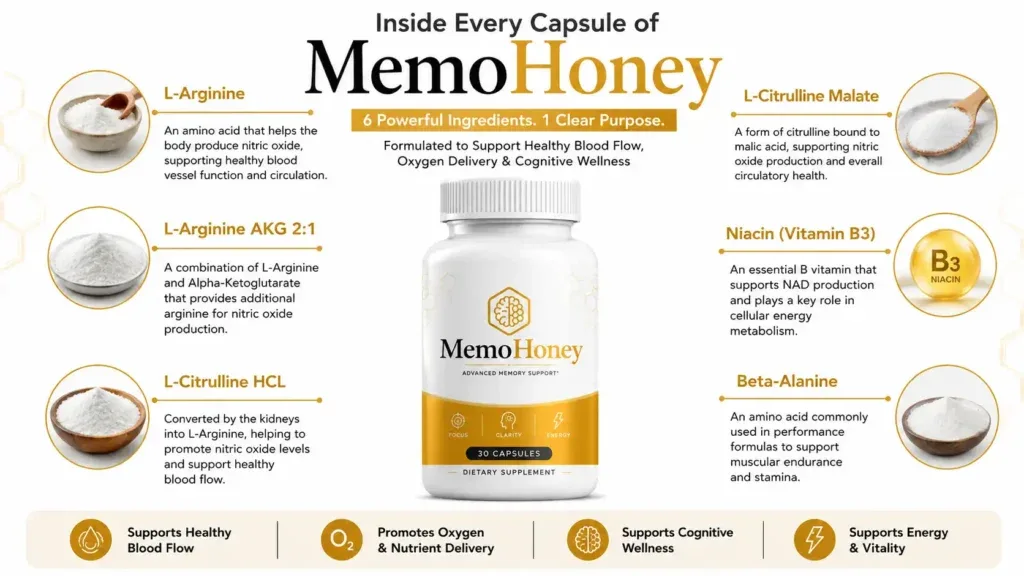
MemoHoney contains a combination of vitamins, minerals, and amino acids selected to support normal energy metabolism, nervous system function, circulation, and cognitive health. Below is a closer look at the key ingredients and their commonly recognized roles in the body.
Niacin (Vitamin B3) (7.5 mg NE)
Niacin, also known as vitamin B3, plays an important role in converting nutrients from food into energy. It also supports normal nervous system function and cellular metabolism. Adequate niacin intake is important for maintaining normal energy levels and overall neurological function.
Calcium (as Calcium Carbonate) (18 mg)
Calcium is best known for its role in maintaining strong bones, but it is also involved in normal nerve transmission and muscle function. The calcium included in MemoHoney provides a small amount of this essential mineral as part of the overall formula.
L-Arginine (Base) (200 mg)
L-Arginine is an amino acid that the body uses to produce nitric oxide. Nitric oxide plays a role in blood vessel function and circulation. Because blood flow is important for delivering oxygen and nutrients throughout the body, L-arginine is commonly included in formulas focused on circulation and physical performance.
L-Arginine AKG 2:1 Extract (200 mg)
L-Arginine AKG combines L-arginine with alpha-ketoglutarate. L-arginine contributes to nitric oxide production, while alpha-ketoglutarate is involved in cellular energy metabolism. Together, these compounds are included in MemoHoney to support normal circulation and energy-related processes.
L-Citrulline HCl (100 mg)
L-Citrulline is an amino acid that can be converted by the body into L-arginine. This pathway is connected with nitric oxide production and normal blood vessel function. Citrulline is therefore commonly used in supplements designed to support circulation and exercise performance.
L-Citrulline Malate (100 mg)
L-Citrulline Malate combines citrulline with malic acid. Citrulline contributes to the body’s arginine and nitric oxide pathways, while malate is involved in energy metabolism. The combination is commonly found in formulas intended to support physical endurance and energy production.
Beta-Alanine (40 mg)
Beta-alanine is an amino acid that the body uses to produce carnosine, a compound involved in muscle buffering during exercise. It is primarily associated with physical performance and exercise endurance rather than directly improving memory or cognitive function.
MemoHoney Memory Support Supplement Benefits
MemoHoney Memory Support Supplement is intended for adults who want nutritional support for normal cognitive function, healthy circulation, and overall brain wellness. Instead of making dramatic claims about improving memory, the formula is positioned around supporting the body’s normal processes that contribute to general brain health.
Supports Healthy Circulation:
The formula is designed to support normal blood circulation, which helps transport oxygen and nutrients throughout the body. This may make it appealing to adults who are looking to include circulation support in their daily wellness routine.
Supports the Body’s Nitric Oxide Pathway:
The amino acids included in the formula are intended to support the body’s natural nitric oxide production. Nitric oxide plays a role in normal blood vessel function and circulation.
Helps Support Cellular Energy Metabolism:
Niacin is involved in normal energy metabolism and helps the body convert nutrients into energy. Getting adequate niacin as part of a balanced diet supports normal cellular functions.
Convenient Once-Daily Routine:
The suggested one-capsule daily routine makes MemoHoney relatively simple to incorporate into an existing supplement or wellness schedule.
Clearer Safety Information:
The product information outlines potential medication interactions and provides more realistic expectations about what the supplement is intended to support. Consumers should still review the ingredients with a healthcare professional if they take medications or have an existing medical condition.
Manufactured With Quality Controls:
According to the product information, MemoHoney is manufactured in facilities that follow GMP standards. These manufacturing practices are intended to support consistency, quality control, and proper production procedures.
Pros & Cons
Pros
- Ingredient list is disclosed and relatively short compared to many competitors
- Core mechanism (nitric oxide production) is a real, well-studied physiological pathway
- Manufactured in a GMP-certified, FDA-registered facility
- Stimulant-free formula, no caffeine crash
- 60-day money-back guarantee offered on most official storefronts
Cons
- No clinical trial on the finished product itself
- Several sold “official” websites, with inconsistent ingredient lists and pricing between them
- Some ingredients (e.g., beta-alanine) appear at doses well below researched amounts
- Independent review counts (Trustpilot) are far lower than the figures cited on brand-affiliated pages
- Not available through major retailers — direct-to-consumer purchase only
- One version of a product page incorrectly implied FDA “approval,” which does not apply to dietary supplements
How to Use MemoHoney?
Manufacturer instructions across official pages consistently describe one capsule daily, taken with water, ideally at a consistent time each day. Marketing materials note that any noticeable effect is described as building gradually — several reviewers described a 3-to-8-week window before mentioning subjective changes in focus. This is standard language for supplements in this category and is not, on its own, evidence of an actual delayed effect.
Are There Any Side Effects?
Because MemoHoney’s mechanism is vasodilation, its own safety disclosures are more specific — and more worth reading closely — than a typical “consult your doctor” boilerplate. Multiple official pages advise that people taking blood pressure medication, blood thinners, nitrates, or PDE5 inhibitors (such as sildenafil) speak to a doctor before use, since combining vasodilating supplements with vasodilating medications can compound effects on blood pressure. The same caution is extended to people with kidney disease, pregnant or nursing individuals, and anyone with upcoming surgery. Commonly reported mild effects include digestive discomfort and niacin flushing — a temporary warming/reddening of the skin that’s a well-known, generally harmless side effect of niacin, though understandably alarming if you don’t expect it.
Is MemoHoney a Scam or Legit?
Based on available evidence, MemoHoney is not a scam in the legal sense — it’s a purchasable product with a disclosed ingredient list, GMP/FDA-registered manufacturing, and a working refund process reported by reviewers. But “not a scam” and “clinically proven” are different claims, and the second one isn’t supported yet. The fairest characterization, echoed across several independent review sources, is that MemoHoney’s marketing is more confident than its evidence base — a common pattern across this entire supplement category, not unique to this brand. The unusually large number of “official” websites, inconsistent formulations between them, and one page’s inaccurate FDA-approval claim are all reasons for a more skeptical read than the glowing review sites suggest.
MemoHoney Customer Reviews & Complaints
⭐ Positive Reviews Reviewers describing positive experiences commonly report gradually improved focus during work, reduced brain fog over several weeks of consistent use, and appreciation for the simple, non-caffeinated ingredient list. Several noted the effect felt subtle rather than dramatic, requiring weeks of use before noticing a difference.
⚠️ Common Complaints The most consistently reported issues are logistical rather than medical: delayed shipping, occasional stock outages, and capsule size (some users found them larger than expected). Mild digestive discomfort was mentioned by a small share of reviewers. No serious adverse events appeared in the reviews surfaced during this research.
Is MemoHoney Worth Trying?
For someone who wants a stimulant-free supplement built on a real (if brain-specific-unproven) physiological mechanism, and who has no interacting medications, MemoHoney sits in a reasonable middle ground: it’s not a proven cognitive treatment, but it’s also not an obviously predatory product. The bigger question is expectation management — anyone hoping for a dramatic, fast-acting memory boost is likely to be disappointed, while someone open to a modest, unproven circulatory-support supplement, taken with realistic expectations and a doctor’s sign-off if on medication, faces relatively low risk.
MemoHoney Money-Back Guarantee
Most official storefronts advertise a 60-day money-back guarantee from the purchase date (one version lists 90 days). Reviewers who mentioned refunds generally described the process as functional, though exact terms — including whether opened bottles are eligible — vary by which “official site the purchase was made through, so reading the specific terms at checkout matters more than trusting a general guarantee claim.
MemoHoney Pricing
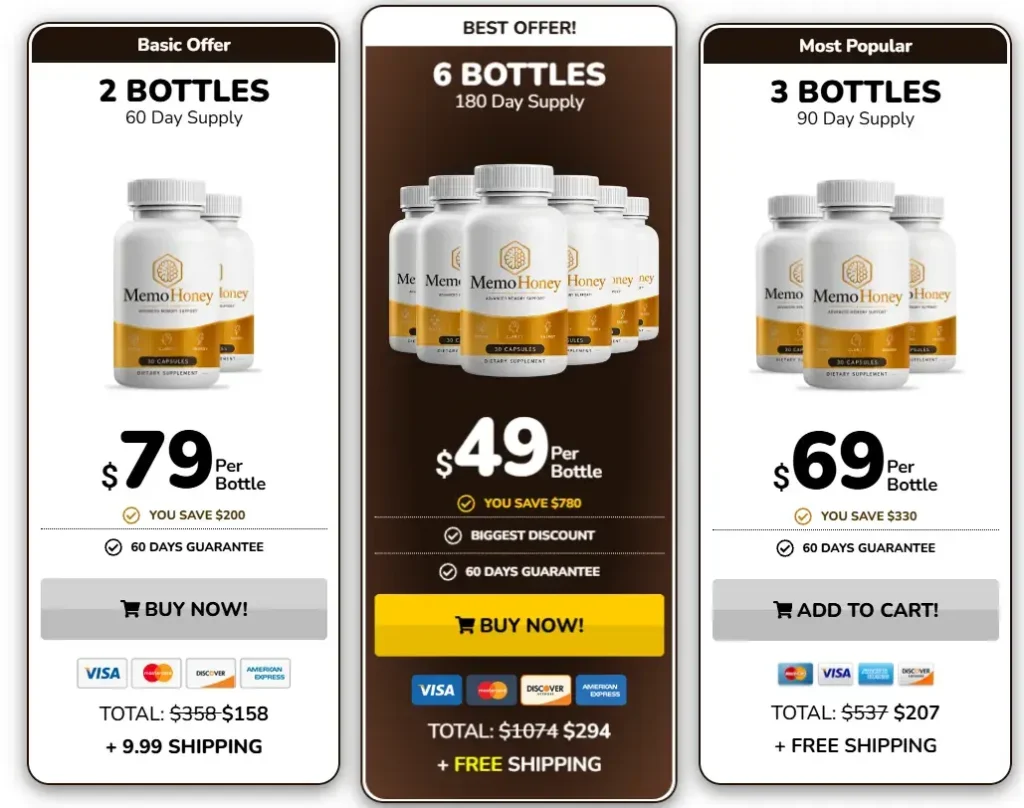
Bundled, multi-bottle pricing structures like this are standard in the direct-to-consumer supplement industry and are designed to lower the per-bottle price as commitment increases — a normal practice, but worth factoring in before buying a large multi-month supply of a product you haven’t tried yet.
✅ Click to Check the Availability.
Where to Buy MemoHoney?
MemoHoney is sold exclusively direct-to-consumer, not through Amazon, Walmart, or pharmacy chains. Multiple domains present themselves as the official store, which makes “where to buy” a genuinely harder question than it should be for a single-product brand. Before purchasing, it’s worth cross-checking that the ingredient list, pricing, and guarantee terms on the site you’re about to buy from match what you’ve researched, rather than assuming any page ranking well in search is automatically the authentic source.
Conclusion
MemoHoney occupies a familiar spot in the crowded brain-health supplement market: a real physiological mechanism, a disclosed but not fully dosed-to-research ingredient list, transparent safety warnings around drug interactions, and a marketing ecosystem — official sites and reviews alike — that consistently overstates certainty relative to the underlying evidence. It isn’t a scam, but it also isn’t a clinically validated memory treatment. Anyone considering it should read the actual supplement facts panel on the exact site they intend to buy from, check for interactions with any current medication (especially blood pressure drugs or blood thinners), and treat the more dramatic before/after claims in reviews with healthy skepticism.
Frequently Asked Questions
Is MemoHoney FDA-approved?
No. Dietary supplements are not FDA-approved. MemoHoney is manufactured in an FDA-registered, GMP-certified facility, which is a manufacturing standard, not a product approval.
How long does it take to see results?
Reviewer accounts generally describe a 3-to-8-week window before noticing any subjective change; this isn’t independently verified.
Can I take MemoHoney with blood pressure medication?
Multiple official pages specifically advise consulting a doctor first, since the formula’s vasodilating ingredients may interact with blood pressure medication, blood thinners, nitrates, and PDE5 inhibitors.
Is MemoHoney the same as prescription memory medication?
No. It does not contain any prescription pharmaceutical ingredient and works through a different, unproven-for-cognition mechanism.
Where is the real official website?
Multiple domains claim official status with differing ingredient lists and prices; there is no single, universally confirmed canonical source based on available research.
Research and Sources
- Trustpilot
- wellbeingmagazine.com
- NIH National Institute on Aging — Cognitive Health and Older Adults
- NIH Office of Dietary Supplements — Niacin (Vitamin B3) Fact Sheet
- NIH Office of Dietary Supplements — Calcium Fact Sheet
- PubMed — L-Arginine and Nitric Oxide Pathway Research
- PubMed — L-Citrulline Supplementation and Blood Flow Research
- PubMed — L-Citrulline Malate and Exercise Performance Research
- PubMed — Beta-Alanine and Cellular Performance Research
- PubMed — Amino Acids and Brain Function Research
- National Center for Complementary and Integrative Health (NCCIH) — Herbs and Supplements Information

Better Health Focus Team
Health, Wellness & Supplement Research Team
The Better Health Focus Team researches and reviews health, wellness, nutrition, and dietary supplement products. Our goal is to provide readers with clear, practical, and research-informed information before they make a purchasing decision.
Our reviews examine product ingredients, potential benefits, usage instructions, available scientific research, customer feedback, pricing, refund policies, and manufacturer claims. We also look at potential limitations and highlight claims that may require additional evidence.
We believe supplement information should be presented realistically—not through exaggerated promises. Where scientific evidence is limited or conflicting, we make that clear so readers can make more informed decisions.
Areas We Cover:
Dietary Supplement Reviews
Nutrition & Wellness
Ingredient Research
Product Benefits & Potential Side Effects
Customer Reviews & Complaints
Pricing & Money-Back Policies
Evidence-Based Health Information
Editorial Approach: Our content is based on information available from reputable scientific, government, manufacturer, and consumer sources. Supplement reviews are informational and should not replace advice from a qualified healthcare professional.
Affiliate Disclosure: Some articles may contain affiliate links. If a reader purchases a product through one of these links, Better Health Focus may receive a commission at no additional cost to the reader. This does not determine how we evaluate or describe products.