
Do you usually rush out of bed and start to feel exhausted before midday? How you spend the first 30 minutes of your morning completely sets the vibe for your mood, focus, and ability to handle stress later in the day. The good news is that protecting your mental wellness doesn’t require waking up at 4:00 AM or following a strict, exhausting routine.
The best morning habits for mental wellness are actually simple, quiet actions like hydrating, getting natural sunlight, and staying off your smartphone. These small changes help you wake up gently instead of throwing your nervous system into immediate panic mode.
If you are someone who usually rushes out of bed and feels completely drained by noon, hitting the reset button on your morning can change everything. Let’s grab a coffee and talk about six small, easy-to-maintain habits that will actually bring peace to your mind.
Table of Contents
Why Your Morning Routine Matters for Balanced Mental Wellness
When your mornings are chaotic, your brain spends the whole day in catch-up mode. You react instead of respond. You feel stressed before the actual challenging stuff even shows up.
A calm, consistent morning works the opposite way. It helps lower cortisol (the stress hormone that naturally spikes right after waking), gives your brain a sense of control, and provides balanced mental wellness to handle whatever the day throws at you.
You don’t need an ideal morning to feel better. You only need simple, long-term habits with which you can maintain consistency.
6 Morning Habits to Improve Your Mental Wellness
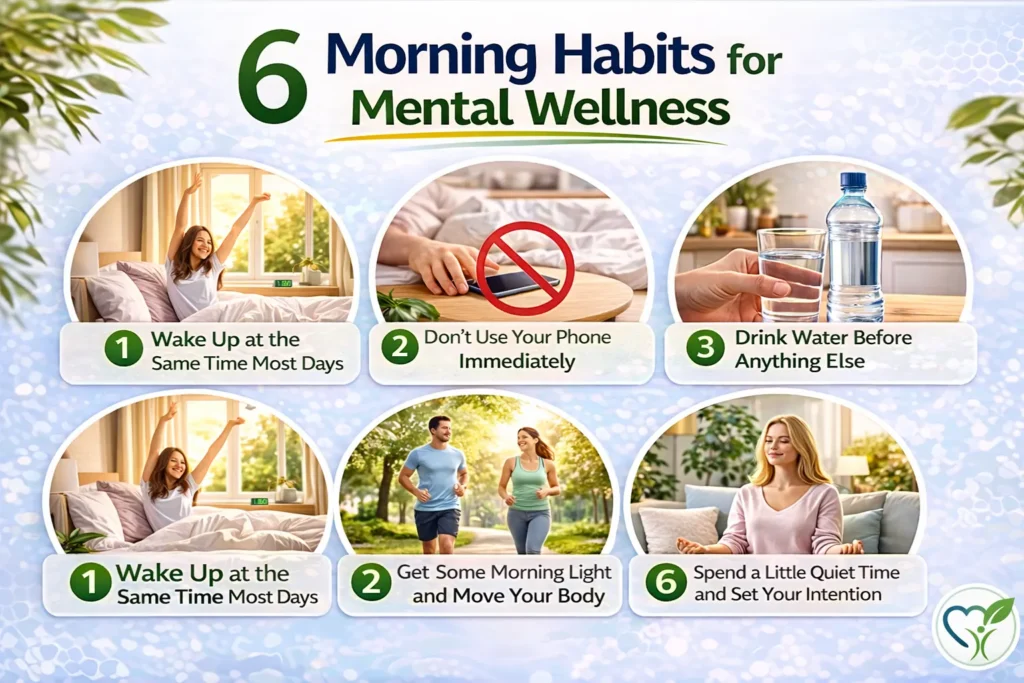
These everyday morning habits are not complicated or hard to follow. And there is no need to be perfect from the start and do each one of them to improve mental wellness. Simply start with one or two habits and keep adding as the last one becomes a normal part of your life.
1. Wake Up at a Consistent Time
The most powerful thing you can do for your mental wellness is to try to wake up around the same time each day.
When you are sleeping in until noon one day and waking up early in the morning on another day, your body clocks get completely confused. You feel groggy, and your sleep quality suffers. Researchers call this phenomenon “social jet lag,” and it’s more common than most people realize.
A consistent waking time helps your body know when it’s time to wake up and become active. You will not need to force yourself to feel awake and will feel more in control of how your day starts.
Tip: Set an alarm for the same time for a week. This will help your body become adjusted to that time and give a better start in the morning.
2. Stay Off Your Phone for the First 20 Minutes
Checking your phone just after waking up is one of the most negative starts to your morning, which affects your mental wellness.
Why? Because your brain is in a calm state right after waking up, but the moment you open Instagram, mail, or news, your mind floods with information it wasn’t prepared for. You immediately start to compare yourself to others, absorb stress from disturbing news, and hand over control of your thoughts of morning to those notifications.
Don’t use your phone for at least 20 minutes after waking up. Instead, do some stretching, drink water, take a short walk, or meditate for a few minutes. It might feel like nothing at first, but after a few days, you might start thinking of it as one of the best decisions of your life.
3. Drink a Glass of Water Before Anything Else
While this habit might sound too simple, the mental fog and sluggishness you feel every morning are a big part of dehydration.
Your brain is roughly 75% water, and your body loses water overnight. When it’s running low, your mental wellness gets affected. Your focus gets weak, your mood drops, and everything feels a little harder than it should be. But a single glass of water after waking up gives your brain a quick boost and is a very easy way to start your day in a positive way.
The important part is to stay consistent with this habit. Keep a water bottle or a glass of water beside your bed to make it easier to follow.
4. Get Some Natural Light and Move Your Body a Little
The natural light of morning sunlight is one of the most underrated things for your mental wellness, and it costs nothing.
When natural light hits your eyes in the morning, it sends a clear signal to your brain that “it’s time to wake up.” It helps to balance your body’s internal clock, boosts serotonin levels, and even improves your sleep quality at night.
Another thing is to do some physical exercise in the morning. You don’t need a full workout plan or gym membership. Even 5-10 minutes of waking is more than enough.
5. Spend 5 Minutes in Quiet Intention
You don’t need hours of meditation to feel good. Even five minutes in the morning can change the entire mental state for the day.
Most of us go straight into autopilot mode without giving our brains any time to think about how we want our day to go. Then all day we feel scattered and out of control, without knowing the reason.
In those five quiet minutes you take back control. Sit still. Take a few slow, deep breaths. Ask yourself:
- How do I actually want to feel today?
- What’s the one thing I most need to get done?
- What’s one thing I’m genuinely grateful for right now?
That’s it. You don’t need anything. Just you, a few quiet minutes, and a clear intention.
Many mental wellness blogs and professionals recommend this practice. Intentional thinking in the morning reduces anxiety disorder, improves focus, and helps you set goals for the day.
6. Eat Something Simple and Balanced
Always eat breakfast. Skipping it doesn’t just affect your brain, your mood, and your ability to handle stress.
Your brain needs energy (glucose) to work all day. After 7-8 hours of sleep, it’s been running on empty. Without breakfast, blood sugar levels drop, and suddenly you become irritable, struggling to concentrate, and feeling anxious, often without even knowing reason.
You don’t need a fancy meal. You need something simple and solid like:
- Oatmeal with fruit or a handful of nuts
- Eggs on toast
- Yogurt with seeds or berries
- A smoothie with some protein and fruit
- A banana with peanut butter
The goal is to eat a balanced breakfast with a little protein, complex carbs, and fiber. That keeps your energy and mood stable throughout the start of the day.
My Personal Experience
I’ve followed most of these morning habits consistently for the past few years, and they’ve made a noticeable difference in how I start my day. I usually wake up at the same time, avoid checking my phone immediately, drink water first, spend a few minutes outdoors, and plan my top priorities before beginning work.
For me, these simple habits have helped reduce morning stress, improve focus, and create a calmer mindset throughout the day. While everyone’s experience is different, I found that consistency mattered much more than trying to build the perfect routine overnight.
These habits aren’t a replacement for professional mental health care, but they have become an important part of my overall well-being.
Common Morning Mistakes That Harm Your Mental Health
Now you know what to do to improve your mental health. Let’s discuss what you have to avoid. It is just as important as following good habits.
Grabbing your phone immediately after waking up
This is worth mentioning twice. Stressful mail, sad news, and social media put your brain unnecessarily in high-alert mode right after waking up before even it’s ready. That’s why you should try to avoid using your phone for 20-30 minutes after waking up.
Waking up at the very last minute
Rushing through your morning is a stress trigger. You feel behind before you’ve even started. Setting your alarm just 15 minutes earlier than you think you need can change how your entire morning feels.
Skipping breakfast
Your brain needs fuel. That’s why you should avoid skipping your breakfast. It lowers your blood sugar, spikes anxiety levels, and tanks your ability to focus.
Trying to change everything at once
If you try to do everything at once, you’ll burn out quickly. That’s why you should start with one habit. Stick with it for 7-10 days and add others as it becomes a part of your life. Small steps done consistently always beat big plans done once.
A Simple 30-Minute Morning Routine for Mental Wellness
Now that you know what to do and what not to do, let’s put it all together to give you a simple morning routine.
| Time | What to Do |
| 0–5 min | Wake up, drink a glass of water, keep the phone down |
| 5–10 min | Step outside or sit near an open window for natural light |
| 10–15 min | Take a short walk, stretch, or do light movement |
| 15–20 min | Sit quietly, breathe slowly, set your intention for the day |
| 20–30 min | Eat a simple, balanced breakfast |
Thirty minutes, that’s all you need. No expensive equipment, supplements, or coaching. This is a practical routine that mental wellness club and professionals recommend.
How Often to Check In on Mental Well-Being?
This question is not asked enough, as much as it should be. Most people think to pay attention to mental health when something is seriously wrong.
You should check on your mental wellness every single day, even if it’s only for a few minutes.
Your morning time is the best opportunity for this. As you sit, breathe, and give yourself a little time to ask a few questions, such as the following:
- How am I actually feeling right now?
- Have I been sleeping well lately?
- Am I feeling more anxious or withdrawn than usual?
- What do I genuinely need today?
For a deeper check-in, like journaling or having a real conversation with someone you trust once a week.
Take care of your mental health just as you take care of your physical health. Don’t wait until you have gotten a serious problem. Stay consistent with these small check-ins to catch problems early and keep your mental wellness protected.
Final Thoughts
Mental wellness isn’t something that a quick fix can improve. You improve it a little bit every day. You stay consistent with your healthy habits for a long time to get balanced mental wellness. You don’t need to start following all habits at once. Just pick one, stay consistent with it, and see how you feel, and keep adding more habits to your routine.
These everyday habits are an excellent start if you want to develop a more advanced mental health and wellness care routine.
Frequently Asked Questions
What is a mental wellness club, and could it actually help?
A mental wellness club is a group of people, usually formed at school, workplaces, or even online, where people come together to support each other’s mental health however they can. If you’re trying to build better habits and want some accountability and encouragement along the way, joining one can be genuinely helpful.
Do I have to wake up very early to improve my mental wellness?
No, the point is not waking up at 4 am, but waking up around the same time every day. This helps you avoid rushing through the morning. And it also helps to fix your internal clock for a better sleep routine. That’s why waking up early is not necessarily good for mental health.
What are the best morning habits for mental wellness?
The best habits are surprisingly simple: wake up at a regular time, drink water, get some sunlight, eat a solid breakfast, and ignore your phone for a few minutes to just sit quietly and plan your day
How long should a morning routine for mental wellness be?
Around 20-30 minutes every morning is more than enough to make a significant difference if you are consistent with them. Avoid making your morning routine too long because it can make you feel exhausted.
Can morning habits help with depersonalization?
Healthy morning habits such as maintaining a regular sleep schedule, getting morning sunlight, staying hydrated, and practicing mindfulness may support overall mental wellness. However, there is no evidence that these habits treat depersonalization disorder. If symptoms are persistent or distressing, consult a mental health professional.
Can a morning routine actually help with mental wellness goals?
Yes. A morning routine can help reduce anxiety, improve your mood, and build emotional resilience over time. It won’t solve every mental health challenge, but it supports mental wellness goals.
References & Sources
American Psychological Association (APA)
World Health Organization (WHO)

Noah Ross
Health & Wellness Writer
Better Health Focus
Expertise
Weight Management • Gut Health • Nutrition • Metabolic Health • Healthy Lifestyle • Mental Wellness • Preventive Health • Dietary Supplement Research • Evidence-Based Health Education
About Noah Ross
Noah Ross is a Health & Wellness Writer at Better Health Focus, where he creates evidence-based educational content focused on helping readers make informed decisions about their health. His work covers weight management, gut health, nutrition, metabolism, preventive wellness, and healthy lifestyle strategies.
With a background in health communication, Noah specializes in translating complex medical research into clear, practical, and easy-to-understand articles. He believes reliable health information should be accessible to everyone without relying on sensational claims or misleading marketing.
Before publishing an article, Noah reviews scientific literature and guidance from respected health organizations, including the National Institutes of Health (NIH), PubMed, the World Health Organization (WHO), the Centers for Disease Control and Prevention (CDC), the Office of Dietary Supplements (ODS), and other peer-reviewed medical journals. His writing emphasizes transparency by distinguishing well-established scientific evidence from preliminary findings and promotional claims.
At Better Health Focus, Noah regularly researches topics related to digestive wellness, metabolism, healthy eating, blood sugar management, dietary supplements, weight loss strategies, healthy aging, and preventive healthcare. His content is designed to help readers understand both the potential benefits and limitations of current scientific evidence while encouraging realistic expectations and sustainable lifestyle habits.
Education
Bachelor of Arts (B.A.) in Communications
Professional Development
- Continuing education in Nutrition Science and Public Health
- Ongoing study of evidence-based medicine and clinical research
- Regular review of peer-reviewed research related to nutrition, metabolism, obesity, digestive health, and preventive medicine
- Continuous monitoring of updates from major public health organizations and medical research databases
Areas of Focus
- Weight Loss & Healthy Weight Management
- Gut Microbiome & Digestive Wellness
- Nutrition & Healthy Eating
- Blood Sugar & Metabolic Health
- Mental Wellness & Lifestyle Habits
- Preventive Health Education
- Dietary Supplement Reviews
- Evidence-Based Wellness Research
Editorial Standards
Every article written by Noah Ross follows the editorial standards of Better Health Focus. Content is developed using current scientific evidence, reputable medical references, and trusted public health resources whenever applicable.
Each article is written with a commitment to:
- Accuracy and factual reporting
- Evidence-based health education
- Transparent discussion of scientific findings
- Balanced coverage of benefits, risks, and research limitations
- Clear, reader-friendly language
- Compliance with Google E-E-A-T principles for health content
Noah avoids unsupported health claims, miracle cures, and exaggerated promises. When evidence is limited or still emerging, that uncertainty is clearly communicated so readers can make informed decisions based on the best available research.
Research Sources
Articles may reference information from organizations and databases such as:
- National Institutes of Health (NIH)
- PubMed
- World Health Organization (WHO)
- Centers for Disease Control and Prevention (CDC)
- Office of Dietary Supplements (ODS)
- U.S. Department of Agriculture (USDA)
- American Heart Association (AHA)
- Peer-reviewed scientific journals
Editorial Disclaimer
The information published by Noah Ross on Better Health Focus is intended for educational and informational purposes only. It should not be considered medical advice and is not a substitute for consultation with a qualified physician or other licensed healthcare professional. Readers should seek professional medical guidance before making decisions regarding diagnosis, treatment, medications, supplements, or significant lifestyle changes.