
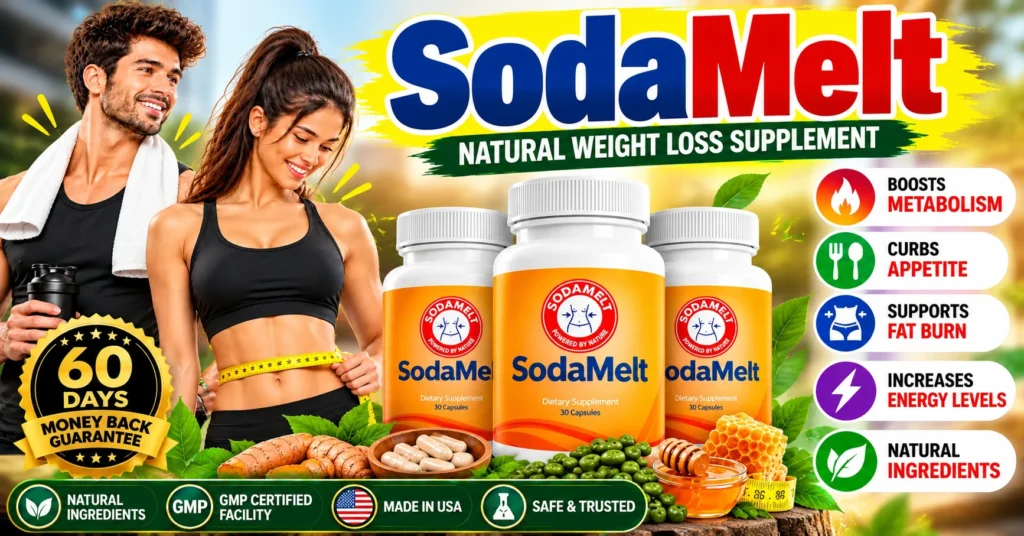
SodaMelt is a once-a-day capsule sold online as a digestive and “metabolic wellness” supplement. Its marketing leans on bloating relief, a lighter feeling after meals and a natural-formula image. This review goes through the label, the pricing, the reviews and the science so you can decide whether it deserves your money.
Table of Contents
Quick Overview
| Category | Details |
| Product Name | SodaMelt |
| Product Type | Dietary supplement, vegetable capsule |
| Natural Formula | 12 fiber, botanical, probiotic and mineral ingredients, in a non-GMO, gluten-free capsule |
| Key Benefits (claimed) | Less bloating, digestive comfort, a lighter feeling |
| Usage | One capsule daily with 8 oz of water, ideally 20 to 30 minutes before a meal |
| Customer Ratings | 4.5 out of 5 from 1,164 reviews on a seller-linked site (not independently verified) |
| Price | From $49 to $89 per bottle |
| Official Website | Vendor Official Site |
What Is SodaMelt?
SodaMelt is marketed as a natural metabolic wellness supplement built around fiber, botanicals and probiotics, with each bottle holding a 30-day supply. It is aimed at adults who feel bloated or heavy after meals and want a simple daily routine. The sales page ties the name to an old home-remedy tradition involving baking soda, but baking soda does not appear among the 12 listed ingredients.
SodaMelt Ingredients
The label shows a Supplement Facts panel with twelve ingredients. Psyllium husk, cascara sagrada, aloe vera, oat straw, Chinese rhubarb root, scabrous gentian root, goldenseal root, buckthorn bark, bentonite and Lactobacillus acidophilus sit inside a proprietary blend, alongside calcium as calcium carbonate. The other ingredients are rice flour, a hypromellose capsule shell, magnesium stearate and silicon dioxide.
The label does disclose the plant parts, which is better than many competitors. The problem is the dosing. One detailed review notes that calcium at 100 mg is the only dosed ingredient, and eleven botanicals share a 250 mg blend. The same review points out that the studied psyllium dose is 5,000 to 10,000 mg, so psyllium’s share of a 250 mg blend is a small fraction of that. You cannot tell how much of each ingredient you are getting.
There is a second point to understand. Four of the eleven blend ingredients are stimulant laxatives: cascara sagrada bark, Chinese rhubarb root, buckthorn bark and aloe vera leaf.
SodaMelt Benefits
The seller’s claimed benefits include less everyday bloating, feeling lighter day to day, clearer digestive comfort, steady energy, and more comfort around food. Treat these as marketing language rather than clinical outcomes. No published trial tests the SodaMelt formula itself. What can be said is that some of the ingredients have a real research record, mainly psyllium for regularity and some probiotics for digestive symptoms, at doses much larger than this capsule appears to contain. The stimulant laxative ingredients can also cause bowel movements, which some users may interpret as the product working.
Pros & Cons
- A full ingredient list with plant parts is printed on the label.
- The capsule is simple to take once a day.
- It is a one-time payment, with no subscriptions or auto-shipments.
- A 60-day money-back guarantee is offered.
- Psyllium and probiotics have genuine research behind them in general.
- Eleven ingredients share a 250 mg blend, so individual doses are hidden and likely low.
- Four ingredients are stimulant laxatives, which sits awkwardly beside the sales page’s talk of avoiding harsh laxatives.
- No independent trial has tested this formula.
- The price per bottle is high compared with plain psyllium.
- Many “review” pages are brand-linked or promotional.
How to Use SodaMelt
The directions are to take one capsule daily with a full glass of water before a meal, and to use it consistently. The seller suggests most people use it for at least three to six months. That recommendation should be weighed carefully. A summary of the ingredients concluded that the blend contains four anthranoid stimulant laxatives, making it a short-course product rather than a daily habit. Long-term daily use of stimulant laxatives is generally discouraged, so ask a doctor or pharmacist before planning a multi-month course.
Are There Any Side Effects?
Possible side effects follow from the ingredients. Fiber can cause gas, bloating and cramping if you do not drink enough water. Stimulant laxatives can cause cramps, diarrhea and dehydration. The review above also notes that the calcium row and the goldenseal row both carry documented medicine interactions.
The seller advises showing the bottle to your doctor if you are pregnant, nursing, or taking medication. If you have a bowel condition, kidney problems or heart disease, or take regular prescriptions, check with a healthcare professional first. Stop use and seek medical advice if you have severe pain, blood in the stool or symptoms that persist.
Is SodaMelt a Scam or Legit?
SodaMelt appears to be a real, purchasable product with a printed label, a business address and a published refund policy. In that narrow sense it is not a phantom product. The more useful question is whether the marketing is honest, and the answer is mixed.
Concerns:
- The sales page says the formula works without harsh laxatives, yet the blend contains four stimulant laxatives. One reviewer flagged this and said the claim should not be repeated, since it is a fact about the ingredients rather than an opinion.
- The sales page cites research on psyllium and aloe, but those studies concern single ingredients at their own doses, not SodaMelt.
- The page shows both a $99 and an $89 single-bottle price and a very large “original” price for bundles. These crossed-out prices are marketing devices.
Fair points: the label is printed in full, the plant parts are named, and the guarantee is clearly stated. My assessment is that SodaMelt is a legitimate product with promotional claims that run ahead of the evidence. It is not proven to be a scam, but it is not proven to work as advertised either.
SodaMelt Customer Reviews & Complaints
Reviews on the brand’s own pages are positive. Typical comments describe a simple daily routine, with benefits noticed after a few weeks rather than overnight. Complaints in the seller’s own summary include a slow start and wanting more results within the first week.
Treat all of this cautiously. Several sites using the SodaMelt name look brand-affiliated, and their ratings and review counts cannot be verified. For a more reliable picture, look at reviews on neutral platforms, check complaint boards for billing and refund problems, and note that people vary widely in how they respond to laxative ingredients.
Is SodaMelt Worth Trying?
It may suit an adult who understands what is in the capsule, accepts that it contains stimulant laxatives, drinks enough water, and wants a short trial. It is a poor fit for pregnant or nursing women, people on regular medication, anyone with a chronic bowel condition, and anyone hoping for a gentle, fiber-only product.
If your main goal is regularity, plain psyllium husk, with a known dose and a much lower price, is a simpler and better-studied option. If bloating is persistent, see a doctor, because the cause may not be something a supplement can fix.
SodaMelt Money-Back Guarantee
The brand offers a 60-day money-back guarantee, with a full refund if you send the bottles back. Before buying, confirm the details on the refund policy page: whether empty bottles are accepted, how long approval takes, and whether shipping is refunded. Pay by credit card for added protection, and keep your order confirmation and any support emails.
SodaMelt Pricing
Pricing on the official site, as checked in October 2026:
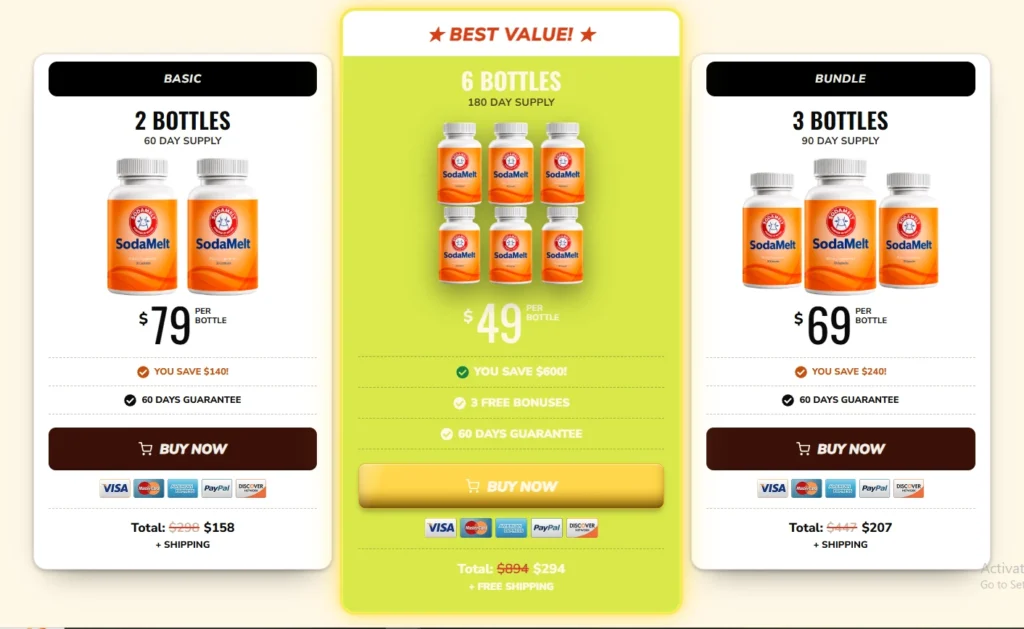
The 6-bottle pack also includes three digital bonus guides, and the seller says 94% of customers choose it. Remember that the bundles lock in months of a product whose own reviewers suggest as a short course. Starting with a single bottle costs more per capsule but limits your risk.
Where to Buy SodaMelt Supplement
The safest route is the official website. Checkout is processed through a retailer called BuyGoods, and the seller lists a customer support email and phone number. Avoid third-party marketplaces and look-alike domains. appeared in my research, and it is not always clear which are official. Check the URL carefully before entering payment details.

Conclusion
SodaMelt is a real product with an openly printed label, but it comes with notable caveats. Its twelve ingredients share a small blend, four of them are stimulant laxatives, and the claims about gentleness and long-term use do not sit comfortably with that. Independent evidence on the formula itself is missing, and the review landscape is full of promotional content.
If you decide to try it, buy one bottle, read the label, drink plenty of water, check with a healthcare professional if you take medication, and use the refund window if you are not satisfied.
Frequently Asked Questions
Is SodaMelt a laxative?
It contains four ingredients known as stimulant laxatives, so it can have a laxative effect, even though marketing describes it as gentle.
How long does SodaMelt take to work?
Reviews mention weeks rather than days, though a laxative effect can appear sooner.
Can I take SodaMelt every day?
The seller suggests months of use, but with stimulant laxatives in the formula, ask your doctor before long-term daily use.
Is it safe with medication?
Not necessarily. Calcium and goldenseal both have documented interactions, so check with a pharmacist.
Does SodaMelt contain baking soda?
No. Baking soda is not among the listed ingredients despite the product name.
Is it a subscription?
The seller says orders are a one-time payment with no auto-shipments.
Science Research and Sources
The sales page lists scientific references. They support individual ingredients, not the finished SodaMelt formula:
- Bijkerk CJ, et al. Soluble or insoluble fibre in irritable bowel syndrome in primary care? BMJ. 2009;339:b3154.
- Aloe vera is effective and safe in short-term treatment of irritable bowel syndrome (systematic review and meta-analysis). J Neurogastroenterol Motil. PubMed 30153721.
- Odes HS, et al. A double-blind trial of a celandin, aloe vera and psyllium laxative preparation in adult patients with constipation. Digestion. 1991;49(2):65-71.
- Effect of fiber supplementation on chronic constipation in adults: an updated systematic review and meta-analysis. PubMed 35816465.
- Efficacy of probiotics in the management of irritable bowel syndrome: a systematic review and meta-analysis. PMC11741147.
- Ho SS, et al. Cholesterol-lowering effects of oat β-glucan: a meta-analysis of randomized controlled trials. PubMed 25411276.

Better Health Focus Team
Health, Wellness & Supplement Research Team
The Better Health Focus Team researches and reviews health, wellness, nutrition, and dietary supplement products. Our goal is to provide readers with clear, practical, and research-informed information before they make a purchasing decision.
Our reviews examine product ingredients, potential benefits, usage instructions, available scientific research, customer feedback, pricing, refund policies, and manufacturer claims. We also look at potential limitations and highlight claims that may require additional evidence.
We believe supplement information should be presented realistically—not through exaggerated promises. Where scientific evidence is limited or conflicting, we make that clear so readers can make more informed decisions.
Areas We Cover:
Dietary Supplement Reviews
Nutrition & Wellness
Ingredient Research
Product Benefits & Potential Side Effects
Customer Reviews & Complaints
Pricing & Money-Back Policies
Evidence-Based Health Information
Editorial Approach: Our content is based on information available from reputable scientific, government, manufacturer, and consumer sources. Supplement reviews are informational and should not replace advice from a qualified healthcare professional.
Affiliate Disclosure: Some articles may contain affiliate links. If a reader purchases a product through one of these links, Better Health Focus may receive a commission at no additional cost to the reader. This does not determine how we evaluate or describe products.