
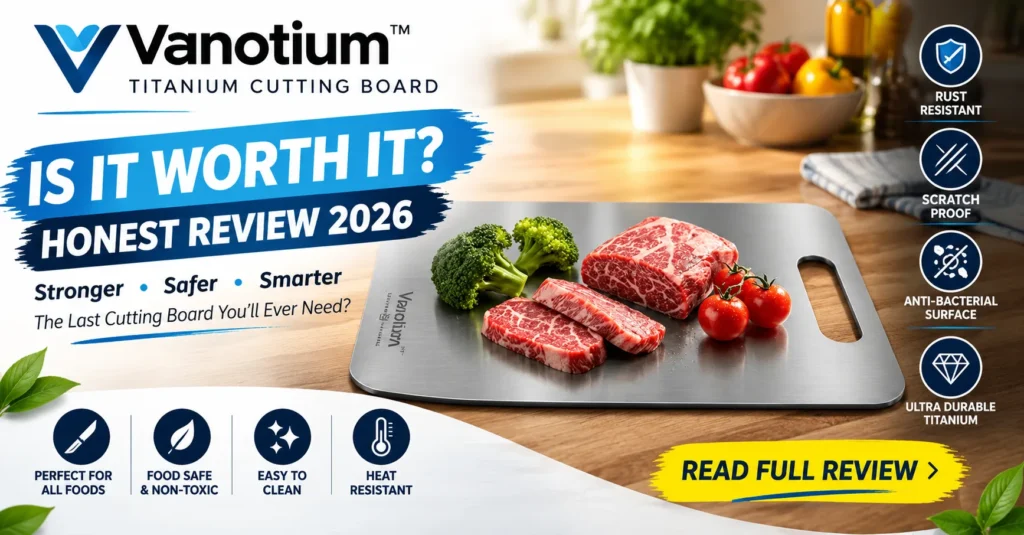
Vanotium is a good fit for home cooks who are tired of stained, smelly, warped or knife-scarred boards and want one low-maintenance surface to wash, dry and forget. It is non-porous, dishwasher-safe and built to last far longer than a typical plastic board. The trade-offs are a higher price than a basic board and the fact that titanium is a hard material, so you should use sharp knives and good technique.
Table of Contents

Why Your Current Cutting Board Might Be the Problem
Think about the cutting board you use now. It probably has a few of these problems:
- Grooves and knife scars that are hard to clean.
- Stains and smells from garlic, onions, beets or raw meat.
- Warping, cracking or splitting after repeated washing.
- A damp underside that never fully dries.
These are not just cosmetic. Food-safety references point out that bacteria can reside in grooves produced by cutting, or in liquids left on the board. The more scarred a board gets, the harder it is to keep clean. That is the problem the Vanotium board aims to solve. Wikipedia
What Is the Vanotium Titanium Cutting Board?
Vanotium is a kitchen cutting board made from titanium. The company announced the product on October 14, 2026, describing it as intended for everyday food preparation in residential kitchens, with a focus on cutting-surface design, routine maintenance and practical considerations for preparing food at home.
On the retail side, a popular listing describes a 100% pure titanium board measuring 11.4 by 7.9 inches, with a non-porous, knife-friendly, dishwasher-safe, double-sided chopping surface for meat, fish, fruit and vegetables. That listing was tagged as a best seller in the Worktop Savers category.
The official site presents it as a cutting board made from premium titanium, designed for durability and hygiene, that is gentle on knives, easy to clean, and resistant to bacteria and odors.
In simple terms: it is a flat, thin, double-sided metal board that you use like any other cutting board but clean far more easily.
Key Features That Matter in Real Kitchens
1. A Non-Porous Surface
Wood soaks up liquid, and plastic gets deep grooves. A non-porous metal surface does not absorb juices, so garlic, onion and raw-meat smells are less likely to linger. For anyone who has ever thrown away a smelly board, this is the biggest selling point.
2. Dishwasher-Safe Convenience
The Amazon listing highlights that the board is dishwasher-safe. Wooden boards usually cannot go in the dishwasher, so this makes cleanup much faster. It is a real advantage on busy weeknights.
3. Double-Sided Design
Two sides mean you can dedicate one to raw proteins and the other to produce, which is a good habit for avoiding cross-contamination.
4. Durable, Low-Maintenance Build
Titanium resists warping, cracking and staining, so you skip the monthly oiling that wood requires. One review page estimated that a typical household replaces plastic boards every 6 to 12 months, which is an estimate, not a lab figure, but it matches what many home cooks experience. If a titanium board lasts years, the higher upfront price can pay off.
5. Heat Resistance
A metal board will not melt or warp, so it can double as a hot-pan surface or work surface in a pinch. Check the manufacturer’s guidance before relying on this.
6. Slim and Easy to Store
Thin boards slide into a drawer or a vertical organizer, which helps in small kitchens.
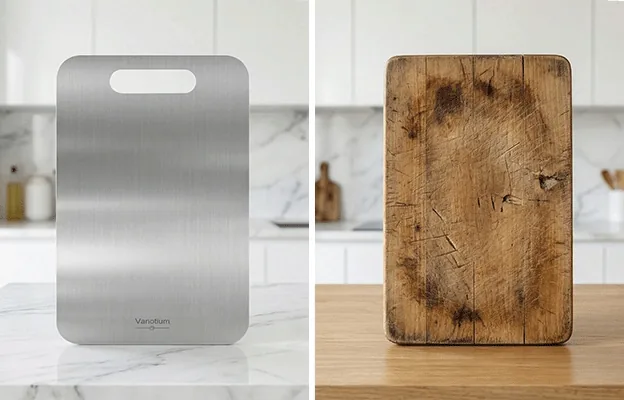
Vanotium vs. Wood vs. Plastic vs. Bamboo
| Feature | Vanotium (Titanium) | Wood | Plastic | Bamboo |
| Porous? | No | Yes | Becomes scarred | Somewhat |
| Dishwasher-safe | Yes (per listing) | Usually no | Usually yes | Usually no |
| Maintenance | Wash and dry | Regular oiling | Replace when scarred | Occasional oiling |
| Odor/stain resistance | Strong | Moderate | Weak over time | Moderate |
| Knife-edge friendliness | Firmer surface | Best | Good | Fair |
| Upfront price | Higher | Mid to high | Low | Low to mid |
| Lifespan | Long | Long with care | Short to medium | Medium |
Wood is still the knife-friendliest option, and plastic is the cheapest. Titanium wins on hygiene convenience and low maintenance.
An Honest Note About Hygiene Claims
Some marketing calls this a “germ-proof” board. Treat that language carefully. Even the company’s own announcement notes that describing the product as germ-proof should not be read as proof that it prevents all microbial contamination. No cutting board, whatever the material, removes the need to wash it properly after raw meat, poultry or fish.
What a non-porous surface does give you is an easier job: with no pores to absorb liquid, washing with hot soapy water or running it through the dishwasher is simpler and more thorough.
What About Your Knives?
This is the question I would ask before buying. Titanium is much harder than wood. General cutting board guidance notes that a good board material should be soft and non-abrasive, and that hard boards are better suited to tasks that do not require a sharp knife. The brand says its board is gentle on knives, helping them stay sharper for longer. I could not find independent lab testing that confirms this, so treat it as a manufacturer claim.
My practical advice:
- Use a sharp knife and a smooth slicing motion rather than hard chopping.
- Avoid serrated blades, which wear all board types faster.
- Hone your knives regularly, as you should with any board.
- If you own expensive Japanese carbon-steel knives, consider keeping a wood board for them.
- Check the refund policy so you can test the board with your own knives.
For most home cooks using standard stainless-steel knives, this is manageable. If you want a board for butchering and heavy chopping, wood may still be the better partner.
Pros and Cons
- Non-porous, so it resists stains and odors better than wood or plastic.
- Dishwasher-safe for quick cleanup.
- Long-lasting, with no warping or oiling required.
- Double-sided for raw and ready-to-eat foods.
- Slim and simple to store.
- Cleaner look that suits modern kitchens.
- Costs more than basic plastic or bamboo boards.
- Harder surface, so it is not ideal for aggressive chopping with delicate knives.
- Can feel less “forgiving” than wood.
- The popular size is fairly compact (about 11.4 by 7.9 inches), so large prep jobs may need a bigger option.
- Many look-alike titanium boards exist. A search for the product shows hundreds of titanium cutting board results, so buy from a trusted seller.
Pros
- Non-porous, so it resists stains and odors better than wood or plastic.
- Dishwasher-safe for quick cleanup.
- Long-lasting, with no warping or oiling required.
- Double-sided for raw and ready-to-eat foods.
- Slim and simple to store.
- Cleaner look that suits modern kitchens.
Cons
- Costs more than basic plastic or bamboo boards.
- Harder surface, so it is not ideal for aggressive chopping with delicate knives.
- Can feel less “forgiving” than wood.
- The popular size is fairly compact (about 11.4 by 7.9 inches), so large prep jobs may need a bigger option.
- Many look-alike titanium boards exist. A search for the product shows hundreds of titanium cutting board results, so buy from a trusted seller.
Who Should Buy the Vanotium Cutting Board?
It is a strong match if you:
- Hate scrubbing stained or smelly boards.
- Want something you can put in the dishwasher.
- Cook often and replace plastic boards regularly.
- Prefer a clean, modern look.
- Want a gift for a home cook who has everything.
Skip it or consider wood if you:
- Own very delicate or expensive blades.
- Mostly do heavy butchery or bone work.
- Want the quietest, softest chopping feel.
- Are on a very tight budget.
Price: Is It Worth the Money?
Prices vary by seller and promotion. One older sponsored article listed a single board at $66.66, while the brand’s site data showed a price range starting at $45.75. Pricing also changes with size and multi-packs, so confirm the current number before you order.
Here is the value argument. If you spend around $10 to $15 on a plastic board and replace it twice a year, you spend roughly $20 to $30 a year, and you still deal with stains and scarring. A durable board that lasts for years can reduce that cost and the hassle. Whether it is “worth it” depends on how often you cook and how much you value easy cleanup.
See today’s price and any current discounts →
How to Get the Best Deal
- Compare official and trusted retailer listings. Prices and shipping differ.
- Look at multi-packs. If you want different sizes for meat and produce, bundles often lower the per-board cost.
- Check the refund and return policy. Know the window and whether return shipping is covered.
- Read recent reviews. Look for comments on knife feel, size and durability.
- Watch for seasonal sales. Holiday periods often bring discounts.
Tips to Get the Most From Your Board
- Wash it after each use with hot, soapy water or in the dishwasher.
- Use one side for raw meat and the other for produce.
- Keep your knives sharp and honed.
- Dry it fully before storing.
- Replace it if you ever see damage or a coating failure.
Frequently Asked Questions
Is the Vanotium cutting board really made of titanium?
The listings describe it as pure titanium, and the company calls it a titanium cutting board. As with any product, check the seller’s specification page before you buy.
Is it dishwasher-safe?
The retail listing says yes. Confirm the manufacturer’s care instructions for your specific model.
Will it dull my knives?
Any hard surface can wear an edge faster than wood. The brand says it is gentle on knives, but I found no independent testing. Use sharp knives and a slicing motion, and test it during the return window.
Is it safe for raw meat and fish?
Yes, as with any board, provided you wash it thoroughly afterward. A non-porous surface makes that easier but does not replace cleaning.
Is it better than a wooden board?
It is easier to maintain and more stain-resistant. Wood is gentler on blades. The best choice depends on your priorities.
How big is it?
One popular listing shows 11.4 by 7.9 inches, and other sizes and sets appear on marketplaces. Pick the size that suits your counter space.
Where is the best place to buy it?
Buy from the official site or a reputable retailer. Because many look-alike boards exist, use the link below to go to a verified seller.
Final Verdict: Should You Buy It?
If you want a cutting board that is easy to clean, resists stains and odors, goes in the dishwasher and should last for years, the Vanotium titanium cutting board is a smart upgrade over a worn plastic or high-maintenance wooden board. It is not magic. It will not make hygiene effortless and it is not the softest surface for your knives. But for everyday home cooking, the convenience and durability make a strong case, especially if you replace boards often or are tired of scrubbing.
Sources
- GlobeNewswire, “Vanotium Introduces Vanotium Titanium Cutting Board for Everyday Kitchen Food Preparation,” Oct. 14, 2026.
- Amazon.com listing results for the Vanotium titanium cutting board.
- Vanotium official product website.
- Wikipedia, “Cutting board.”
- Third-party Vanotium review pages (promotional, used for price and comparison context only).

Better Health Focus Team
Health, Wellness & Supplement Research Team
The Better Health Focus Team researches and reviews health, wellness, nutrition, and dietary supplement products. Our goal is to provide readers with clear, practical, and research-informed information before they make a purchasing decision.
Our reviews examine product ingredients, potential benefits, usage instructions, available scientific research, customer feedback, pricing, refund policies, and manufacturer claims. We also look at potential limitations and highlight claims that may require additional evidence.
We believe supplement information should be presented realistically—not through exaggerated promises. Where scientific evidence is limited or conflicting, we make that clear so readers can make more informed decisions.
Areas We Cover:
Dietary Supplement Reviews
Nutrition & Wellness
Ingredient Research
Product Benefits & Potential Side Effects
Customer Reviews & Complaints
Pricing & Money-Back Policies
Evidence-Based Health Information
Editorial Approach: Our content is based on information available from reputable scientific, government, manufacturer, and consumer sources. Supplement reviews are informational and should not replace advice from a qualified healthcare professional.
Affiliate Disclosure: Some articles may contain affiliate links. If a reader purchases a product through one of these links, Better Health Focus may receive a commission at no additional cost to the reader. This does not determine how we evaluate or describe products.